
Myofascial Release and Craniosacral Therapy in Oklahoma City: Helping the Body Feel Safe Enough to Soften

Myofascial Release and Craniosacral Therapy in Oklahoma City is performed by Amy Jackson, PT, LMT at OK Theta & Wellness.
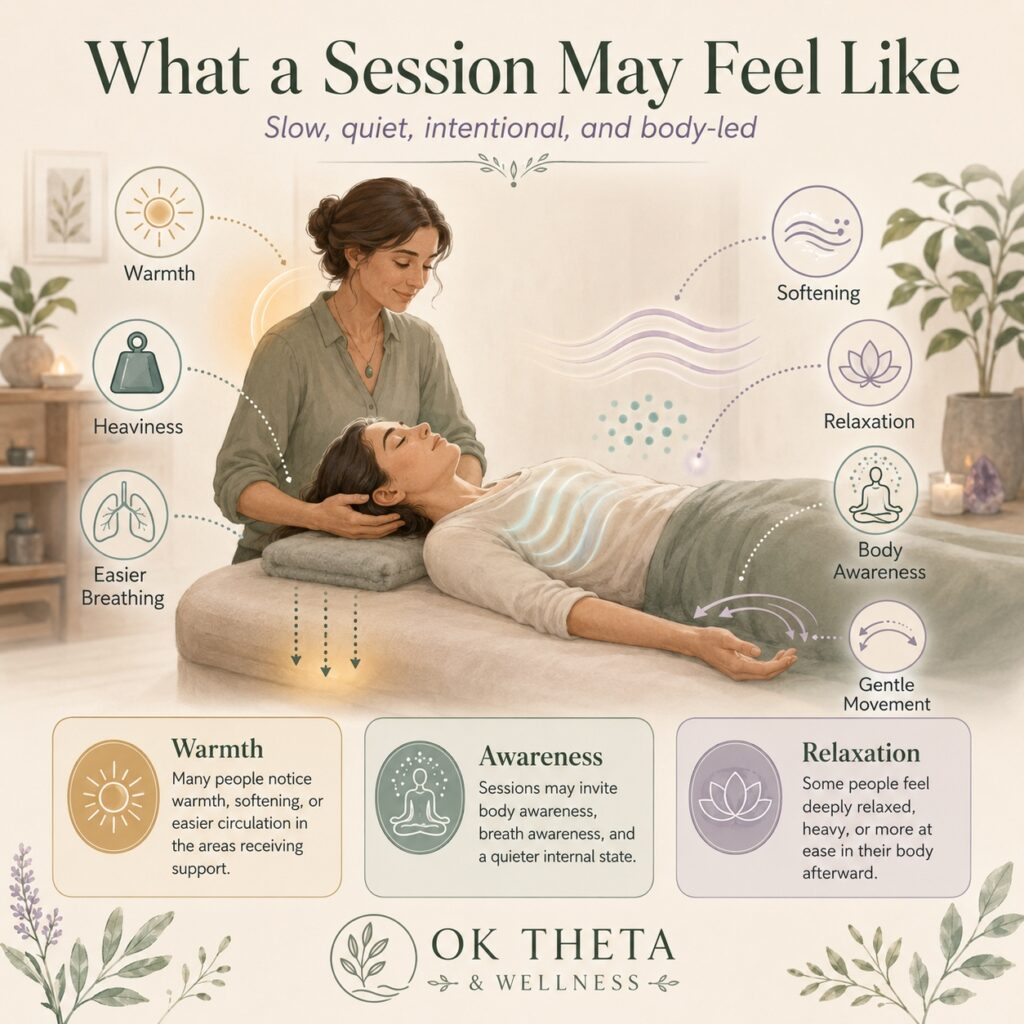
There are times when the body feels like it is holding on, even when we are trying to relax. The shoulders stay lifted, jaw stays tight, hips do not let go, back feels braced, and breathing is shallow. Movement may feel restricted, guarded, or slightly negotiated, as if the body is asking for permission before it moves. I see this often. Sometimes it follows an injury, after surgery, with stress, poor sleep, grief, trauma, repetitive posture, or years of pushing through discomfort. Sometimes the person does not even realize how much tension they are carrying until they finally have a quiet moment where the body can speak.
At OK Theta & Wellness, this is one reason I am interested in the combination of myofascial release and craniosacral therapy. These approaches are different, but they fit together in a very natural way. Myofascial release works with the body’s connective tissue, soft tissue restrictions, and movement patterns. Craniosacral therapy uses gentle touch, stillness, rhythm, and nervous system awareness. Together, they may help create an environment where the body does not feel forced to change, but invited to soften.
For many people, pain and tension are not purely mechanical. They are also shaped by the nervous system, stress physiology, sleep, inflammation, movement habits, and the body’s sense of safety. When the body feels threatened, it protects. When it protects long enough, that protection can start to feel like the problem.
Spin into Wellness in Oklahoma’s First Theta Chamber!
What Is Myofascial Release?
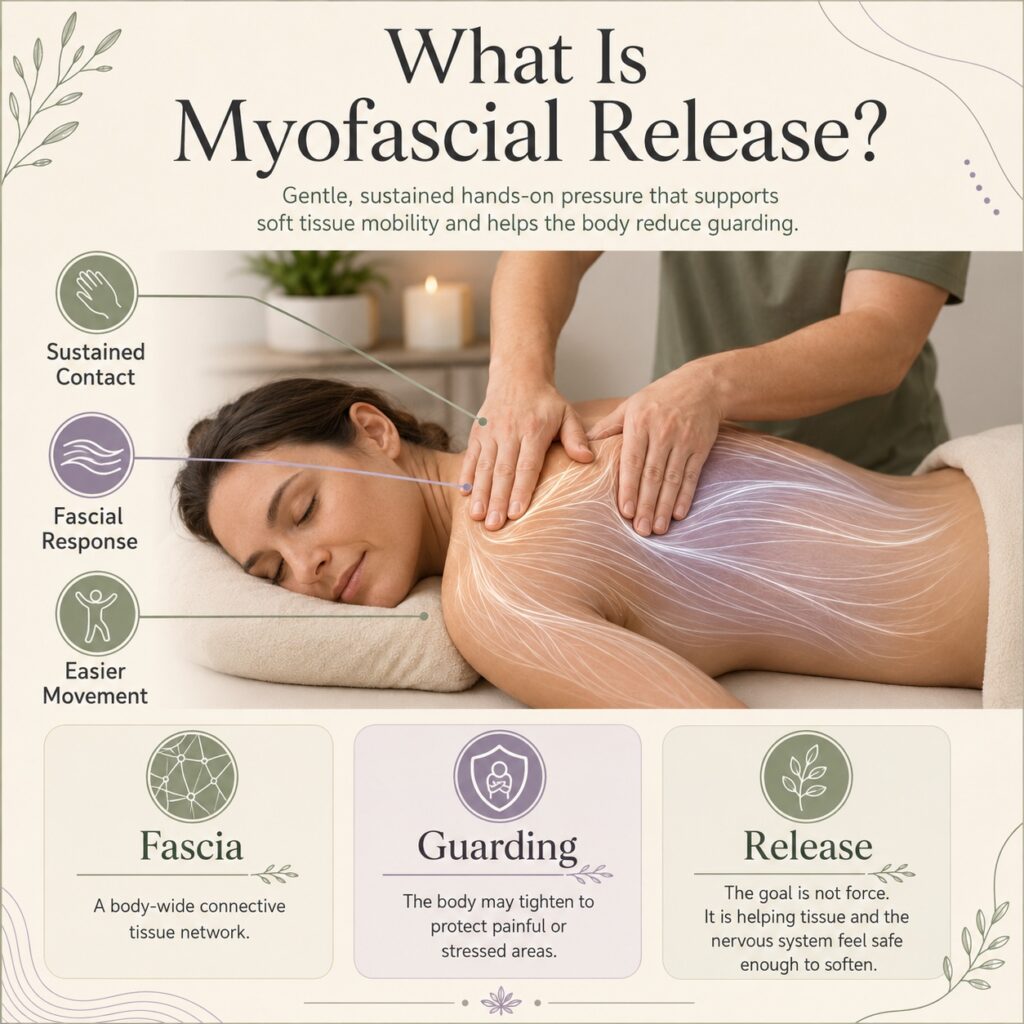
Fascia is connective tissue that surrounds and supports muscles, nerves, joints, blood vessels, organs, and other structures throughout the body. It is not just packing material. It is part of how the body organizes movement, senses position, distributes force, and responds to strain.
When people hear the word fascia, they often think of tightness, knots, adhesions, or restrictions. Those words can be useful, but I try not to reduce fascia to something that simply needs to be smashed, stripped, or “broken up.” The body is more intelligent than that. Myofascial release is a hands-on approach that uses sustained contact, pressure, stretch, and tissue engagement to help areas of restriction soften and move more freely. The goal is not to attack the tissue. The goal is to work with the tissue and the nervous system together.
That may involve the neck, shoulders, back, hips, jaw, chest, abdomen, legs, or feet, depending on the person’s pattern. Sometimes the place that hurts is not the only place that needs attention. A person may feel pain in the low back, but the hips, abdomen, ribs, pelvis, or breath pattern may also be part of the story. In that sense, myofascial release is not just about chasing symptoms. It is about listening to the body’s pattern.
What Is Craniosacral Therapy?
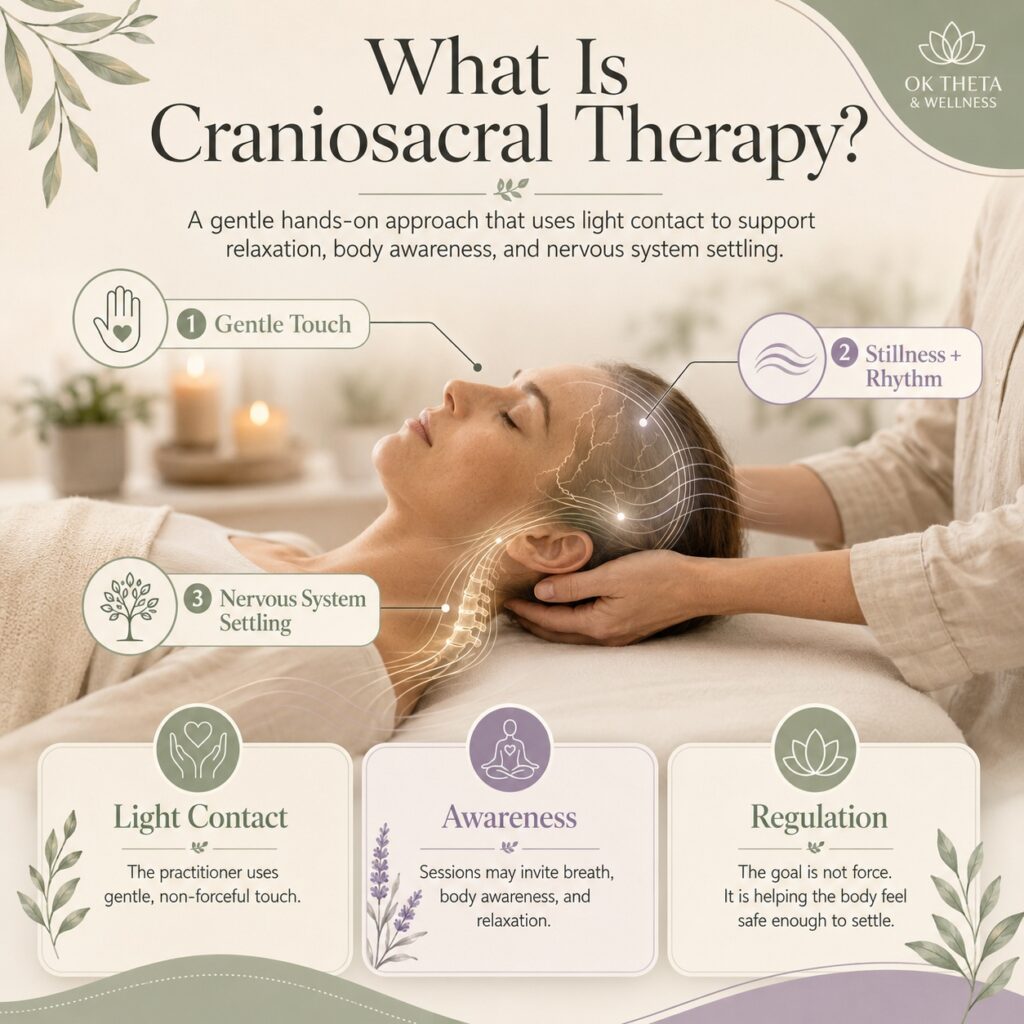
Craniosacral therapy is a gentle hands-on approach that often involves contact around the head, neck, spine, sacrum, and related fascial structures. The touch is usually light, slow, and non-forceful. For some people, that gentleness is exactly the point. Not every person’s body responds well to deeper pressure right away. Some people are too guarded, sensitive, overwhelmed, inflamed, or stuck in high alert. If you push too hard into that kind of system, the body may simply brace harder. It may tolerate the session, but not truly receive it.
Craniosacral therapy offers a quieter entry point. Instead of trying to overpower tension, it gives the body time to notice that it may not have to protect so intensely. The pace is slower and the contact is less demanding. A session may feel still from the outside, but internally, many people notice changes in breath, muscle tone, warmth, heaviness, emotional quieting, or a sense of settling.
Why Combine Craniosacral Therapy With Myofascial Release?
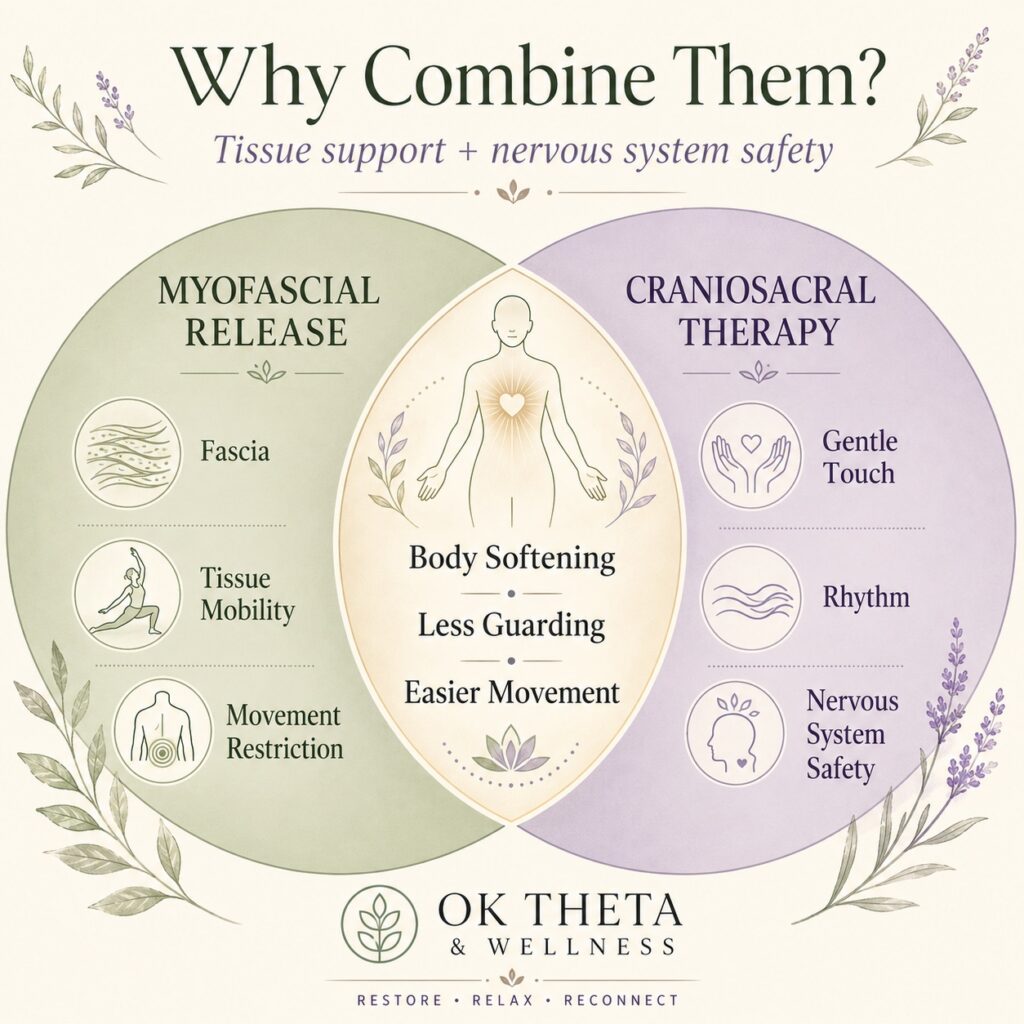
The way I think about it is this: Myofascial release asks, “Where is the body restricted?” Craniosacral therapy asks, “Does the nervous system feel safe enough to let that restriction soften?”
Both questions matter. If we only look at the tissue, we may miss the reason the body keeps recreating the tension. If we only focus on relaxation, we may miss the specific soft tissue patterns that need support. When these approaches are combined thoughtfully, the work can become more complete.
- A person with chronic neck tension may need myofascial work through the shoulders, chest, upper back, jaw, and base of the skull. But they may also need the nervous system to quiet down enough that the neck stops acting like a drawbridge in a storm.
- Someone with low back or hip tightness may benefit from fascial work through the pelvis, abdomen, spine, and legs. But if the body is guarding because of stress, fear of movement, poor sleep, or old injury memory, the tissue work may need to be paired with a gentler nervous system approach.
- A person with jaw tension may need work through the face, neck, throat, shoulders, and breathing patterns. But if the jaw is part of a larger high-alert pattern, craniosacral therapy may help the person experience a different internal state before more direct work is added.
This is where bodywork becomes less about forcing a muscle to relax and more about helping the whole system renegotiate its relationship with safety.
Guarding Is Not a Character Flaw
One thing I try to communicate often is that guarding is not weakness, failure, or the body being dramatic for no reason. Guarding is protection. The body may guard after injury. It may guard after repeated pain, when sleep has been poor, or during stress. In addition, it may guard when the nervous system has learned that certain movements, positions, emotions, or sensations are not safe.
At first, guarding can be helpful. It limits motion, protects an area, and keeps us from doing too much too soon. But when guarding becomes chronic, the body can get stuck in a protective loop. Muscles stay tense. Fascia loses ease of movement. Breathing becomes restricted. The person may move less, sleep worse, recover more slowly, and become more sensitive to pain.
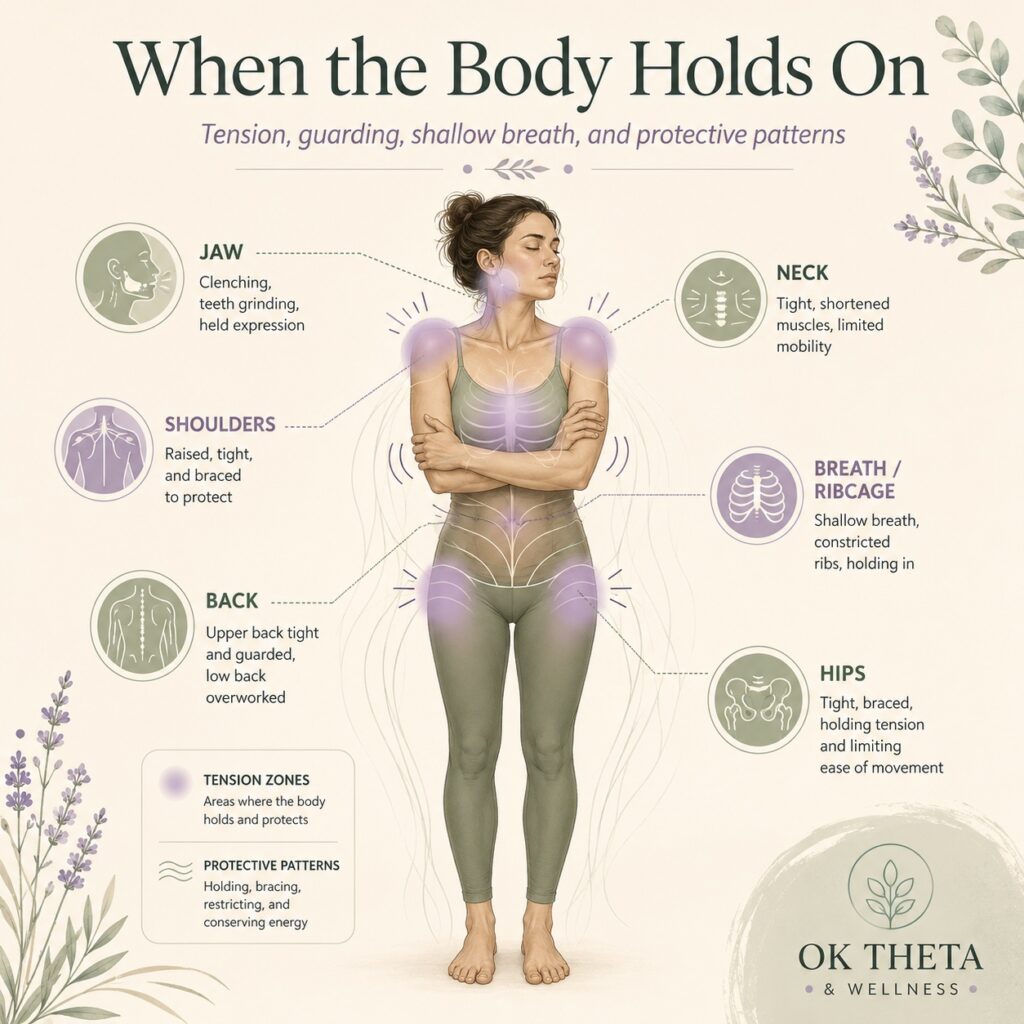
The Nervous System and the Felt Sense of the Body
Manual therapy is both a tissue experience and a sensory experience. The body is constantly sending information to the brain about pressure, movement, stretch, temperature, pain, position, and internal state. This inner body awareness is sometimes called interoception. When a person receives careful bodywork, they may begin to notice sensations they usually ignore. They may feel where they are holding tension, notice how they breathe, realize one side of the body feels different from the other, and become aware of how much effort they are using to simply lie still.
That awareness can be powerful. The goal is to create a setting where the person can safely notice the body without immediately fighting it, judging it, or bracing against it. This is one of the reasons craniosacral therapy and myofascial release can feel so different from aggressive bodywork. The session is about communication. The practitioner listens with the hands while the client listens from the inside. Somewhere in that quiet exchange, the body may begin to soften its argument.
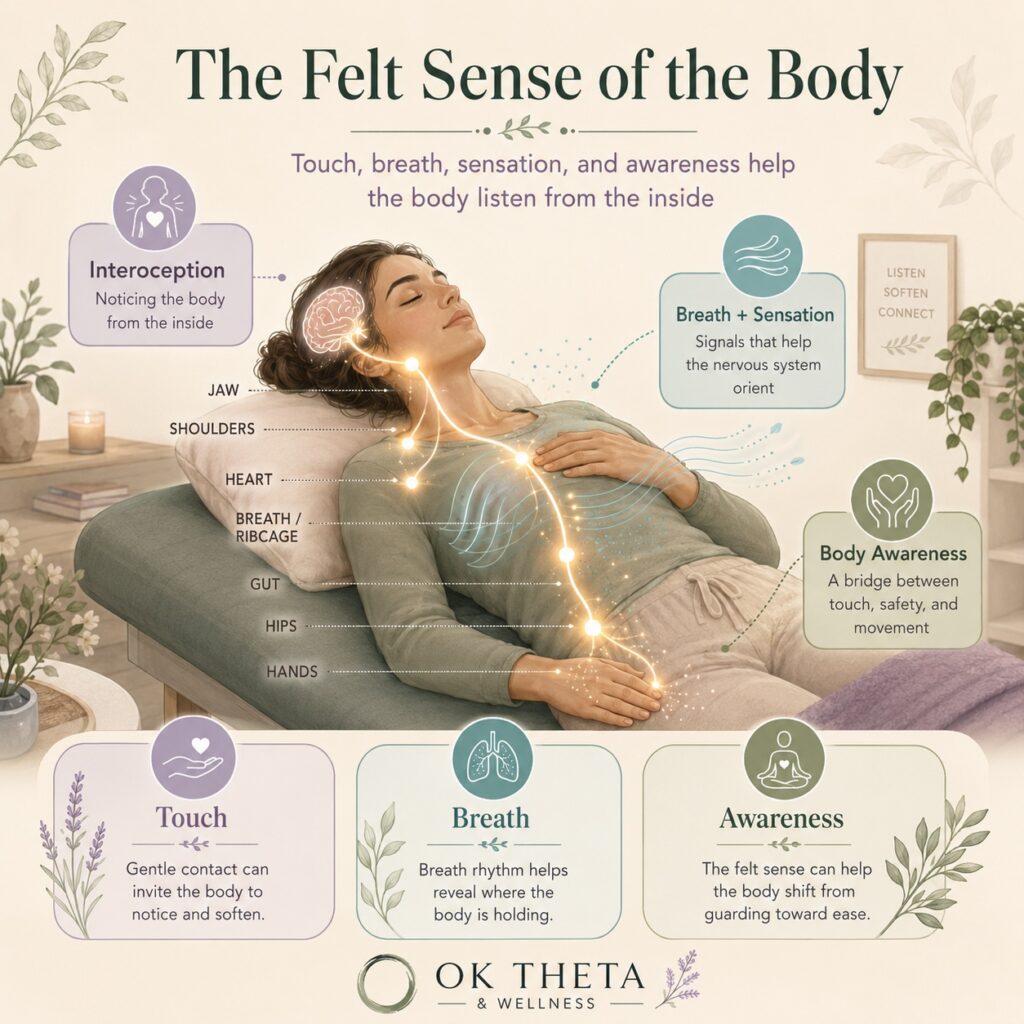
Who Might Consider Myofascial Release and Craniosacral Therapy?
This combination may be worth considering for people dealing with patterns such as:
- Chronic neck, back, shoulder, hip, or jaw tension.
- Stress-related muscle guarding.
- Headaches associated with neck, jaw, or shoulder tension.
- A body that feels braced, guarded, or stuck in high alert.
- Pain that worsens with stress or poor sleep.
- Postural tension from desk work, driving, caregiving, or repetitive movement.
- Old injury patterns that still influence movement.
- Sensitivity to deeper massage or aggressive stretching.
- Difficulty relaxing during bodywork.
- Nervous system sensitivity or feeling easily overwhelmed.
- Restricted breathing patterns or a sense of holding tension in the chest, ribs, or abdomen.
- A desire for gentle, non-forceful manual therapy.
This is not an emergency treatment, and it is not a replacement for appropriate medical care when symptoms need medical evaluation. But for many people with chronic tension, guarded movement, stress-related body patterns, or persistent soft tissue discomfort, it may be a useful part of a larger support plan.
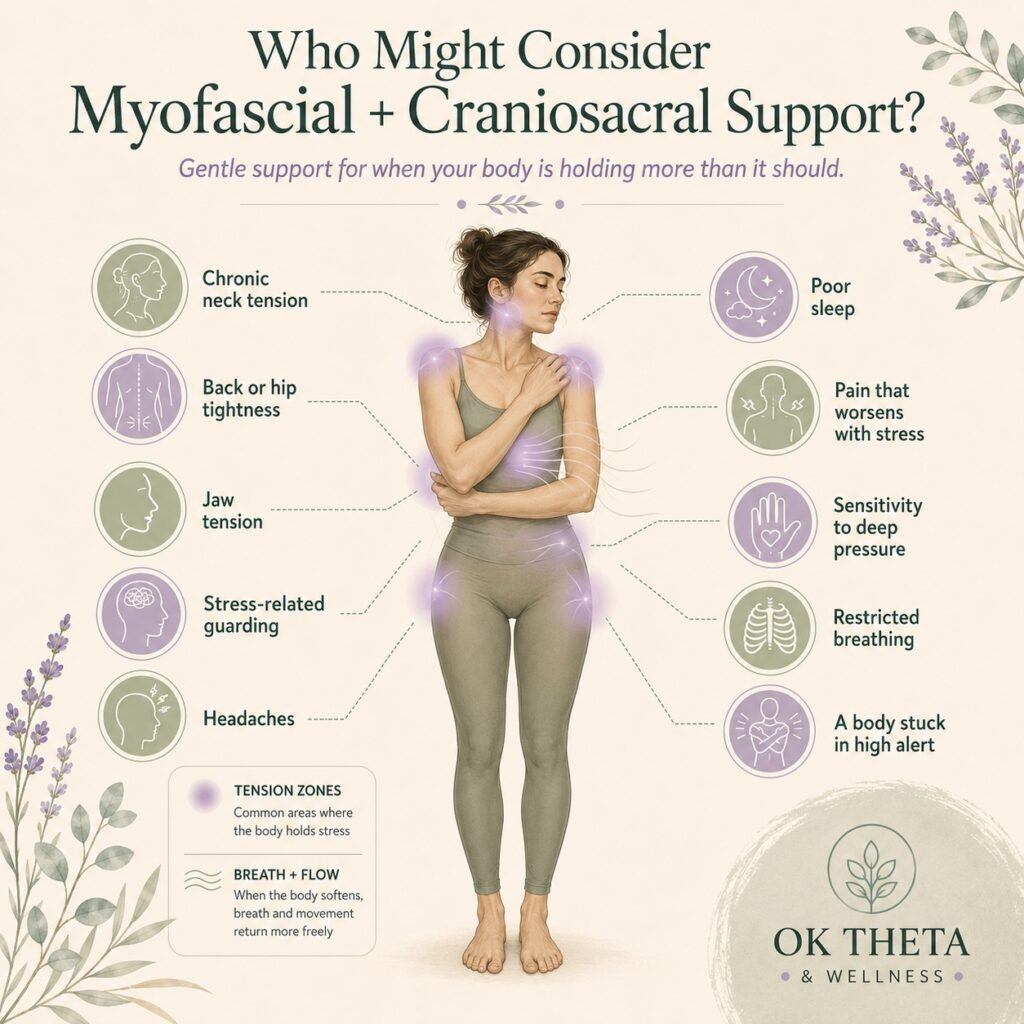
What a Session May Feel Like
A session may feel quiet, slow, and intentional. Some parts may involve gentle stillness. Other parts may involve sustained myofascial contact, light stretch, or more specific tissue engagement. The pressure can vary depending on the person, the area being treated, and how the body responds. Some people feel warmth, heaviness, softening, or easier breathing. Others feel subtle shifts before they notice obvious changes. Some feel emotional release, not necessarily because they are reliving anything, but because the body finally has a chance to stop holding so much. Some people feel deeply relaxed. Others simply feel a little more present in their body.
Afterward, one may notice better movement, less tension, improved breathing, or a calmer internal state. Some may feel tired, light, spacey, or mildly sore as the body adjusts. I think it is important to set realistic expectations. One session can be helpful, but chronic patterns usually take repetition. If the body has been guarding for months or years, it may need time to learn that it does not have to return to the same pattern immediately. Myofascial release and craniosacral therapy in Oklahoma City is performed by a license physical therapist.
Why the Theta Chamber Makes Sense With This Work
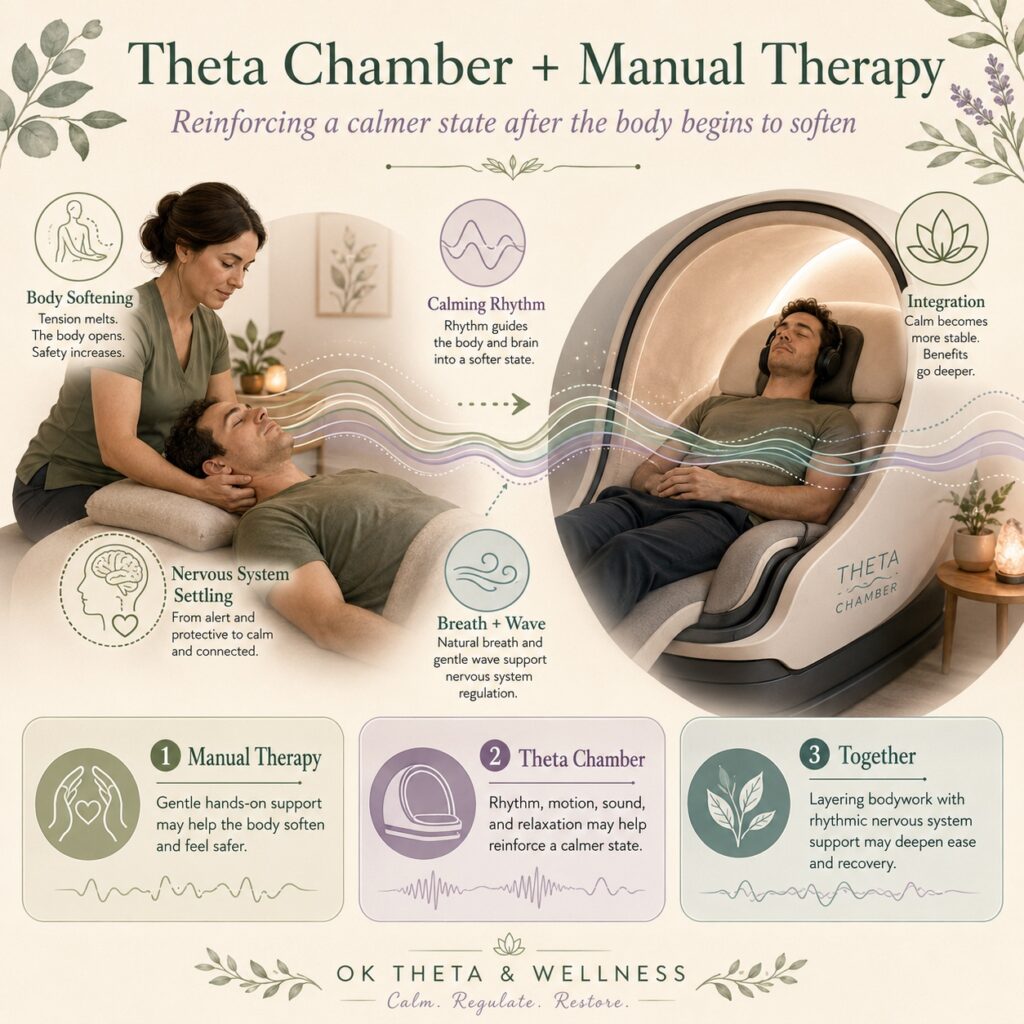
Of all the supportive modalities we offer at OK Theta & Wellness, the Theta Chamber is the most obvious companion to this type of manual therapy. That is because both approaches are interested in the same larger question: Can the body and nervous system find a safer state? The Theta Chamber uses a combination of rhythm, light, sound, vestibular motion, and relaxation to help the brain and body shift into a different state. Many people experience it as calming, dreamlike, meditative, or deeply restful.
For someone who arrives guarded, overstimulated, anxious, tense, or unable to relax, the Theta Chamber may be useful before manual therapy. It may help the person enter the bodywork session with less defensive tone. For someone who softens during manual therapy, the Theta Chamber may be useful afterward. In that case, the body has already experienced more ease, and the chamber may help reinforce that calmer state.
This is the part I find most interesting. Manual therapy can help the body experience less guarding. The Theta Chamber may help the nervous system spend time in that new state. When those are combined, the person is not only receiving tissue work. They are rehearsing a different relationship with their body.
What Should You Track Over Time?
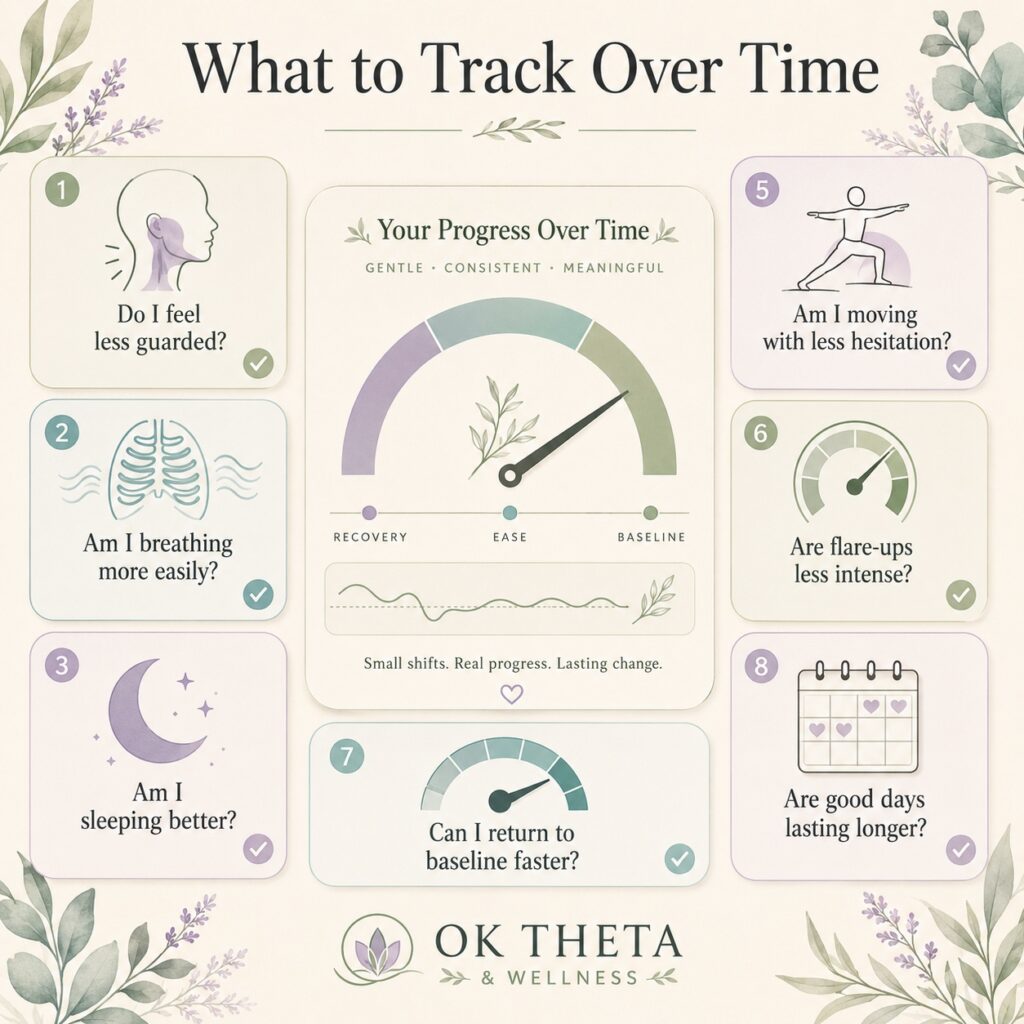
With this kind of work, I would not only track pain. Pain matters, of course, but it is not the whole story. I would also pay attention to questions like:
- Am I holding less tension in my jaw, neck, shoulders, back, or hips?
- Am I breathing more easily?
- Am I moving with less hesitation?
- Is my pain less disruptive?
- Am I recovering faster after stress or activity?
- Am I sleeping better after sessions?
- Do I feel less guarded in my body?
- Are my flare-ups less intense?
- Are my good days lasting longer?
- Can I return to baseline more quickly?
- Do I feel more comfortable being still?
- Do I feel more connected to my body rather than at war with it?
The goal is to help the person build a different body experience over time.
Helping the Body Stop Bracing
Myofascial release and craniosacral therapy are about creating the conditions where the body can stop protecting so hard rather than forcing the body into submission. For some people, that begins with gentle touch. For others, it includes fascial release, breath awareness, assisted movement, neuromodulation, or time in the Theta Chamber. The right combination depends on the person, their sensitivity, their goals, and the pattern their body has been carrying.
At OK Theta & Wellness, I am most interested in approaches that help the body feel safer, move easier, and return to baseline more naturally. Sometimes that means working with tissue, or working with rhythm. Other times it means working with the nervous system. Often, it means working with all of those at once.
The body is not just a machine with tight parts. It is a living system that listens, protects, adapts, and learns. When we approach it that way, bodywork becomes more than a technique. It becomes a conversation with the part of us that has been holding on, waiting for the right conditions to finally let go.
What if your body does not need to be pushed harder, but supported differently?
If you feel like your body is stuck in a pattern of tension, guarding, or stress-related discomfort, myofascial release and craniosacral therapy may be a gentle place to begin. At OK Theta & Wellness, we can help you explore whether hands-on bodywork, the Theta Chamber, assisted stretching, or other supportive therapies may fit your goals. Experience Myofascial Release and Craniosacral Therapy in Oklahoma City!
Additional References
A 2021 meta-analysis found preliminary evidence that myofascial release may improve pain and physical function in chronic low back pain, while also noting limitations in study quality. (PMC)
A 2019 systematic review reported that craniosacral therapy showed benefits for chronic pain outcomes, though the authors called for more rigorous trials. (PMC) A randomized sham-controlled trial for chronic neck pain reported reduced pain intensity and improved function up to 3 months after treatment. (PubMed)
Fascia research increasingly describes fascia as richly innervated, including proprioceptive and nociceptive nerve fibers, which supports a careful discussion of fascia, pain, movement sense, and the nervous system. (PMC)