
Theta State, HRV, and Nervous System Reset
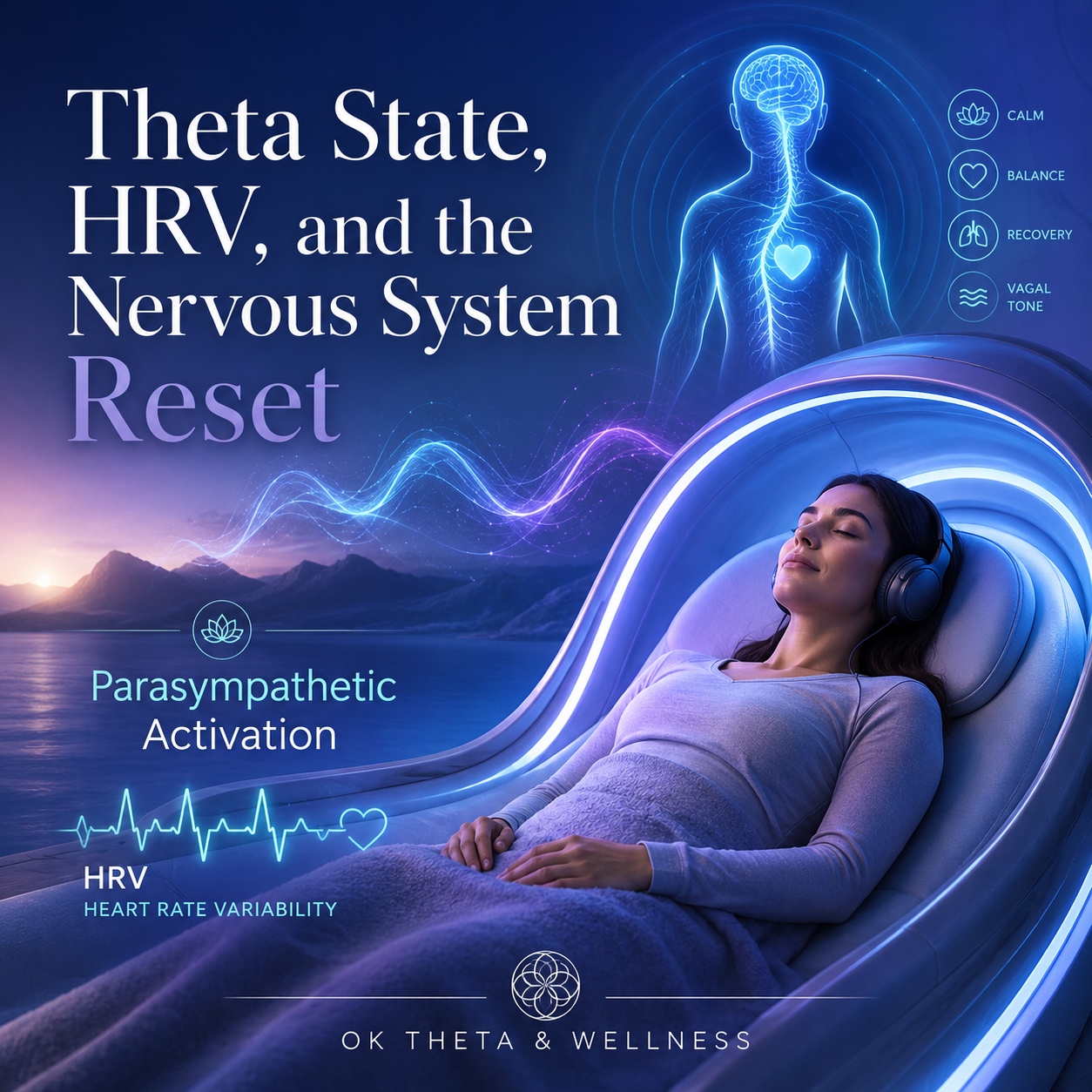
Most people know what it feels like to be tired. Fewer people know what it feels like to be truly recovered. That difference matters. A lot of people walk around in a body that is technically awake, technically functional, and technically “fine,” but their nervous system is still on patrol. The jaw is tight. The breath is shallow. The mind is scanning the horizon. Sleep may happen, but it does not always feel restorative. Rest may happen, but the body does not fully believe it is safe enough to let go. That is the world of sympathetic overdrive. This is where the Theta State, HRV, and Nervous System Reset may help.
At OK Theta & Wellness in Oklahoma City, we see this pattern often. People are not always coming in with one simple complaint. They may say they feel wired but tired. They may feel hypervigilant, emotionally overloaded, unable to relax, or exhausted from living in a body that never quite stands down. This is where the theta state becomes interesting. Not as a magic word. Not as a promise. But as a doorway.
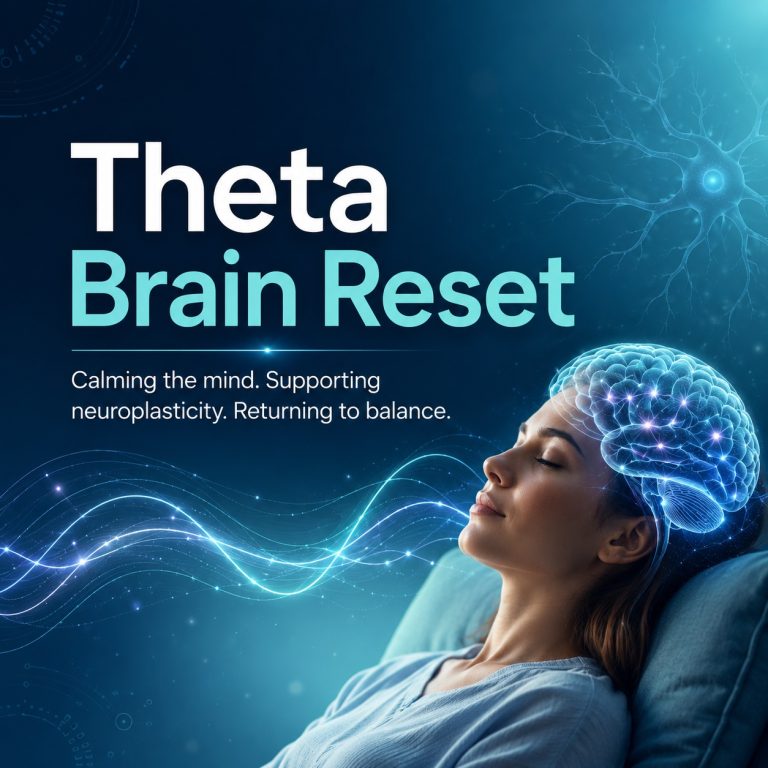
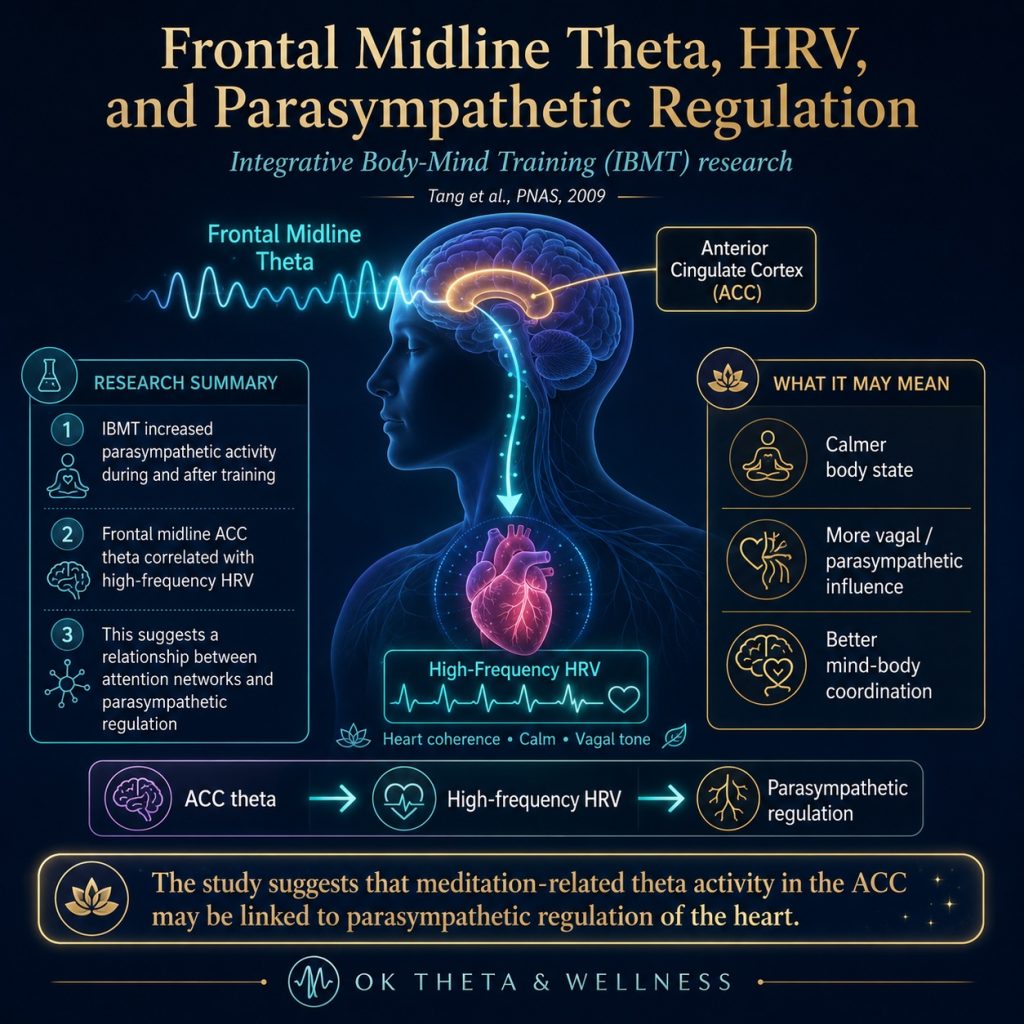
Theta brainwave activity is commonly discussed in the 4–8 Hz range and is associated with drowsiness, early sleep transitions, memory processing, internal awareness, and certain meditative states. In meditation research, theta activity, especially frontal midline theta, has been associated with attention, internal regulation, and autonomic changes. One study found a relationship between frontal midline theta and cardiac autonomic activity during meditation, suggesting a connection between meditative brain states and body regulation. (PubMed)
That is the bridge we care about. Because the goal is not just to “relax the mind.” The goal is to help the body remember how to shift from defense into recovery.
Spin into Wellness in Oklahoma’s First Theta Chamber!
Fight-or-flight is not just an enemy
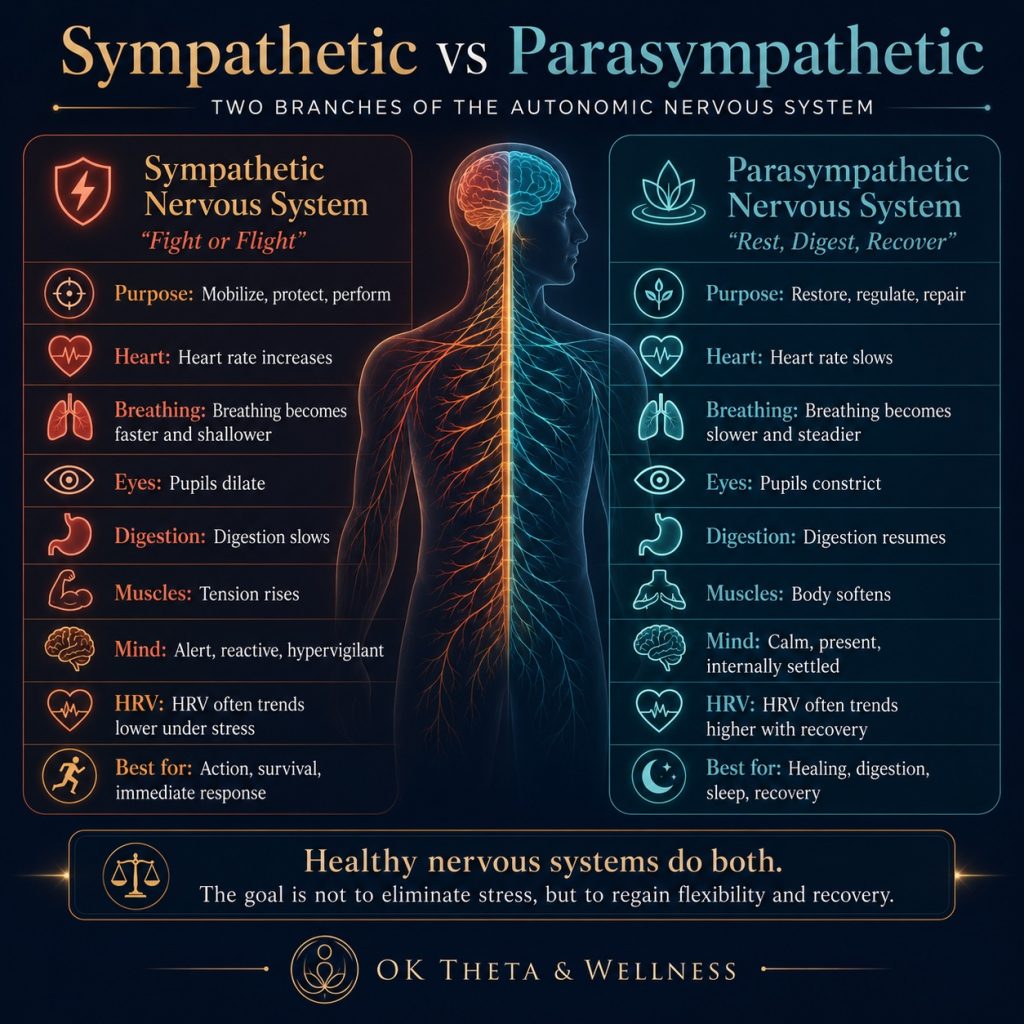
The sympathetic nervous system is not bad. It is necessary. It helps us respond, protect, perform, run, lift, focus, and survive. If a storm is coming across the plains, you want a nervous system that can mobilize. You want alertness. You want increased heart rate. You want your body ready to act. The problem is not fight-or-flight. The problem is getting stuck there.
When the body stays in a defensive state too long, rest starts to feel unfamiliar. Quiet can even feel threatening. The nervous system may become so accustomed to stimulation, vigilance, and control that stillness feels like something is wrong. That is one reason many people struggle with meditation. It is not because they are bad at it. It is because the moment they get quiet, the internal alarm system gets louder.
The body has been guarding the gate for years. It does not always surrender just because the thinking mind says, “Relax.”
The parasympathetic system: rest, digest, repair, integrate
The parasympathetic nervous system is often described as the “rest and digest” system, but that phrase is too small for what it does. Parasympathetic activation supports digestion, recovery, immune coordination, emotional regulation, sleep readiness, and repair. It is also tied closely to vagal influence on the heart. Heart rate variability, or HRV, is often used as a noninvasive marker related to autonomic regulation and vagal tone, though interpretation depends heavily on context, breathing, measurement method, and individual physiology. (PMC)
In general, when people shift toward a more parasympathetic state, we may see patterns such as:
- Slower heart rate
- Deeper or more rhythmic breathing
- Increased HRV
- Less muscle guarding
- A quieter mind
- A greater sense of internal safety
That does not mean every session looks the same. The nervous system is not a vending machine. It is more like Oklahoma weather: patterned, powerful, and not fully under our control. But patterns still matter.
Why HRV matters
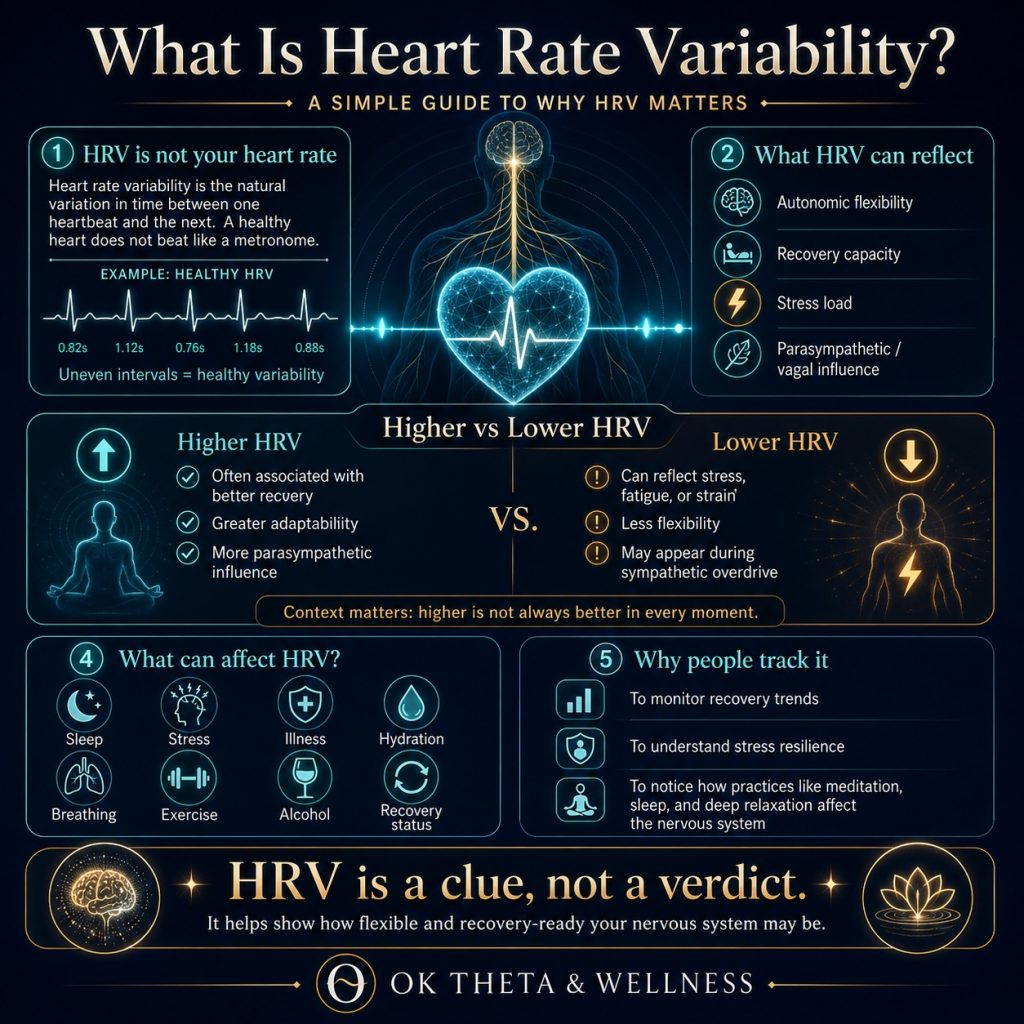
HRV stands for heart rate variability. It refers to the natural variation in time between heartbeats. A healthy heart does not beat like a metronome. It adjusts constantly. It speeds up and slows down based on breathing, posture, stress, recovery, hydration, sleep, and countless other signals. That flexibility is the point.
HRV is not just a number to chase. It is a clue about adaptability. A nervous system with more flexibility can respond to stress and then recover. A rigid system may stay braced even after the stressor has passed.
Meditation and mindfulness practices have been studied for their effects on HRV, but the literature is nuanced. Some studies suggest meditation may improve HRV or vagal activity, while reviews also note that results can be mixed and depend on the specific practice, study design, breathing pattern, and comparison group. (PMC)
HRV gives us a practical window into whether the body may be shifting toward a more recovery-oriented state.
What we notice in the Theta Chamber
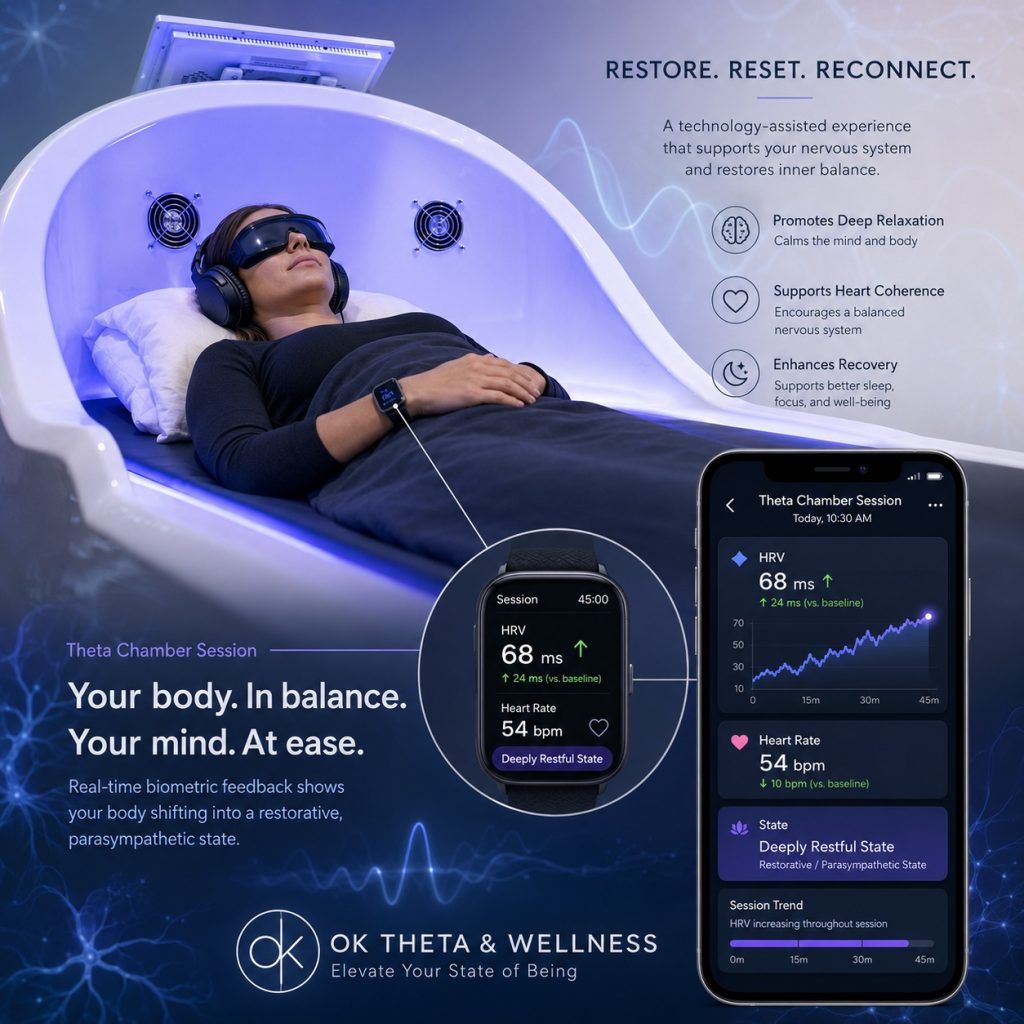
Many people who use wearable devices such as Oura rings, Apple Watches, Garmin watches, or WHOOP straps notice something interesting during Theta Chamber sessions.
Their device may think they are asleep. Sometimes it may even classify the session as deep sleep. Their heart rate may slow. Their HRV may rise. Their body may look, from the wearable’s perspective, like it has entered a deeply restorative state.
Wearables are not EEG machines. They are not directly measuring theta brainwaves. They estimate sleep and recovery states using signals such as movement, heart rate, HRV, temperature, and sometimes respiratory patterns. Validation studies show that devices like Oura can be useful for estimating sleep patterns, but they are still imperfect compared with polysomnography, the gold-standard sleep study that includes EEG brainwave measurement. (ScienceDirect)
So when a wearable says “deep sleep” during a Theta Chamber session, I do not interpret that as proof that the person was truly asleep. I interpret it as a clue. The person may be awake. They may be aware. They may be praying, breathing, observing, or simply floating in that quiet space between thought and sleep. But if the ring thinks they are in deep sleep, that tells us something meaningful: The body may be behaving less like it is defending itself and more like it is recovering. That is worth paying attention to.
The theta state as a bridge
Theta is not simply “sleepy brain activity.” Theta can also be a bridge state. It can sit between waking and sleep, between effort and surrender, between narrative thinking and deeper internal awareness. In some forms of meditation, theta activity appears alongside changes in attention and autonomic regulation. Research on integrative body-mind training found that frontal midline theta was correlated with high-frequency HRV, suggesting a relationship between anterior cingulate activity and parasympathetic regulation. (PNAS)
That matters because many people are trying to think their way into calm. But calm is not only a thought. Calm is a body state. You can tell yourself you are safe, but if your breath is shallow, your heart rate is elevated, your muscles are guarded, and your mind is scanning for danger, the body may not believe the message.
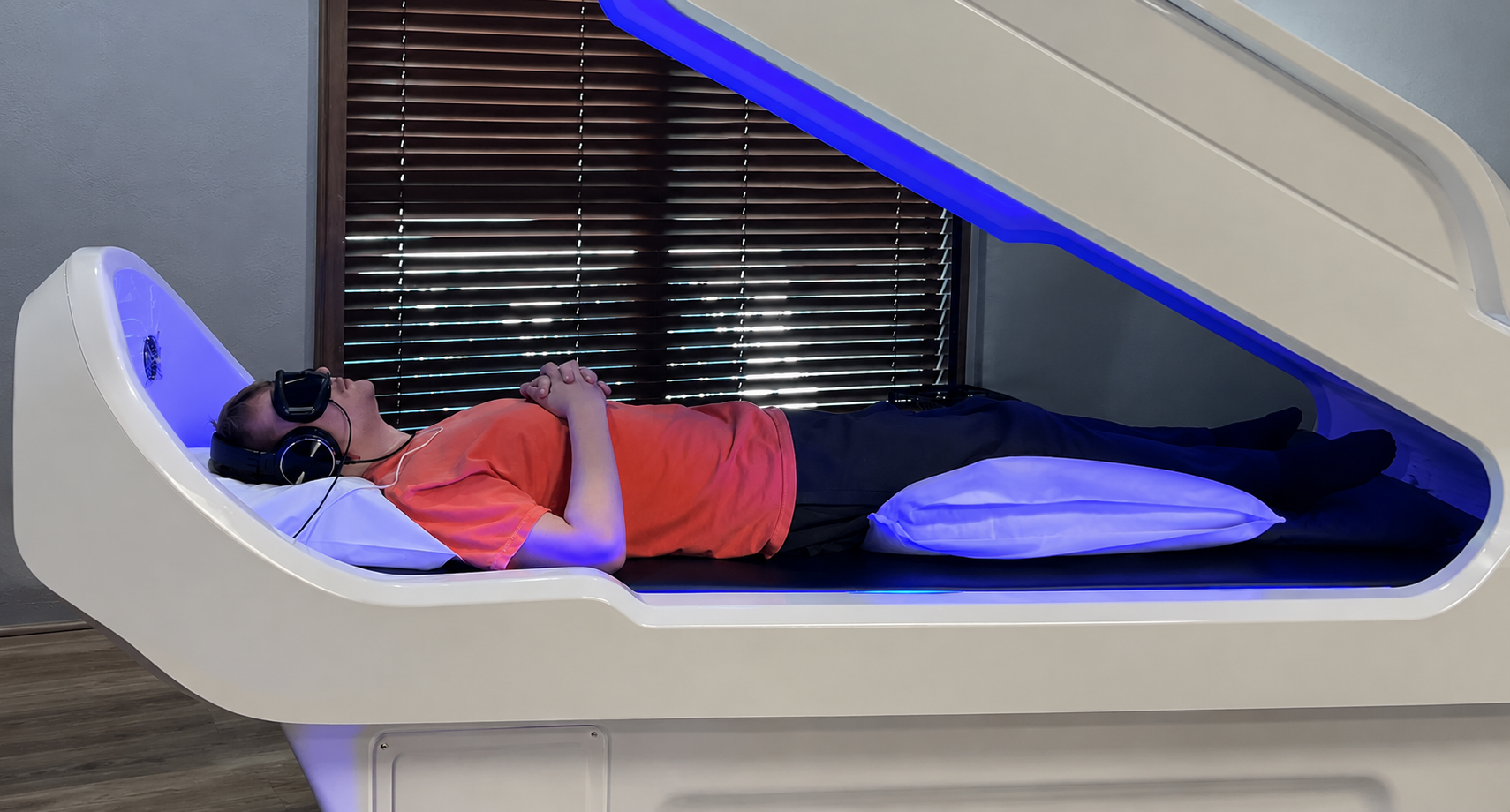
The Theta Chamber gives the body a different kind of message. Not just verbal. Sensory. You are supported. You are still. The room is quiet. The rhythm is predictable. The body does not have to hold itself up. The outside world can wait. For some people, that is when the system finally starts to soften.
Why the chamber may support parasympathetic activation
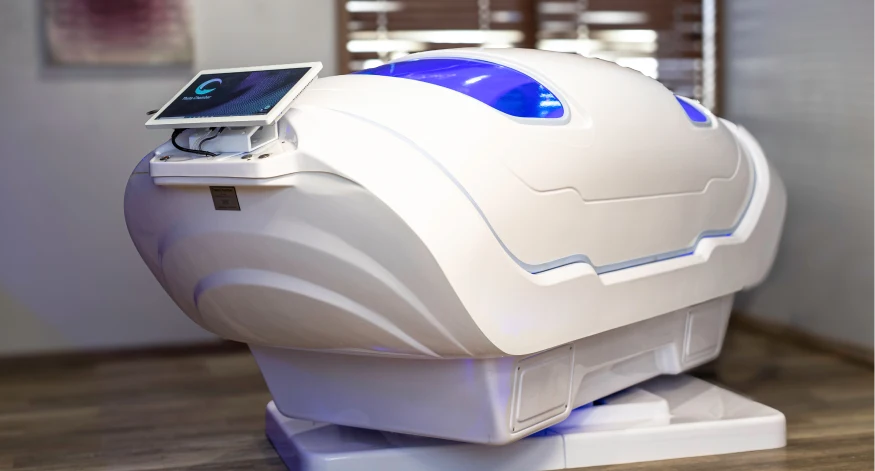
The Theta Chamber is not one stimulus. It is an organized sensory field. A person is not just lying in a dark room. The body is receiving a coordinated set of signals through position, sound, rhythm, light, stillness, and physical support.
Several pieces contribute to the experience:
- The person is lying down and physically supported. That alone reduces the body’s need to brace against gravity.
- The chamber uses rhythmic vestibular motion. Gentle, predictable motion can be deeply regulating for many people. The nervous system often responds to rhythm because rhythm reduces uncertainty.
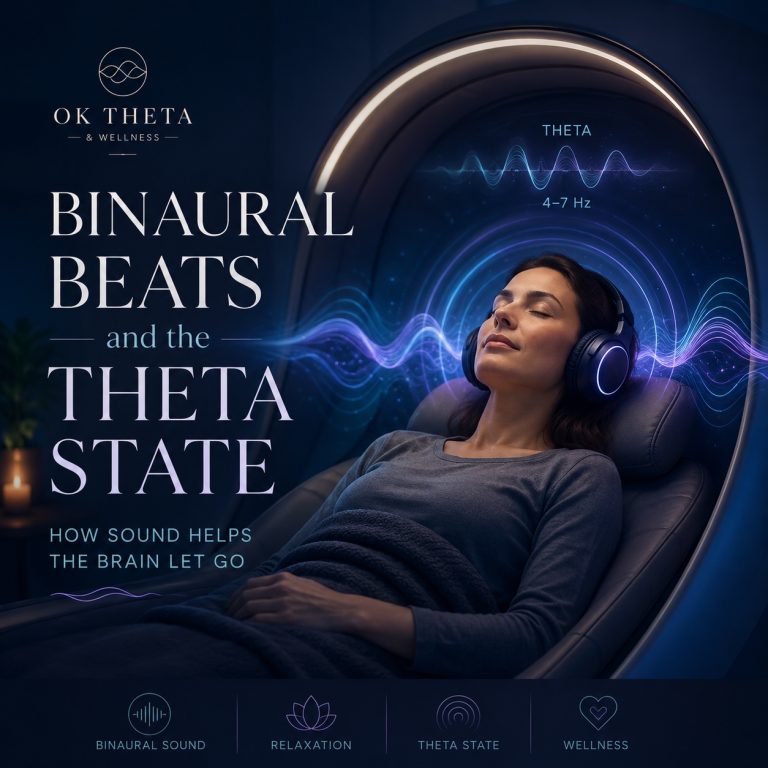
- Sound and binaural beats may provide an attentional anchor. The mind does not have to chase every thought. It has something steady to rest into.
- Strobing goggles and rhythmic light input may help create a frequency-following environment for the brain, depending on the settings used and the individual’s tolerance.
- The chamber setting reduces ordinary demand. No phone. No conversation. No decisions. No performance. No need to be useful for thirty minutes.
That last piece is bigger than people realize. Many people’s bodies are addicted to task mode. Even rest becomes another task to complete correctly. The chamber removes the assignment. It gives the nervous system a place to practice not performing.
Slow breathing, HRV, and the vagus nerve
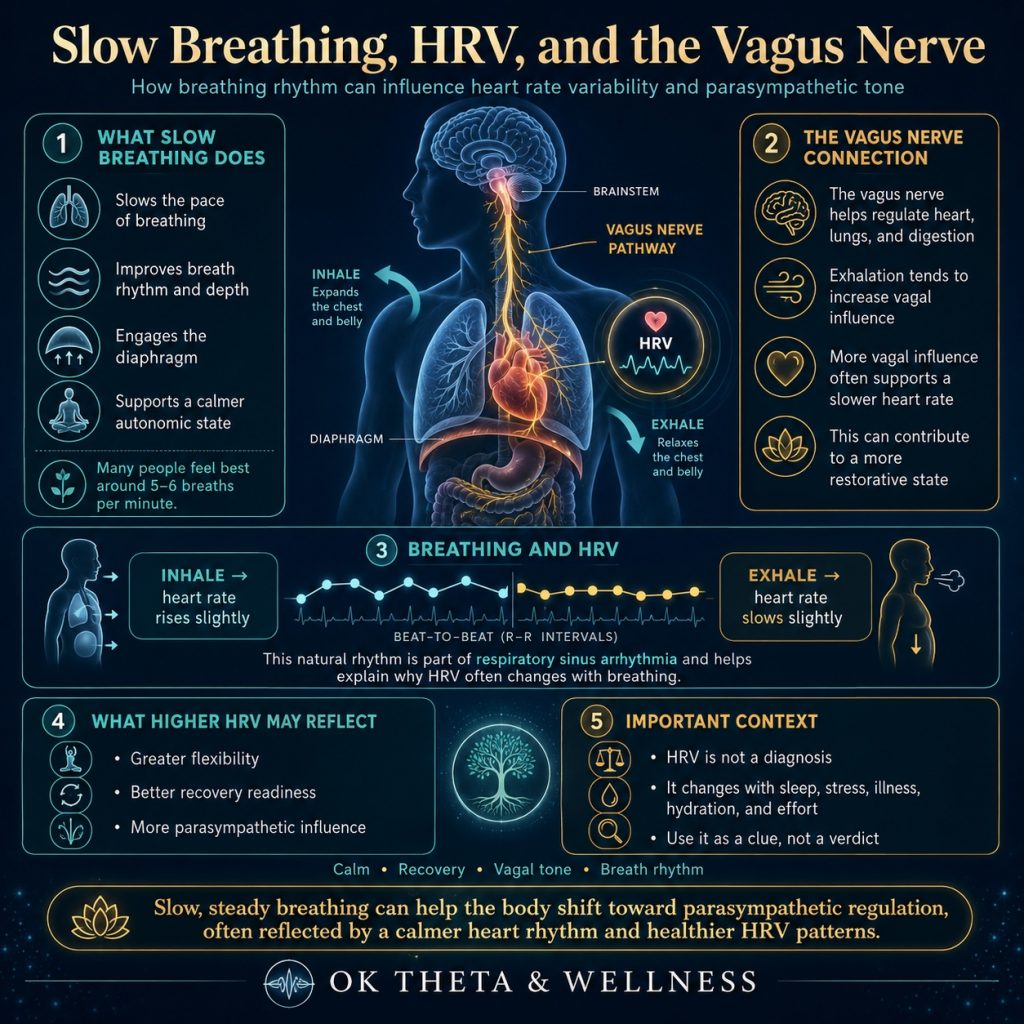
Breathing is one of the most direct bridges between conscious practice and autonomic state. During relaxed breathing, especially slower rhythmic breathing, heart rate naturally varies with the breath. Heart rate tends to increase with inhalation and slow with exhalation. This phenomenon is often called respiratory sinus arrhythmia, and it is closely related to parasympathetic influence on the heart, though researchers caution that it should be interpreted carefully and not treated as a perfect standalone measure of vagal tone. (ScienceDirect) This is one reason breathwork and meditation can affect HRV.
In the Theta Chamber, some people naturally begin breathing more slowly. They may not even be trying to do breathwork. Their body simply begins to follow the environment. That is the beauty of it. Instead of forcing relaxation from the top down, the person is invited into it from the bottom up. The body receives rhythm. The breath slows. The heart follows. The mind notices. The system begins to reset.
Hypervigilance is a body strategy
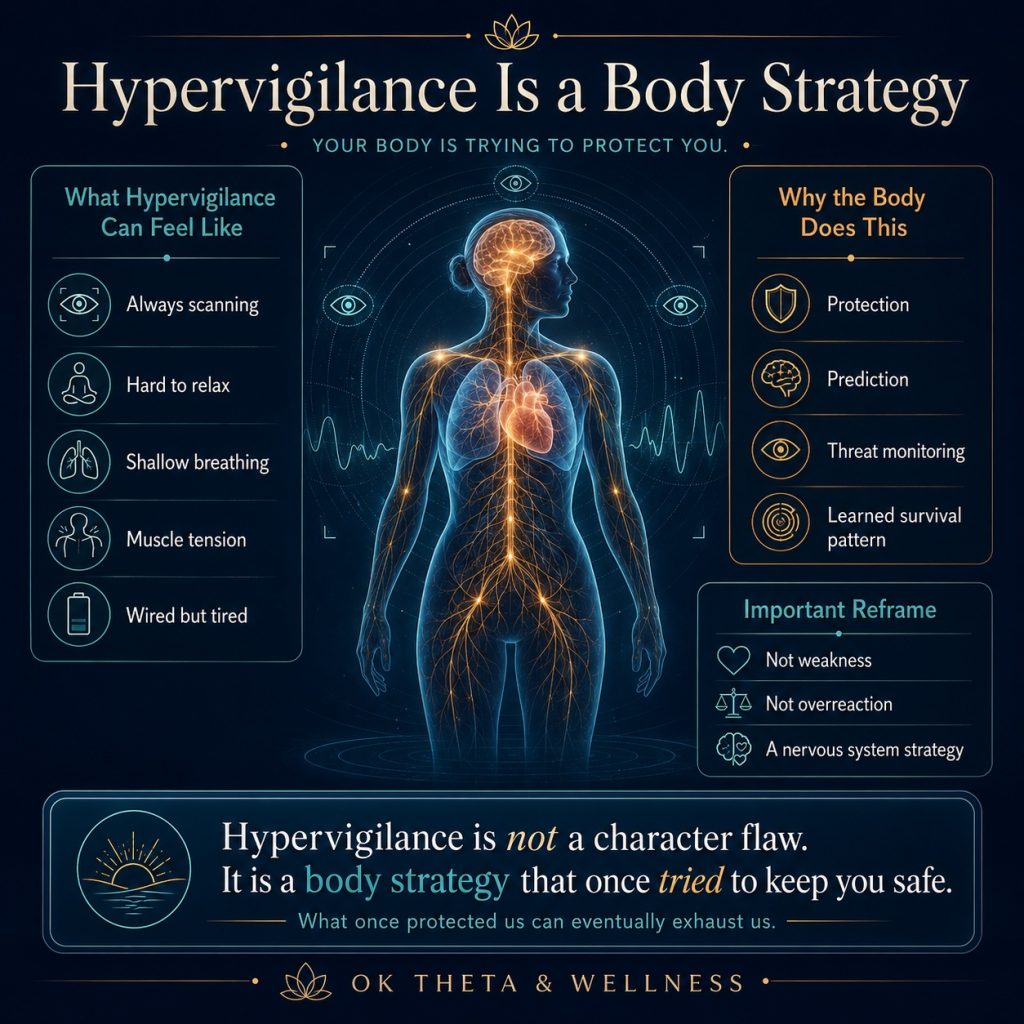
One of the most important points in this conversation is compassion. Hypervigilance is not weakness. It is not a personality defect. It is not someone “being dramatic.” Hypervigilance is a strategy. At some point, the body learned that staying alert was safer than letting go. That may come from trauma, chronic stress, illness, pain, burnout, grief, caregiving, high-pressure work, or years of living in survival mode.
The problem is that a strategy that once protected us can eventually exhaust us. A body stuck in sympathetic overdrive may struggle to digest, sleep deeply, recover after exertion, regulate emotions, or feel safe in quiet. Even good things can feel overstimulating. Even rest can feel uncomfortable. This is where the phrase “nervous system reset” needs to be handled carefully. We are not flipping a switch. We are practicing a shift. The goal is to help the body experience, repeatedly and safely, that it can leave the guard tower and still be okay.
What to track with your wearable
If you wear an Oura ring or other biometric tracker, the Theta Chamber can become an interesting personal experiment. The wearable should not be treated as a perfect medical device, but it can help you observe trends.
Before the session, notice:
- Resting heart rate
- HRV baseline
- Stress level from 1–10
- Breath quality
- Muscle tension
- Mental speed
- Emotional state
During or after the session, notice:
- Did your device classify the session as sleep?
- Did your heart rate drop?
- Did HRV increase?
- Did your body feel heavier, softer, or warmer?
- Did your mind become quieter?
- Did you feel emotionally clearer afterward?
That night or the next morning, notice:
- Sleep quality
- Recovery score
- Resting heart rate
- HRV trend
- Mood
- Energy
- Reactivity
- Cravings
- Brain fog
One session can be interesting. A pattern over several sessions is more useful. The question is not, “Did I get the perfect number?” The better question is: “Is my body learning how to recover?”
What we can and cannot say
It is important to stay in the lane. We cannot say that the Theta Chamber cures anxiety, PTSD, insomnia, dysautonomia, or chronic stress. We cannot say that increased HRV proves a person was in a theta brainwave state. We cannot say that an Oura ring showing deep sleep means the person was truly in deep sleep.
But we can say this:
Many people report entering a deeply relaxed, meditative state during Theta Chamber sessions. Some wearable users notice a drop in heart rate, an increase in HRV, and sleep-like recovery signatures during those sessions. These changes are consistent with a shift toward parasympathetic activation, especially when paired with subjective calm, slower breathing, and reduced internal tension. That is honest. And it is still powerful.
The deeper goal: safety in the body
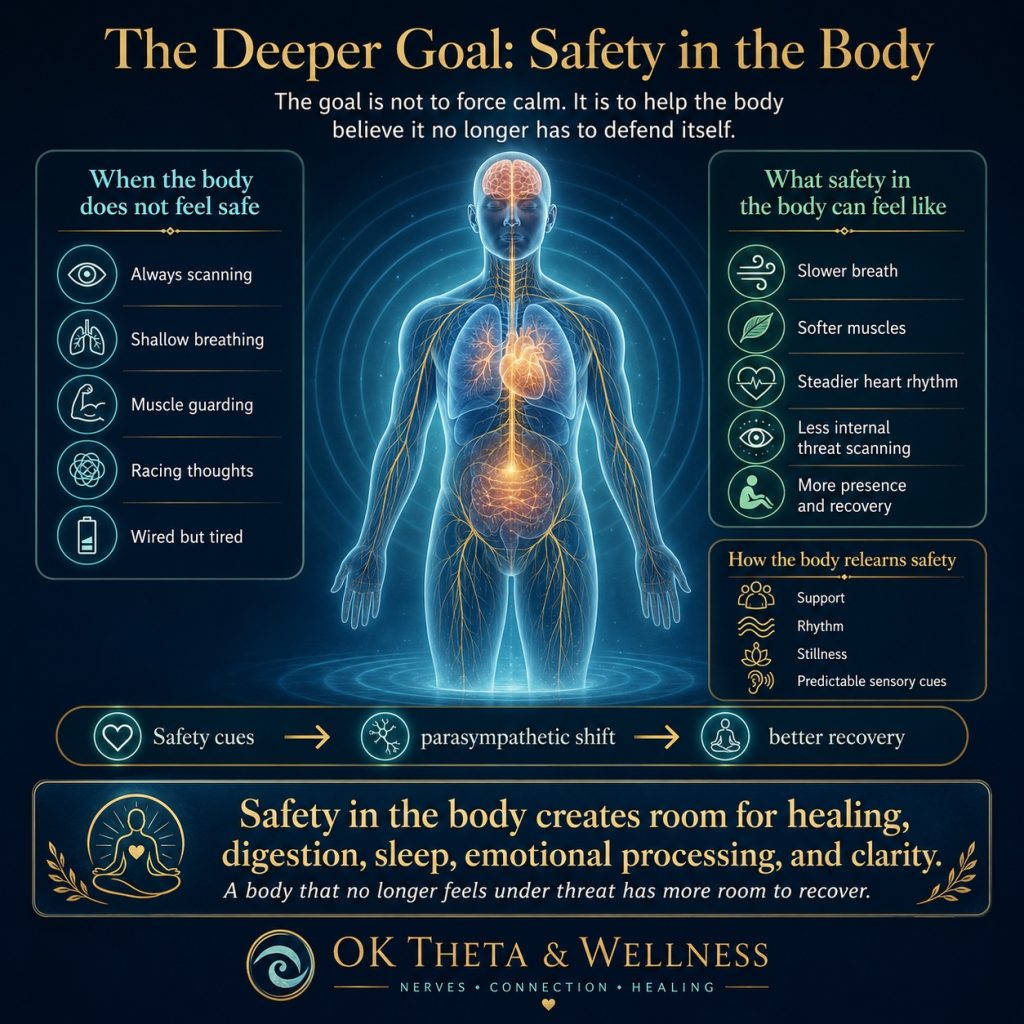
At the heart of this work is a simple idea: The body heals better when it does not believe it is under threat. That does not mean all healing is emotional. It does not mean stress is the cause of every problem. It does not mean we can breathe our way out of every disease. It means the nervous system matters.
A body living in chronic defense has a harder time recovering. A body that can access parasympathetic tone has more room for repair, digestion, sleep, emotional processing, and clarity. The Theta Chamber is one way to practice that shift. Not by demanding calm. Not by arguing with the mind. Not by telling the body to hurry up and relax. But by creating a structured environment where the body may finally receive enough safety cues to soften.
That is the nervous system reset. Not a dramatic lightning strike. More like the first long exhale after a hard season.
Closing invitation
If you feel like your body has been stuck in fight-or-flight, hypervigilance, or sympathetic overdrive, you are not alone. And you are not broken. Your nervous system may simply need practice remembering what safety feels like.
At OK Theta & Wellness in Oklahoma City, the Theta Chamber offers a structured, technology-assisted environment for deep relaxation, meditative practice, and nervous system regulation. Bring your Oura ring, Apple Watch, Garmin, WHOOP, or just your own curiosity. We cannot promise what your numbers will do. But we can give your body a quiet place to show you what it is ready to release. Schedule a Theta Chamber session today!
Revitalize Your Mind,
Renew Your Body