
The Theta Brainwave State: Where the Brain Becomes Teachable
Most people have experienced the theta brainwave state without knowing what to call it. It may happen in the moments just before sleep, when the mind begins to drift and the usual boundaries of thought start to soften. It may happen during deep prayer, meditation, breathwork, or even during a long, quiet drive when the thinking mind finally loosens its grip. It is that strange, spacious state where we are not fully asleep, but we are also not operating from the usual busy, task-oriented mind.
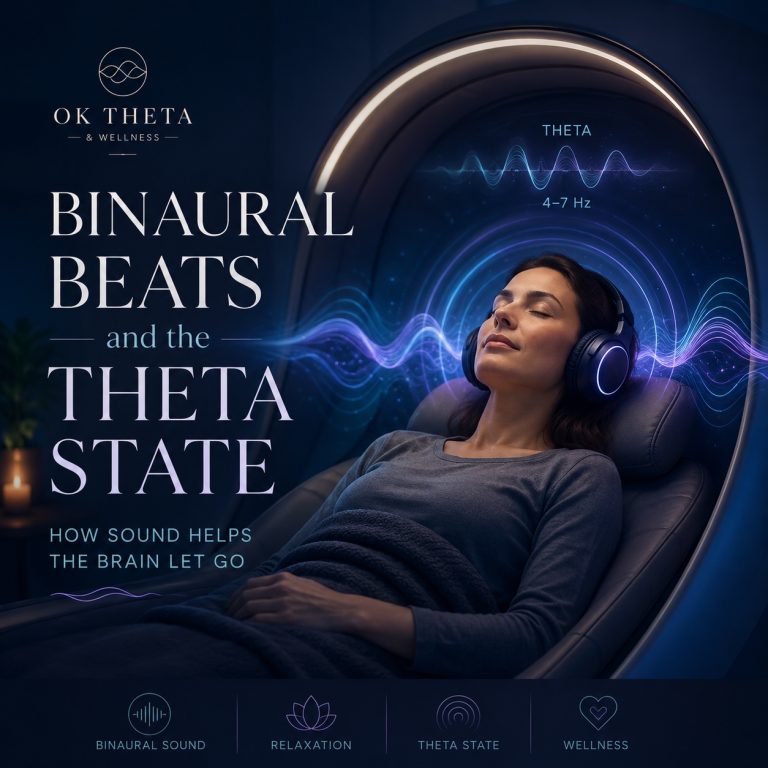
In neuroscience, theta brainwaves are generally measured around 4–8 Hz. That means the brain is producing slower electrical rhythms than the faster beta waves associated with ordinary thinking, planning, analyzing, and problem-solving. But theta is more than a number on an EEG.
The theta brainwave state is best understood as a state of access. It is a state where the mind may become quieter, the body may feel safer, and the brain may become more teachable. That word matters: teachable.
Because many people are not struggling because they lack information. They are struggling because their nervous system is too guarded, too stressed, or too overloaded to truly receive the information they already know. They may understand what they “should” do. They may know the habit they want to change. They may know the thought pattern that keeps repeating. But knowing something intellectually and being able to embody it are not the same thing. Theta gives us a different doorway.
Spin into Wellness in Oklahoma’s First Theta Chamber!
Understanding Brainwaves
The brain is always active. Even in sleep, it is processing, organizing, repairing, and communicating. Brainwaves are one way we describe the rhythmic electrical activity of the brain. Different brainwave patterns are associated with different states of consciousness:
- Delta is the slowest major brainwave range and is most associated with deep sleep, physical restoration, and unconscious processing.
- Theta is associated with meditation, memory, imagery, emotional processing, creativity, and the liminal space between waking and sleeping.
- Alpha is often associated with calm alertness, relaxed presence, and the feeling of being awake without being overly tense.
- Beta is the rhythm of ordinary waking thought: problem-solving, planning, analyzing, talking, working, and managing the demands of daily life.
- Gamma is often discussed in relation to high-level integration, insight, complex processing, and moments where different parts of the brain seem to coordinate rapidly.

Of course, the brain does not live in only one frequency at a time. This is not a light switch. It is more like an orchestra. Multiple rhythms are playing at once, but certain rhythms may become more dominant depending on what we are doing and what state our nervous system is in. The modern world tends to pull people heavily into beta. We are thinking, reacting, checking, planning, scrolling, responding, deciding, and bracing. That is not inherently bad. Beta is useful. We need it to function. But many people are living in an overdriven version of beta. The mind is always “on.” The body is always preparing. The nervous system is always scanning. Over time, that state can make it difficult to sleep, meditate, heal, reflect, or change.
Theta offers a different rhythm.
What Makes the Theta Brainwave State Different?
The theta brainwave state is often described as a bridge between the conscious and subconscious mind. I think that phrase is useful, but it needs to be handled carefully. Theta does not magically unlock every hidden truth in the brain. It does not automatically heal every wound or erase every pattern. But many people do experience theta as a state where deeper material becomes easier to notice. Memories may surface. Emotions may become clearer. Body sensations may become more obvious. Images, symbols, colors, or old associations may arise. Sometimes the experience is peaceful. Sometimes it is emotional. Sometimes it is simply quiet.
One of the most important things about theta is that it may soften the dominance of the verbal, analytical mind. In ordinary waking life, most of us are heavily identified with the “talker” in the mind. This is the inner narrator that explains, judges, compares, predicts, defends, and comments on everything. It is not wrong. It is part of being human. But when the talker never stops talking, we can lose access to the deeper listener underneath it.
Theta can help shift that relationship. Instead of being trapped inside every thought, a person may begin to observe thought. Instead of immediately reacting to every emotion, they may notice the emotion moving through the body. Instead of gripping the same old story, they may experience enough space to see the story from a different angle. That is where the brain becomes teachable.

Theta and the Teachable Brain
When the nervous system feels threatened, the brain becomes protective. It narrows. It defends. It repeats familiar patterns because familiar patterns feel safer than unknown possibilities. This is one reason change can be so difficult.
People often try to change from the very same state that created the problem. They try to think their way out of overthinking. They try to force their way out of stress. They try to shame themselves into discipline. They try to solve nervous system problems with willpower alone. That can work for a while, but it usually has limits. A guarded brain is not always a teachable brain.
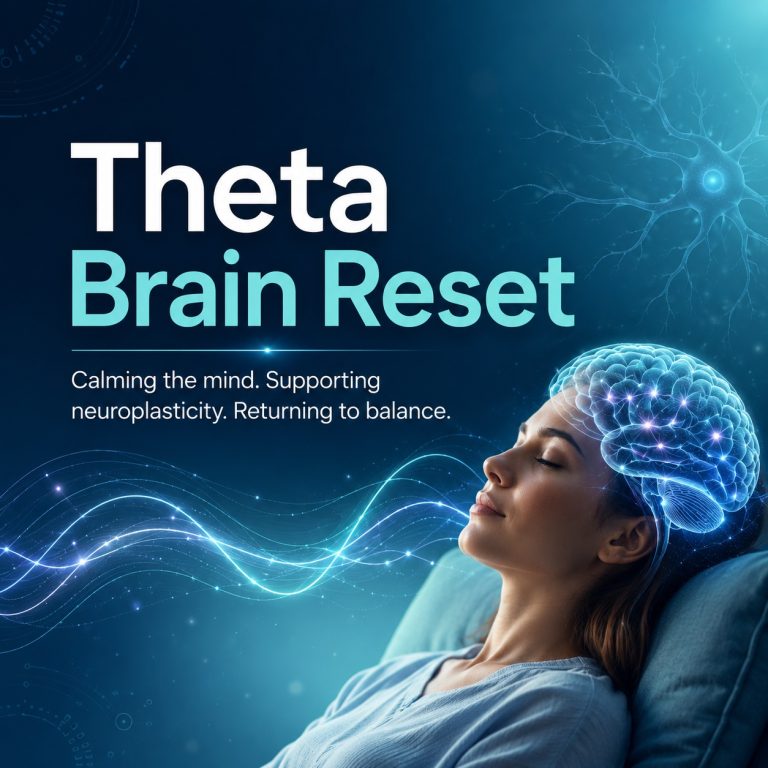
In a calmer theta-dominant state, the brain may become more open to new associations. The body may feel safe enough to soften. The mind may become quiet enough to listen. Emotional material may be processed with less defensiveness. This is why theta is so interesting in relation to meditation, memory, habit change, trauma work, creativity, and personal growth. It is not that theta does the work for us. It is that theta may create a state in which the work can happen differently. The soil becomes softer. And when the soil is softer, new roots have a better chance.

Theta and Meditation
Meditation is one of the oldest natural pathways into theta. Many experienced meditators learn how to settle the nervous system through breath, posture, mantra, prayer, open awareness, or focused attention. Over time, the brain becomes more familiar with shifting out of ordinary task mode and into slower, deeper rhythms of awareness. This is part of what makes meditation so powerful.
But it is also why meditation can be frustrating for beginners. A person may be told to “just relax” or “clear the mind,” but their body may not feel safe enough to relax. Their mind may be loud. Their thoughts may be racing. Their muscles may be tense. Their nervous system may be operating like there is a storm on the horizon, even while they are sitting in a quiet room with their eyes closed. This is not failure. It is physiology.
For some people, meditation is immediately accessible. For others, the first step is not silence. The first step is helping the nervous system find enough rhythm, safety, and support to begin letting go. That is where brainwave entrainment becomes interesting. Instead of trying to force the mind into meditation, we can ask a different question: What if you could entrain to it?

Theta and the Nervous System
The theta brainwave state is not just about the brain. It is also about the body. The brain and body are constantly talking. Breath, heart rhythm, muscle tone, vestibular input, emotional memory, visual stimulation, sound, and internal sensations all influence the state of the nervous system.
When someone is stressed, the body often carries that stress long after the thinking mind understands the situation. The shoulders remain tight. The gut stays guarded. Sleep becomes lighter. Breathing becomes shallow. The mind keeps scanning for problems. This is why healing cannot always be approached from the neck up. Sometimes the body needs to feel safety before the mind can believe safety.
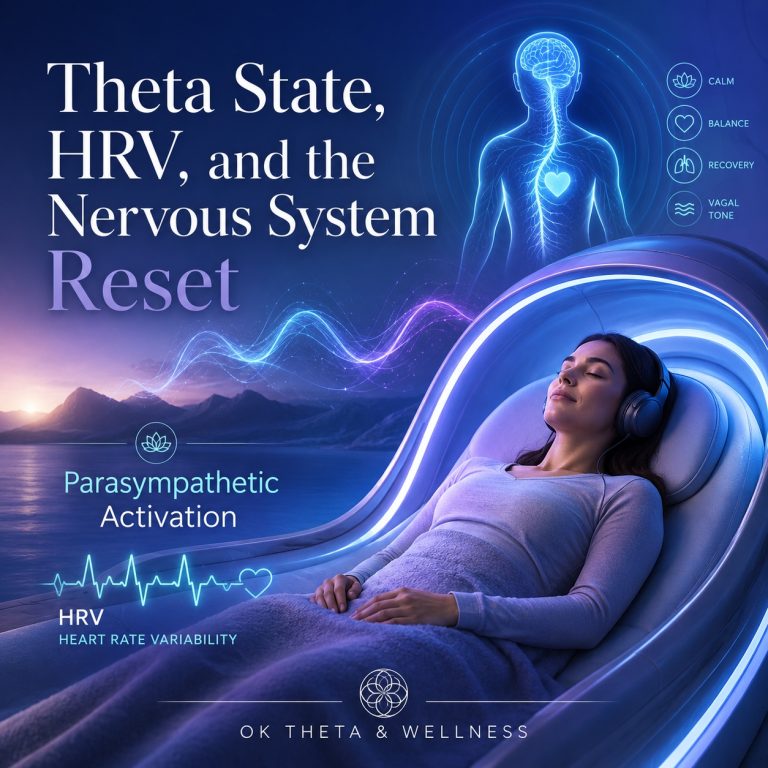
Theta often emerges when the nervous system begins to settle. The state may be associated with deep relaxation, parasympathetic activation, inner imagery, and reduced defensive thinking. In plain language, the body begins to exhale. And when the body exhales, the mind often becomes less rigid.
That does not mean every theta experience is dramatic. Sometimes it feels like a deep inner journey. Sometimes it feels like a nap. Sometimes it feels like floating. Sometimes the person may not notice the effect until later, when they realize they are sleeping better, reacting less intensely, or reflecting with more clarity. The point is not to chase fireworks. The point is to create conditions where the nervous system can learn.

How the Theta Chamber Supports the Theta Brainwave State
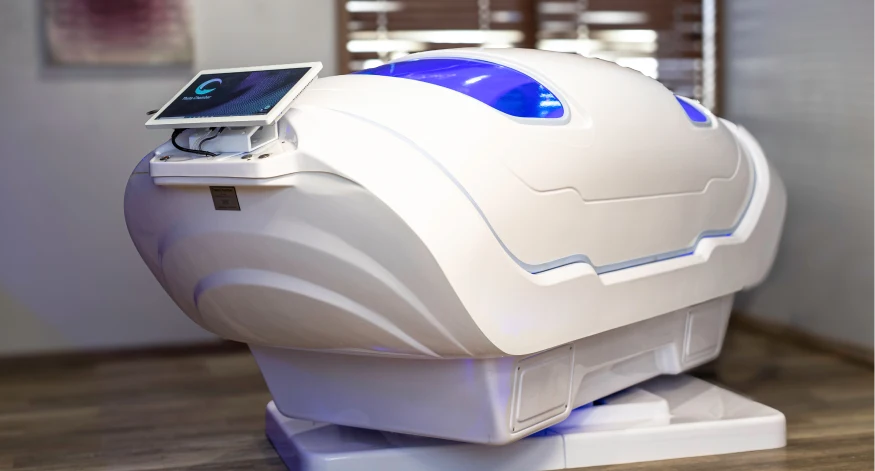
At OK Theta & Wellness, we use the Theta Chamber to help people experience this state through a coordinated blend of rhythm, motion, light, sound, and nervous system support.
The Theta Chamber is not simply a relaxation bed. It is a multisensory environment designed to help guide the brain and body toward meditative states. One of the core features is rhythmic vestibular motion. The gently rotating bed provides a steady form of movement that the nervous system can organize around. The vestibular system is deeply connected to balance, orientation, arousal, and regulation. Gentle rhythm can act like a metronome for the body.
The chamber also uses light and sound entrainment, including strobing goggles and binaural beats. These rhythmic sensory inputs give the brain repeated cues that can support a shift toward slower brainwave states. In other words, instead of asking the mind to create stillness from scratch, the Theta Chamber surrounds the nervous system with rhythm.

Additional modalities may include cranial electrotherapy stimulation, PEMF, sound, and other supportive sensory inputs depending on the individual and the session. The goal is not one isolated stimulus. The goal is a coordinated environment where multiple signals point in the same direction:
Settle. Synchronize. Soften. Receive.
For beginners, this can make meditation more accessible. For experienced meditators, it can deepen the practice. For people who feel trapped in overthinking, stress, or emotional guardedness, it can offer a different kind of entry point. The chamber does not replace the person’s own inner work. It supports the state where that work may become more available.

What Theta May Feel Like
People experience theta differently. Some feel a profound physical relaxation, almost like the body becomes heavier while the mind becomes lighter. Some describe floating, drifting, or moving in and out of dreamlike imagery. Others notice colors, memories, emotions, or symbolic impressions. Some people cry. Some sleep. Some feel peaceful. Some feel very little during the session but notice later that something has shifted.
Common experiences may include:
- A quieter mind.
- A sense of spaciousness.
- Reduced mental chatter.
- Emotional softening.
- Dreamlike imagery.
- Memory fragments.
- Body sensations.
- Deep relaxation.
- Calm clarity afterward.
But theta is not about having a specific experience. It is not a performance. It is not a test of spirituality, intelligence, or emotional depth. Sometimes the most important session is the one where “nothing happened,” except the body finally got a chance to stop bracing. That matters.

Why Theta Matters
We live in a culture that often treats change as a matter of effort. Try harder. Think better. Be more disciplined. Push through. There is a place for discipline. There is a place for effort. But there is also a place for state change.
A person in a state of chronic stress may not need more pressure. They may need a different rhythm. A person caught in repetitive thinking may not need another explanation. They may need enough quiet to observe the pattern. A person carrying emotional tension may not need to be forced open. They may need enough safety to soften.
The theta brainwave state matters because it reminds us that the brain learns differently in different states. When the mind is loud, insight can be difficult to hear. When the body is guarded, healing can feel unsafe. When the nervous system is overloaded, even good advice can bounce off the surface. But when the brain becomes quieter, it may become more honest. When the body feels safer, the mind may become less defensive. When the nervous system settles, change can stop feeling like a fight. That is the heart of theta.
It is not magic. It is not a shortcut around life. It is not a guarantee that one session will change everything. But it is a meaningful state. It is a state of access, reflection, and receptivity. It is a state where meditation may deepen, emotional patterns may become more visible, and the brain may become more teachable.
At OK Theta & Wellness, this is why we care so much about the Theta Chamber. We are not simply trying to help people relax, though relaxation is valuable. We are trying to help people experience a state where the brain and body can relate to themselves differently. Because sometimes the next step in healing is not more force. Sometimes the next step is rhythm. Sometimes it is quiet. Sometimes it is allowing the brain to become teachable again.