
Theta Brain Reset: Using the Theta State to Calm the Mind, Notice Patterns, and Practice Letting Go

Most of us are not short on information. We are short on access. We know what we “should” do. We know the habit we want to break, the emotion that keeps hijacking us, the old defensive pattern that no longer fits the life we are trying to build. But knowing something intellectually and actually loosening its grip in the nervous system are two different things. That is where the idea of a Theta Brain Reset comes in.
At OK Theta & Wellness, when we talk about a Theta Brain Reset, we are usually talking about a structured 28-day theta session program. The goal is not to erase who you are, force a mystical experience, or pretend that one month can solve every pattern built over decades. It is more practical than that. A Theta Brain Reset is a concentrated season of nervous system downshifting, reflection, repetition, and self-observation. It is time set aside to give the brain a different rhythm to practice in.
Spin into Wellness in Oklahoma’s First Theta Chamber!
What Are Brain Rhythms?
The brain communicates through electrical activity. Electroencephalography, or EEG, records this activity as wave-like patterns generated by populations of neurons firing in coordinated ways. Clinically, EEG is used to evaluate brain activity in conditions such as seizures, but conceptually it also gives us a useful window into different brain states. (Mayo Clinic)
Brain rhythms are usually described by frequency bands. Delta is slower and often associated with deep sleep. Theta, commonly discussed around the 4 to 8 Hz range, is slower than alpha and beta but faster than delta. Alpha is often associated with relaxed wakefulness. Beta is linked with active thinking, problem-solving, and external engagement. Gamma is faster and often discussed in relation to binding information, attention, and higher-level integration.
Of course, the brain is not a radio that plays one station at a time. We are always a blend. Different networks can be operating in different rhythms at the same time. But the broad concept still helps: when the brain shifts rhythm, the way we experience ourselves can shift too.

Why Theta Matters
Theta has been studied for its role in memory, learning, attention, navigation, and emotional processing. In hippocampal research, theta has been described as an “online” state of the hippocampus, involved in temporal coding and changes in synaptic weights, which is a technical way of saying theta appears to help the brain organize experience and modify connections. (ScienceDirect) Reviews of human memory research also describe theta as important for organizing sequential information, coordinating encoding and retrieval, and supporting memory processes. (memory.psych.upenn.edu)
That is one reason theta is so interesting for personal growth work. We are not just trying to “relax.” Relaxation is helpful, but relaxation alone is not the whole harvest. The deeper question is: can the brain enter a state where it is calm enough to observe, flexible enough to learn, and safe enough to update?
That is the real doorway.
A theta state may make it easier to notice what is usually automatic. The thought that fires before you realize you are thinking. The emotional trigger that rises before the story forms. The defensive posture that once protected you but now keeps you small. In ordinary beta-heavy life, we often meet those patterns after they have already taken the wheel. In theta, we are trying to catch the pattern earlier, while it is still a ripple instead of a storm.

Childhood Theta and Plasticity
People often hear that children spend more time in theta, and that this is part of why children are so impressionable and adaptive. That idea needs a little nuance. Children do tend to show more theta activity than adults in waking EEG, and developmental EEG research recognizes theta as an important rhythm in childhood and adolescence. A 2024 review described theta as one of the prominent EEG frequency bands in developmental research, while also emphasizing that theta can mean different things depending on context: resting theta and task-related theta do not necessarily point to the same cognitive meaning. (ScienceDirect)
So the point is not that we are trying to “become children” or that theta magically reopens childhood. The better way to say it is this: childhood reminds us that the brain is shaped by rhythm, environment, repetition, safety, and emotional salience. A 28-day Theta Brain Reset uses that same general principle in an adult way. We create a repeated state, give the nervous system a consistent signal, and use that window to practice noticing, releasing, and rebuilding.
The Oklahoma version: the ground does not soften because you yell at it. It softens when the rain comes steady.

Theta and Meditation
Meditative states have been repeatedly associated with changes in brain rhythms, especially increases in frontal midline theta in certain forms of focused attention and internalized awareness. Frontal midline theta has been studied in relation to meditation, attention, autonomic regulation, and self-monitoring. Kubota and colleagues found frontal midline theta during an attention-demanding meditation procedure was related to cardiac autonomic activity, suggesting a connection between meditative attention, medial frontal circuitry, and body regulation. (PubMed)
More recent work has continued exploring frontal midline theta as a meaningful marker in meditation and mindfulness. Tang and colleagues discussed frontal midline theta in relation to mindfulness meditation and white matter plasticity, while Brandmeyer and colleagues developed a neurofeedback protocol specifically targeting frontal midline theta during breath-focused meditation in novices. (PMC)
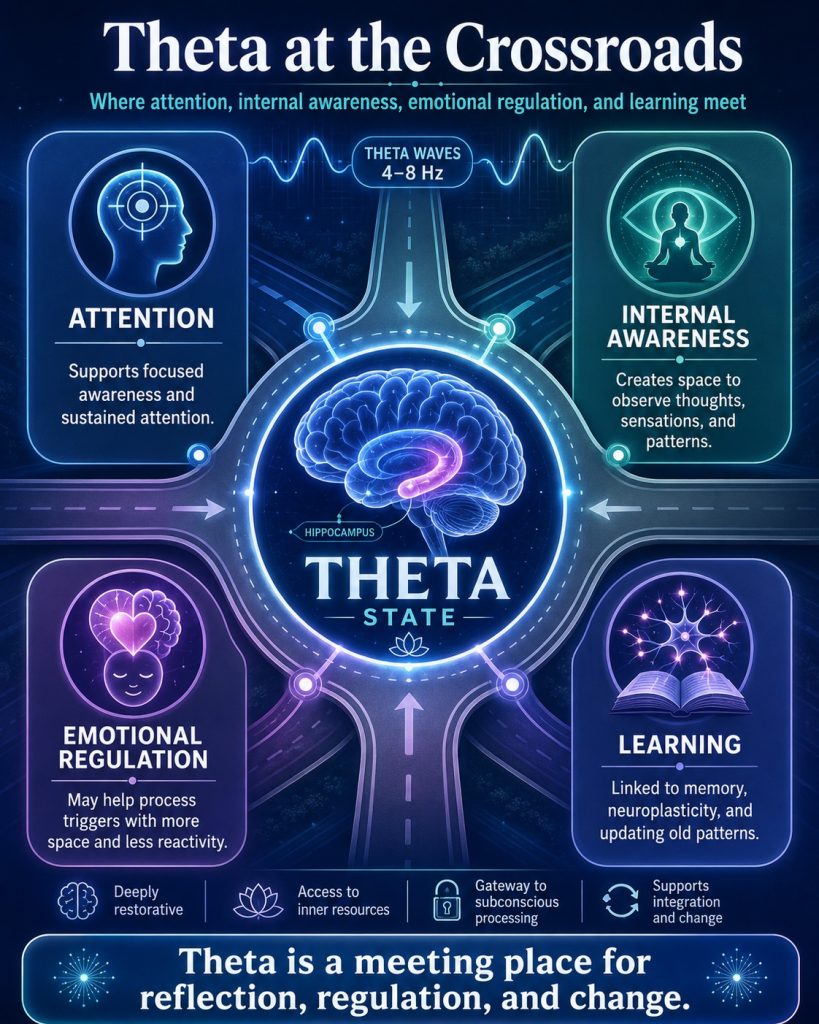
This does not mean frontal midline theta is the entire story of meditation. Meditation is not reducible to one frequency band. But the overlap is meaningful. Theta seems to sit near a crossroads where attention, internal awareness, emotional regulation, and learning can meet.
Using Meditation Inside the Theta Chamber
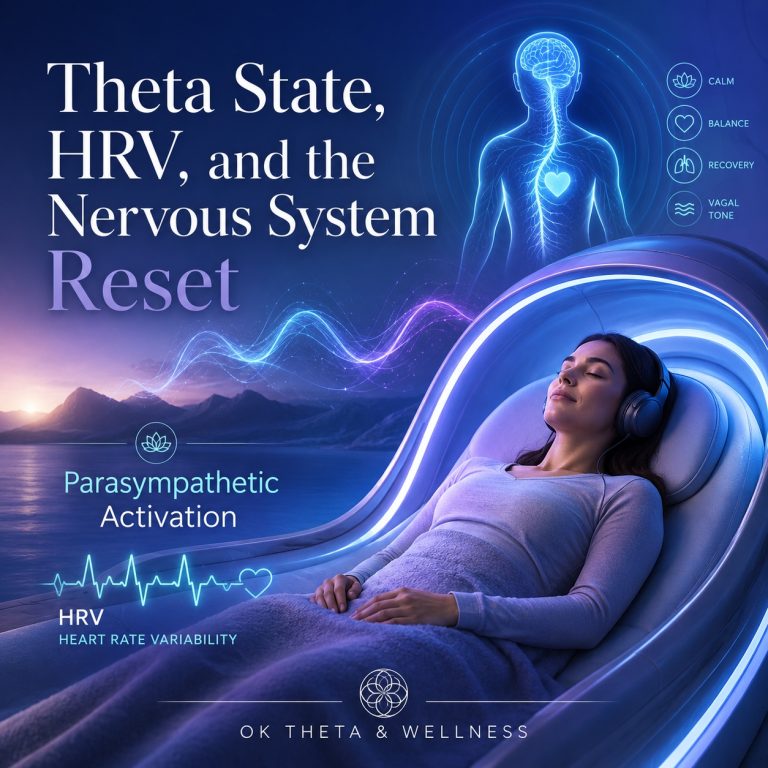
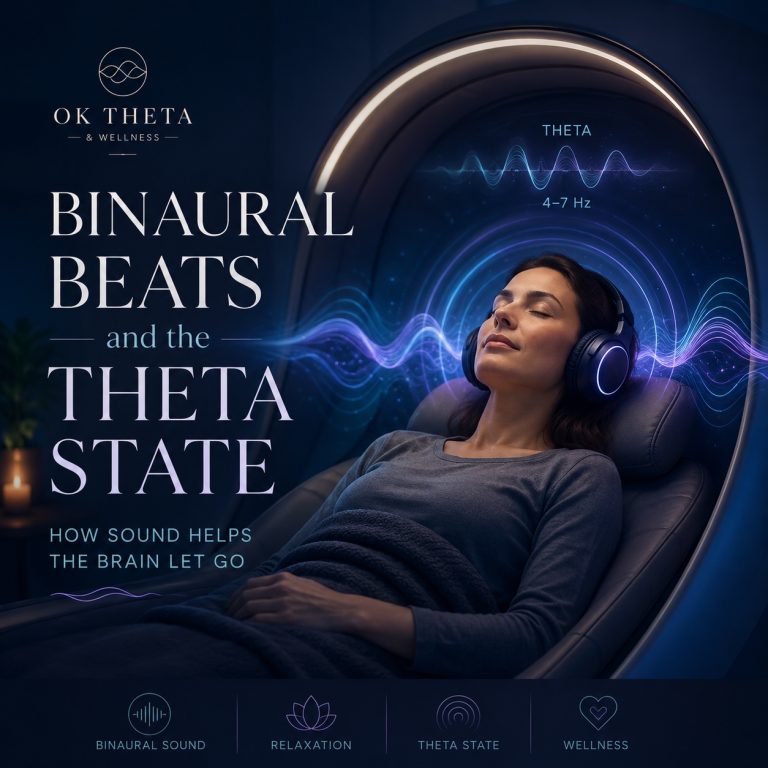
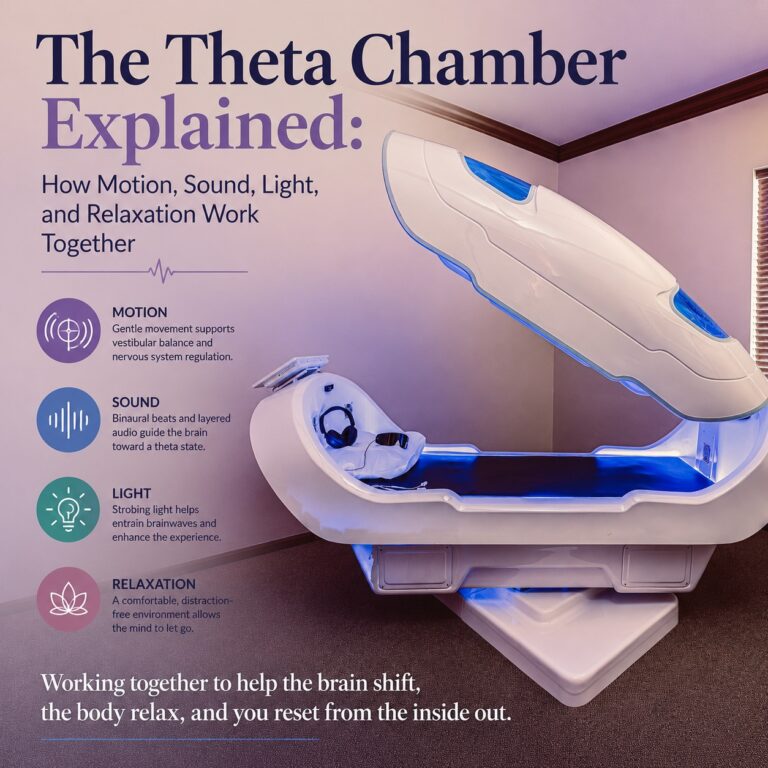
The theta chamber is not a replacement for meditation. It is more like training wheels, weather conditions, and a quiet room all rolled into one. For people who struggle to “get there” on their own, the chamber can make the meditative doorway easier to find. The rhythmic vestibular input, sound, light, and sensory environment can help the brain and body downshift into a slower, more receptive state. Once there, the real practice begins.
A person can use breath awareness, body scanning, prayer, mantra, visualization, or simple observation. The technique matters less than the posture of attention. We are not trying to wrestle the mind into submission. We are learning to watch it without immediately believing every message it sends. That is a big difference.
For example, a person may notice a familiar thought arise: “I am not safe unless I control everything.” In normal life, that thought may instantly recruit the body. The chest tightens. The jaw locks. The breath gets shallow. The person starts planning, defending, correcting, or escaping. But in a theta session, there may be enough space to notice the pattern before becoming it. That space is gold.

The Separation Between Trigger and Self
One of the most important goals of a Theta Brain Reset is learning to create separation between the trigger and the self. A trigger feels personal because the body responds as if the past is happening now. The nervous system pulls an old file and says, “We have seen this before. Prepare accordingly.” Sometimes that response was originally protective. It may have helped someone survive criticism, instability, grief, rejection, trauma, or disappointment. The problem is that protective strategies can outlive the season they were built for.
Control may have protected you once. People-pleasing may have protected you once. Emotional shutdown may have protected you once. Hypervigilance may have protected you once. But there comes a time when the question changes from, “Did this pattern help me survive?” to, “Is this pattern still helping me live?” The theta state can create a calmer internal environment for asking that question honestly.

The 28-Day Reset
A 28-day program matters because repetition matters. One session can be helpful, but repeated exposure gives the brain more chances to recognize the state, enter it more easily, and associate it with reflection, safety, and new learning.
The first sessions may simply be about settling. Some people spend the early phase learning how much tension they carry. Others notice restlessness, emotional material, old memories, or mental chatter. That is not failure. That is the mind showing its weather. Over time, the work becomes more intentional. What pattern keeps returning? What emotional trigger keeps rising? What belief is hiding underneath the reaction? What part of the body responds first? What would it feel like not to obey the old pattern immediately? This is not passive relaxation. It is active observation in a receptive state.

What a Theta Brain Reset Is, and Is Not
A Theta Brain Reset is not a medical cure, and it should not be framed as a substitute for appropriate medical or mental health care. Meditation and mindfulness research is promising, but even major public health resources note that studies on meditation-related brain changes can be difficult to interpret, and practical implications are still being clarified. (NCCIH) That honesty matters.
But we do not need to overclaim to see the value. A Theta Brain Reset is a structured way to practice calming the nervous system, observing thought patterns, working with emotional triggers, and using theta-associated states for reflection and change. It is not magic. It is practice. It is not escape. It is a return to the inner room where the pattern can finally be seen clearly. And once something is seen clearly, it can be worked with.
The Heart of the Work
The real goal is not to become perfectly calm. The goal is to become more conscious. Calm helps because it gives us access. Theta helps because it may support a state where attention turns inward without becoming chaotic. Meditation helps because it teaches us to notice without immediately reacting. Repetition helps because the brain learns by returning to the same trail until the trail becomes easier to walk.
A Theta Brain Reset is a month of returning. Returning to the breath. Returning to the body. Returning to the observer. Returning to the question: “Is this pattern still mine to carry?”
At OK Theta & Wellness, that is what we mean by a Theta Brain Reset. It is not about turning the mind off. It is about helping the mind become teachable again. It is about stepping out of the old reflex long enough to realize you may have a choice. And sometimes, that little space between trigger and response is where a whole new life starts to take root.

Ready for your Theta Brain Reset?
If you feel like your mind has been running the same old roads, the same stress loops, the same protective patterns that once helped you survive but may no longer be helping you live, a Theta Brain Reset may be a meaningful place to begin.
At OK Theta & Wellness, our 28-day theta session program is designed to give your nervous system repeated access to a calmer, more reflective state, a place where you can breathe, observe, notice, and begin to create space between the trigger and the self.
This is not about forcing change. It is about creating the conditions where change becomes possible.
Schedule your Theta Brain Reset consultation with OK Theta & Wellness today, and let’s explore whether 28 days in theta could help you calm the mind, reconnect with yourself, and begin practicing a new way forward.