
Morph Device Oklahoma City: PENFS Therapy for Pain and Nervous System Regulation
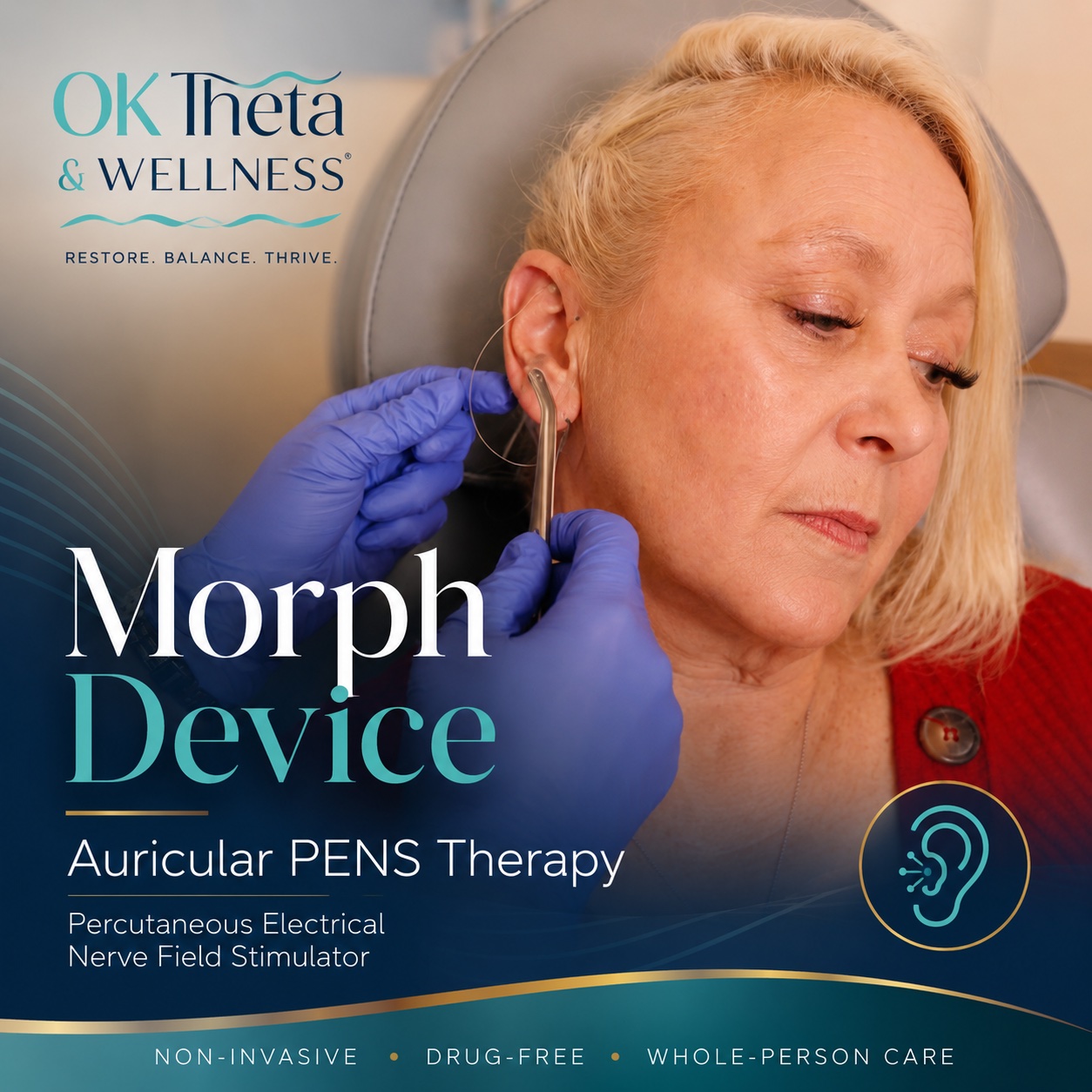
One of the most fascinating things I have learned since leaving neurosurgery and moving into wellness-based nervous system work is that the body often gives us small doorways into very large systems. The ear is one of those doorways.
At first glance, it seems almost too simple. A small device placed behind the ear. Tiny leads positioned around the auricle. Gentle electrical stimulation delivered over time. But the more I have studied and worked with auricular neuromodulation, the more I have come to see the ear as a kind of neural switchboard.
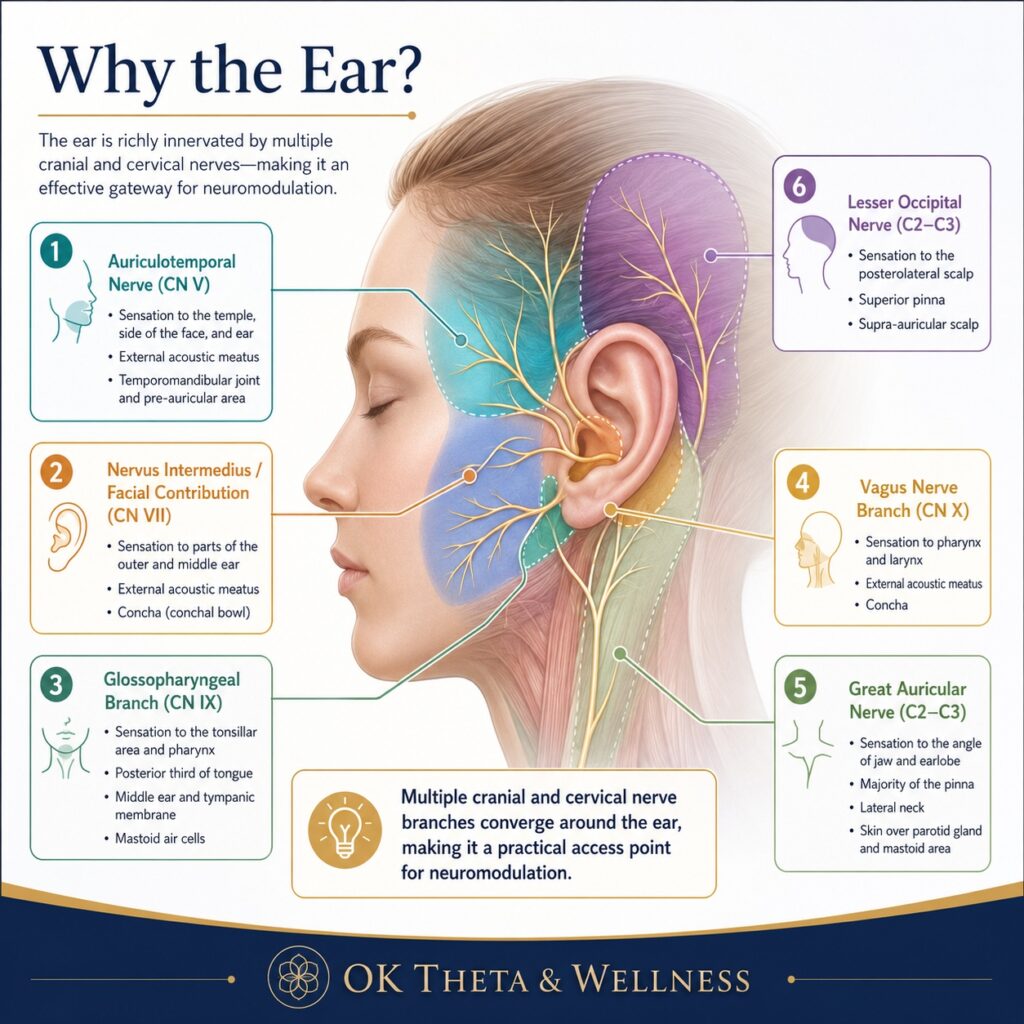
The ear is not just cartilage, skin, and sound collection. It is also richly connected to branches of cranial and cervical nerves that communicate with deeper pain, stress, autonomic, and gut-brain pathways. That is what makes devices like the Morph Device so interesting.
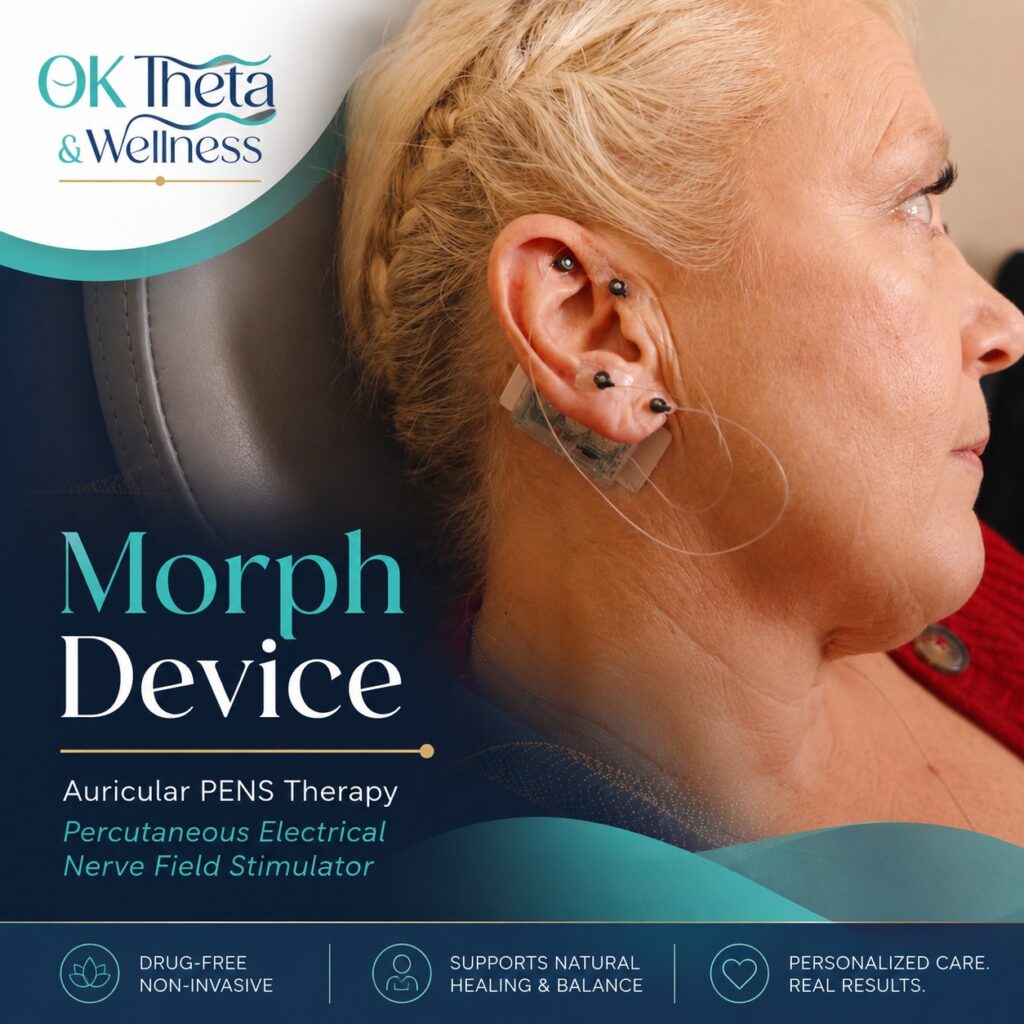
Morph belongs to a broader category of technology often called PENS, or percutaneous electrical nerve stimulation. More specifically, many ear-based devices are described as PENFS, or percutaneous electrical nerve field stimulation. These devices use small percutaneous electrodes near the ear to stimulate nerve branches that can influence pain signaling, withdrawal symptoms, autonomic regulation, and central sensitization.
In plain English: this is a small device that may help quiet an overactive nervous system. And for many people, that is exactly where healing needs to begin.
Spin into Wellness in Oklahoma’s First Theta Chamber!
What Is the Morph Device?
The Morph Device is an auricular neurostimulation device. It is worn behind the ear and uses small leads to deliver low-level electrical stimulation to specific nerve-rich areas around the ear. The goal is not simply to “zap pain.” That is too crude of a model.
A better way to understand Morph is this: it sends organized electrical input into peripheral nerve branches that communicate with the central nervous system. In doing so, it may help shift how the brain and body are processing pain, stress, withdrawal, and internal body signals.
This is one of the reasons I find the technology so compelling. In neurosurgery, I spent years thinking about structure: tumors, anatomy, blood vessels, cranial nerves, fiber tracts, and surgical corridors. In wellness, I still think about structure, but I also think constantly about state.
- Is the body in protection?
- Is the nervous system amplified?
- Is pain being driven only by tissue damage, or is there also an emotional and autonomic overlay?
- Is the brain interpreting ordinary body signals through the lens of threat?
Morph/PENS sits right in that conversation.
What Does PENS Mean?
PENS stands for percutaneous electrical nerve stimulation. “Percutaneous” simply means that the stimulation passes through the skin using tiny needle-like electrodes rather than large surface pads. This makes it different from TENS, which most people know as electrical stimulation through sticky pads placed on the skin. There are several related terms that can be confusing:
| Term | What it means |
| TENS | Surface-level electrical stimulation using pads |
| PENS | Percutaneous stimulation using small needle-like electrodes |
| PENFS | Percutaneous electrical nerve field stimulation, often around the ear |
| PNFS | Peripheral nerve field stimulation |
| tVNS | Transcutaneous vagus nerve stimulation, usually non-needle-based |
| PNS | A broader category of peripheral nerve stimulation, sometimes involving implanted systems |
Morph and similar auricular devices are part of this expanding field of non-opioid neuromodulation. We are living in a time where many patients are looking for options beyond medications, especially opioids, sedatives, and drugs that may help one symptom while creating another problem downstream.
Neuromodulation does not replace good medical care. But it does offer a different way of thinking: instead of only adding chemistry to the body, we can sometimes use rhythm, electricity, sensory input, and peripheral nerve access to help the nervous system regulate itself.
Why the Ear?
The ear is neurologically unusual. Several important sensory nerve branches overlap in and around the auricle, including branches associated with the trigeminal nerve, facial nerve, glossopharyngeal nerve, vagus nerve, and upper cervical/occipital nerves. FDA documents for auricular PENFS devices describe stimulation through branches of cranial nerves V, VII, IX, X, and occipital nerves. (FDA Access Data)
That means the ear gives us access to more than local sensation. It offers a peripheral route into brainstem and autonomic networks involved in pain, nausea, gut signaling, arousal, withdrawal symptoms, and body-state regulation. This is why I like the phrase neural switchboard.
When the nervous system is stuck in a high-alert pattern, the problem is not always limited to one tissue, one joint, one nerve, or one organ. Sometimes the entire system is turned up too loud. Pain becomes amplified. Gut sensations become threatening. Withdrawal becomes unbearable. Sleep becomes fragmented. Anxiety becomes physical. The body starts interpreting itself through a threat filter. Auricular PENS may help provide a regulatory signal into that system.
Similar Devices and FDA-Cleared Uses
Morph is part of a larger family of auricular neurostimulation devices. Different devices have different clearances, indications, and protocols, so I do not want to lump them all together too loosely. But it is helpful to understand the broader landscape.
Opioid Withdrawal Support
The FDA granted marketing authorization for the NSS-2 Bridge in 2017 as a device to help reduce symptoms of opioid withdrawal. The FDA described it as a prescription device placed behind the ear that sends electrical pulses to branches of certain cranial nerves. In the FDA’s summary, a clinical study showed reductions in Clinical Opiate Withdrawal Scale scores after stimulation. (U.S. Food and Drug Administration)
This is clinically meaningful because opioid withdrawal is not just discomfort. It is often a whole-body autonomic storm: sweating, tremors, agitation, body aches, nausea, diarrhea, insomnia, anxiety, and a sense that the body cannot settle. A device that helps reduce that physiologic storm may help someone stay engaged long enough to continue treatment.
The Morph/Drug Relief family is also discussed in this opioid-withdrawal category. The Morph Device website describes FDA 510(k) clearance for Drug Relief as an aid in the treatment of opioid withdrawal symptoms. (DyAnsys)
Functional Abdominal Pain and IBS in Adolescents
Another major example is IB-Stim, a percutaneous electrical nerve field stimulation device used for functional abdominal pain associated with irritable bowel syndrome in adolescents. The FDA De Novo summary describes IB-Stim as a PENFS system intended for patients 11 to 18 years old with functional abdominal pain associated with IBS, used 120 hours per week for up to 3 consecutive weeks, in combination with other IBS therapies. (FDA Access Data)
This is a powerful example because IBS is not simply “stomach pain.” It often involves visceral hypersensitivity, autonomic imbalance, stress reactivity, and gut-brain dysregulation. In other words, the abdomen hurts, but the nervous system is heavily involved in how that pain is interpreted. That is exactly the kind of condition where neuromodulation starts to make sense.
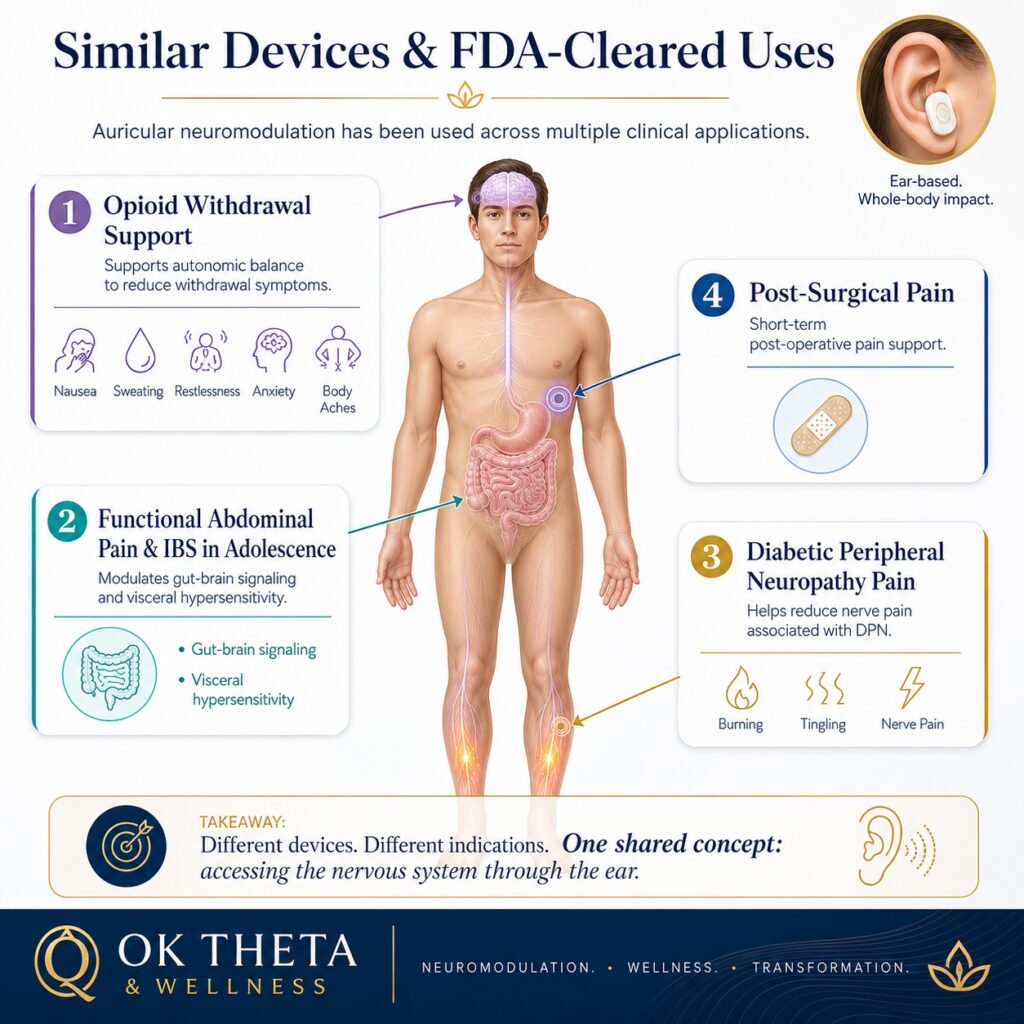
Diabetic Peripheral Neuropathy Pain
Another related device is First Relief, which FDA documents describe as a PENS system indicated for multiple treatments up to 56 days for symptomatic relief of chronic, intractable pain from diabetic peripheral neuropathy. (FDA Access Data)
Diabetic neuropathy is often described as burning, tingling, stabbing, numbness, or painful sensitivity. It can be extremely disruptive to sleep, walking, mood, and quality of life. From my perspective, neuropathy is rarely just a “foot problem.” It is a peripheral nerve problem, a vascular problem, a metabolic problem, and often a central pain-processing problem. That is why I am interested in therapies that support the whole system rather than only chasing symptoms at the surface.
Post-Surgical Pain
Another related device is sometimes referred to in practical conversation as a post-operative surgical pain device, or POSP.
Primary Relief® is described by DyAnsys as a percutaneous electrical nerve field stimulator / PENS device that delivers auricular neurostimulation over 72 hours. It uses needles positioned in the ear and sends electrical pulses through those electrodes. DyAnsys states that it is used mainly for management of post-surgical pain and that it was FDA-cleared initially for post-cesarean section pain and later for cardiac surgery. (DyAnsys)
The FDA 510(k) summary for K213188 states that Primary Relief is a PENS system indicated for up to 3 days for symptomatic relief of post-operative pain following cesarean section delivery. (FDA Access Data) A later FDA 510(k), K221425, expanded the indication language to include up to 3 days adjunctive symptomatic relief of post-operative pain following cardiac surgery, in addition to cesarean section delivery. (FDA Access Data)
I find this important because post-surgical pain is one of the places where the opioid conversation becomes very real. Pain after surgery should be treated seriously. But the more tools we have that may reduce pain without relying exclusively on opioids, the better. Auricular PENS does not replace surgical care, anesthesia, or appropriate medication. But it may become one more bridge between pain control and nervous system regulation.
How Might Morph/PENS Work?
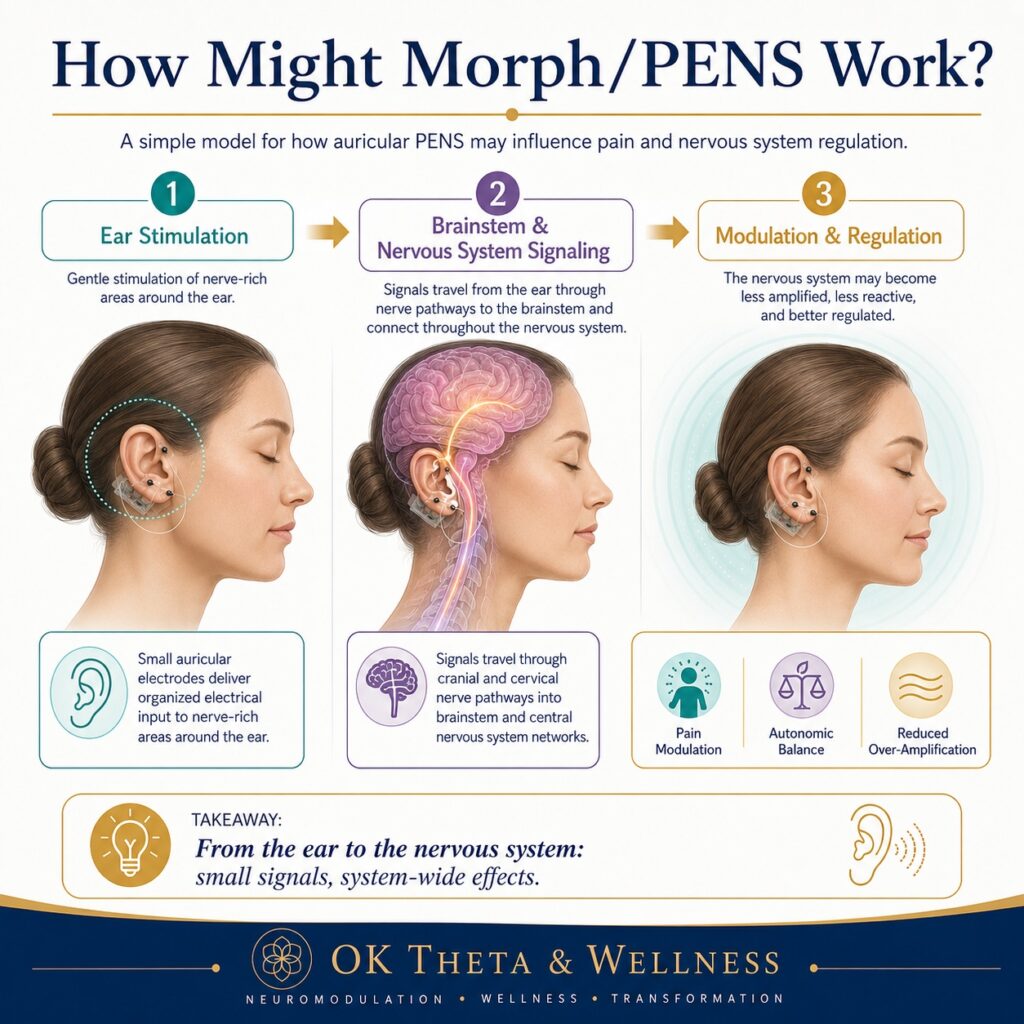
The simplest model is this:
- The device stimulates nerve-rich areas around the ear.
- Those nerve signals travel into brainstem and central nervous system pathways.
- The nervous system may become less amplified, less reactive, and better regulated.
That is the plain-language version. A slightly deeper version is that auricular stimulation may influence networks involved in pain modulation, autonomic regulation, vagal signaling, limbic arousal, and central sensitization. This is why one technology can show up in conversations about neuropathy, withdrawal, abdominal pain, anxiety physiology, and post-surgical pain. Those conditions are not identical, but they share a nervous system theme: the body’s alarm system can become louder than it needs to be.
When I talk with patients, I often explain it this way: Pain is not only a signal from the body to the brain. Pain is also an interpretation by the brain about the body. That interpretation can be shaped by inflammation, nerve injury, fear, sleep deprivation, trauma, stress hormones, blood flow, prior pain experiences, and emotional state. So when we use a device like Morph, we are not pretending the pain is imaginary. We are acknowledging something more sophisticated: pain is real, and the nervous system can be trained, supported, and sometimes quieted.
What We Have Observed Clinically
At OK Theta & Wellness, we think about Morph/PENS as part of a broader nervous system strategy. Some clients are looking for neuropathy support. Others are dealing with chronic pain. Some have a body that feels stuck in high alert. Others are trying to reduce reliance on medications. And still others are simply looking for another layer of support when pain, stress, and sleep disruption begin feeding each other.
In our experience, people most commonly describe feeling calmer, more settled, less pain-amplified, or more able to return to center after treatment. Individual responses vary. This is not a guaranteed cure, and it should not be presented that way. But when it helps, it often seems to help in a way that fits the larger pattern I see again and again: the body does better when the nervous system feels safer.
That is the same basic philosophy behind much of what we do at OK Theta & Wellness. Whether we are talking about the Theta Chamber, EECP, PEMF, StemWave, massage, breathwork, or auricular PENS, I am always asking some version of the same question: How do we help the body move out of survival mode and back toward regulation?
Who Might Consider Morph/PENS?
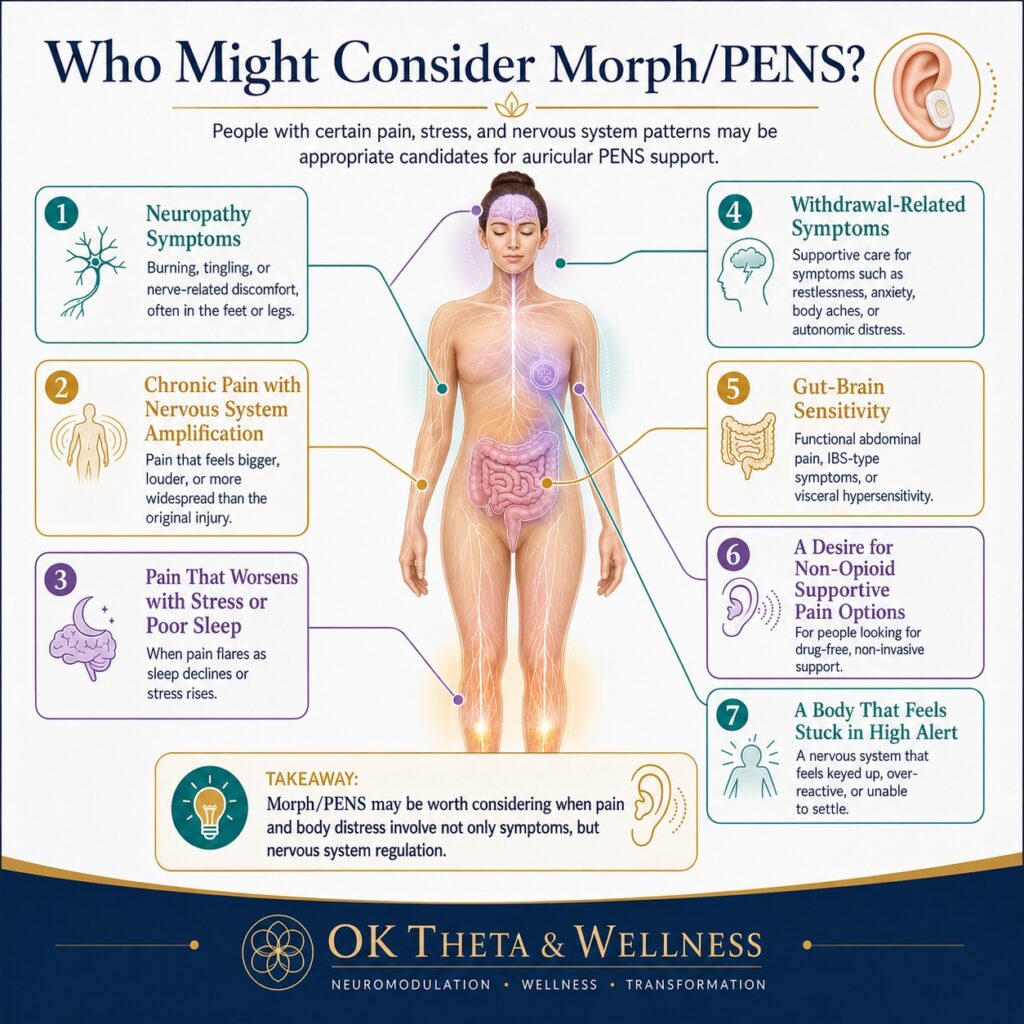
Morph/PENS may be worth discussing for people dealing with:
- Neuropathy symptoms
- Chronic pain with nervous system amplification
- Pain that worsens with stress or poor sleep
- Withdrawal-related symptoms, under appropriate medical supervision
- Gut-brain sensitivity, where appropriate
- A desire for non-opioid supportive pain options
- A body that feels stuck in high alert
This does not mean every person is a candidate. It also does not mean the device replaces medical evaluation. Pain can come from serious structural, inflammatory, infectious, vascular, neurologic, or metabolic causes. Those need to be identified and treated appropriately. But once appropriate evaluation has happened, there is room to ask a deeper question: Is the nervous system now part of the problem? If the answer is yes, neuromodulation may have a role.
Safety and Expectations
Auricular PENS devices should be used with proper screening and supervision. Some FDA materials for related auricular opioid-withdrawal devices list contraindications including cardiac pacemakers, hemophilia, and psoriasis vulgaris. (U.S. Food and Drug Administration)
As with any therapy, the details matter. The patient’s history matters. The indication matters. The device matters. The protocol matters. I also think expectations matter. I would not describe Morph/PENS as a miracle device. I would describe it as a nervous system support tool. For the right person, that can be very meaningful.
Pain and distress often become self-reinforcing loops. Pain worsens sleep. Poor sleep worsens pain. Pain creates fear. Fear increases muscle tension. Muscle tension increases pain. The nervous system becomes a prairie field in a dry season, ready to catch fire from the smallest spark. Morph/PENS may help create a quieter input into that system. Sometimes that is enough to help the body remember that it has another option besides alarm.
Final Thoughts
The Morph Device is interesting because it represents a larger shift in how we think about pain and regulation. For a long time, medicine has treated pain mostly as a tissue problem. Find the damaged structure. Treat the damaged structure. Prescribe something to reduce the signal. That model is still important. I am a former neurosurgeon. I believe deeply in anatomy, pathology, and structural diagnosis. But I also believe pain is bigger than structure alone.
Pain lives at the intersection of tissue, nerve, brain, emotion, memory, inflammation, sleep, stress, and meaning. The nervous system is not a passive wire. It is a living interpreter. That is why devices like Morph matter. They invite us to think differently. They remind us that the body can sometimes be reached through small doors. They show us that the ear, of all places, may be one of those doors.
At OK Theta & Wellness in Oklahoma City, we use Morph/PENS therapy as part of a broader approach to nervous system regulation, pain support, and whole-body wellness. It is not the only tool. It is not the whole answer. But for the right person, it may be a meaningful part of the path.
If your pain feels amplified, your body feels stuck on high alert, or you are looking for a non-opioid way to support nervous system regulation, Morph/PENS therapy may be worth exploring. Contact us at OK Theta & Wellness in Oklahoma City, we can help you decide whether this treatment fits your needs and your goals. Contact us today to schedule a conversation.
Revitalize Your Mind,
Renew Your Body