
Neuropathy Support Oklahoma City: A Layered Approach with StemWave, EECP, and the Morph Device
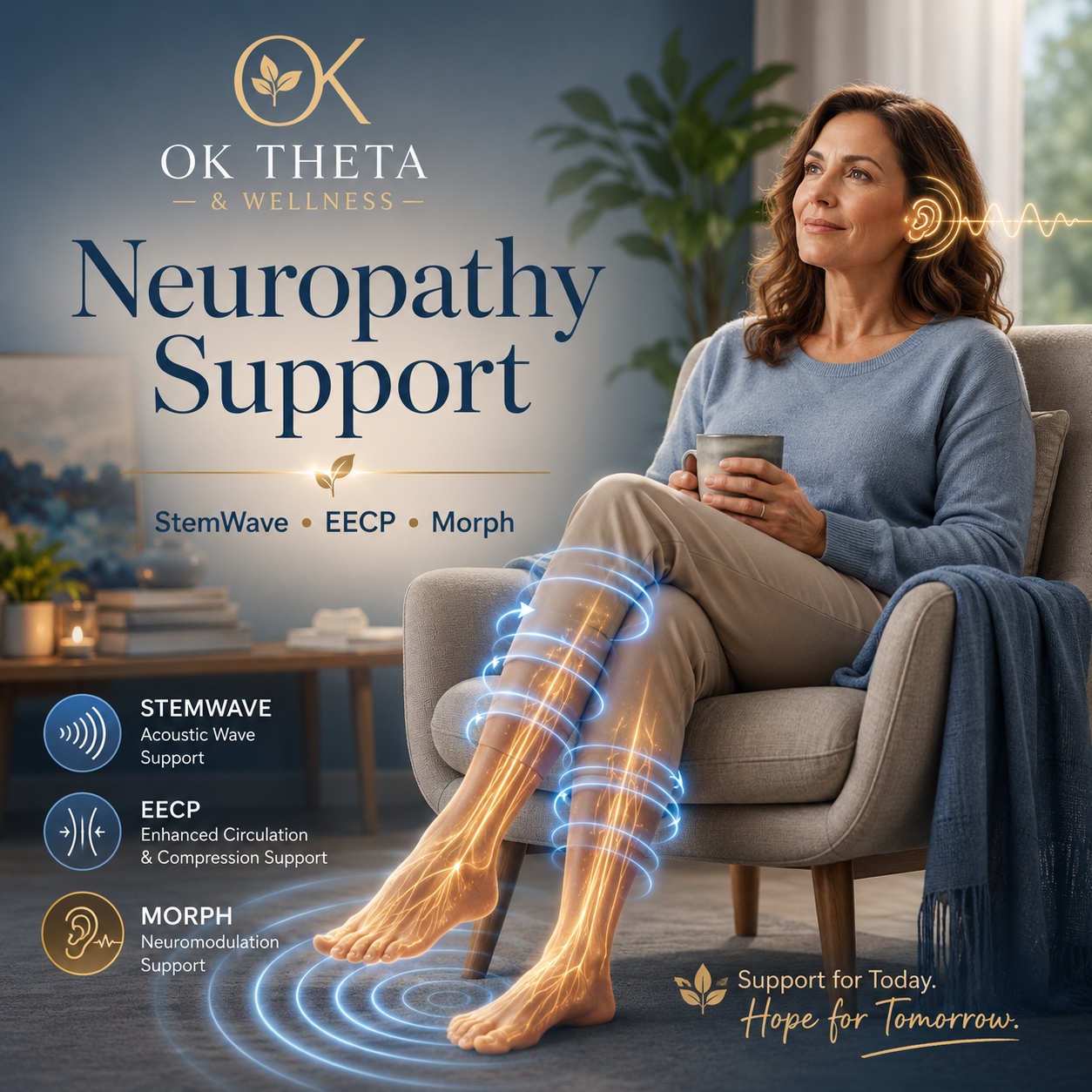
Neuropathy symptoms can be incredibly frustrating because they do not always behave like ordinary pain. OK Theta & Wellness is proud to offer three unique medication-free modalities for neuropathy support in Oklahoma City!
For some people, neuropathy feels like burning. For others, it feels like tingling, buzzing, numbness, coldness, pins and needles, electric shocks, stabbing pain, or hypersensitivity to touch. It may affect the feet, legs, hands, or arms. It may be worse at night. It may interfere with walking, sleep, exercise, balance, and confidence. One of the hardest parts is that neuropathy is not always visible from the outside. A person may look completely fine, yet their feet may feel like they are wrapped in static, sitting on hot pavement, or disconnected from the ground. That can be exhausting.
At OK Theta & Wellness, I think about neuropathy support through a layered lens. I do not view neuropathy as only a “nerve problem.” It can certainly involve irritated or damaged nerves, but it may also involve circulation, inflammation, tissue health, metabolic stress, sleep disruption, pain amplification, and nervous system sensitivity. That is why our approach to neuropathy support may include multiple tools, including StemWave, EECP, and the Morph device. Each one looks at the problem from a different angle.
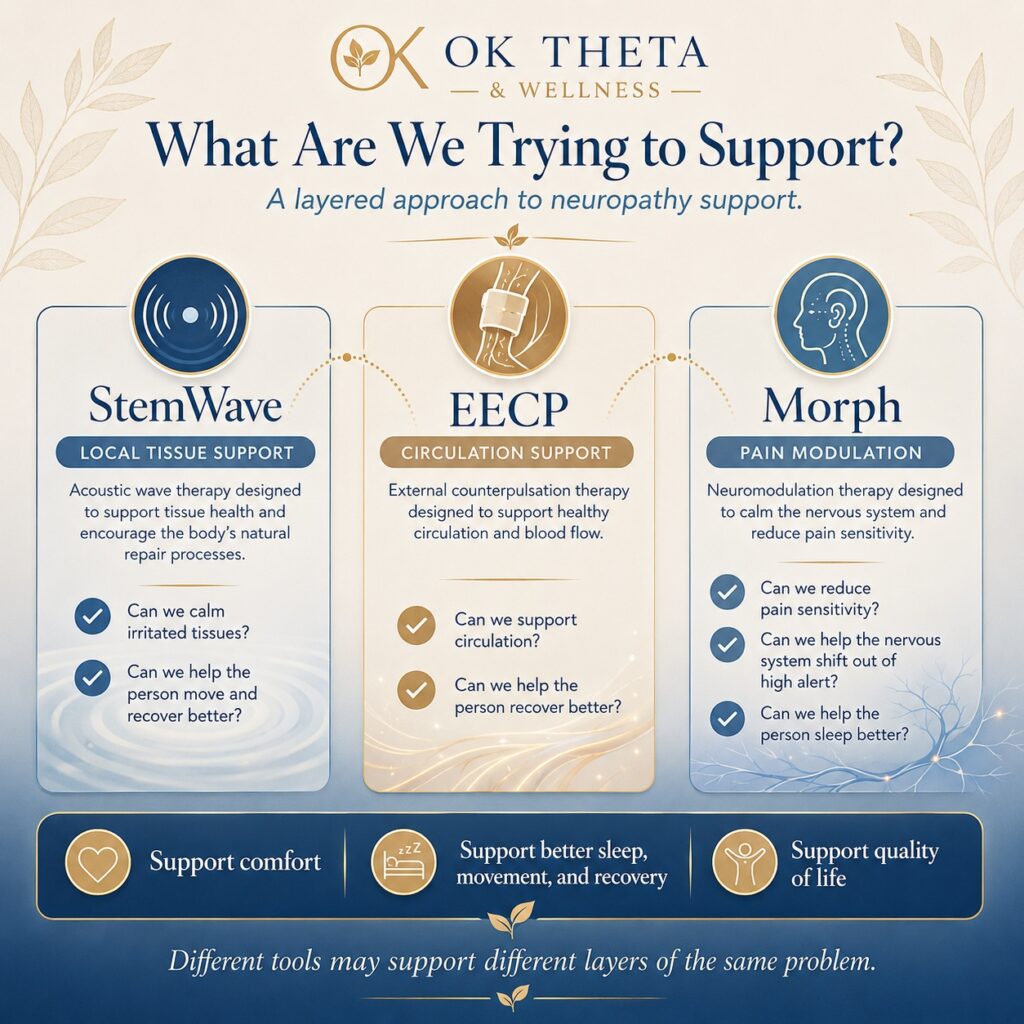
StemWave supports the local tissue environment. EECP supports circulation and vascular function. Morph supports pain modulation and nervous system sensitivity. Neuropathy is rarely simple, so I do not believe support should be one-dimensional.
Spin into Wellness in Oklahoma’s First Theta Chamber!
What Do We Mean by Neuropathy Support?
First, I want to be clear about language. When I talk about neuropathy support, I am not claiming that these therapies cure neuropathy. Neuropathy can have many different causes. Diabetes, chemotherapy, alcohol exposure, vitamin deficiencies, thyroid problems, autoimmune conditions, nerve compression, spinal issues, medication effects, vascular problems, and other conditions may all contribute. Because of that, neuropathy symptoms deserve proper medical evaluation. New, worsening, severe, or unexplained numbness, weakness, balance changes, wounds, or nerve pain should be evaluated by a qualified medical professional.
At OK Theta & Wellness, our goal is supportive. We are asking questions like:
- Can we support circulation?
- Can we calm irritated tissues?
- Can we reduce pain sensitivity?
- Can we help the nervous system shift out of high alert?
- Can we help the person sleep, move, and recover better?
- Can we support comfort and quality of life?
Neuropathy Is Often Layered
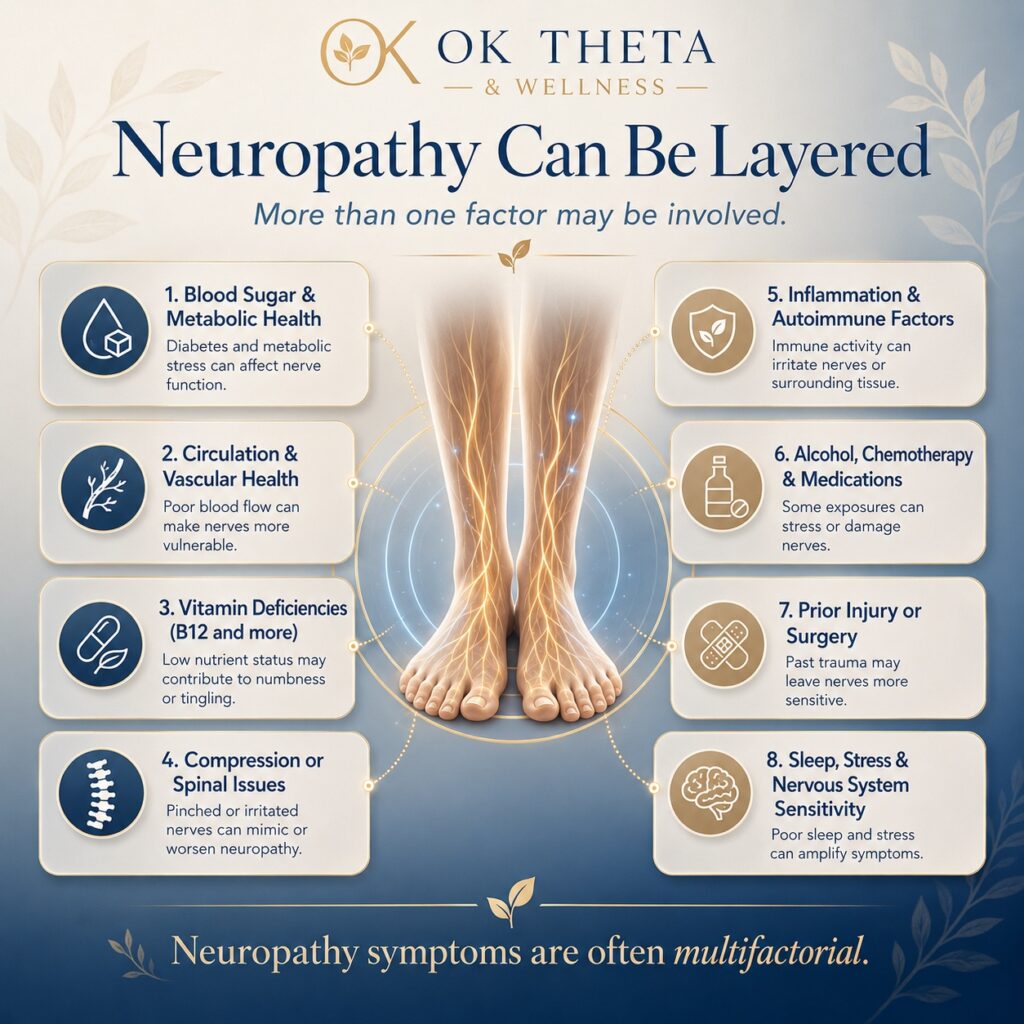
Neuropathy symptoms can be difficult because several layers may be involved at once. There is the nerve layer, a circulation layer, a tissue layer, a pain-processing layer, and a metabolic layer.
The nerve itself may be irritated, inflamed, compressed, metabolically stressed, or damaged. Because nerves are living tissue, they need oxygen, nutrients, and healthy blood flow. If circulation is poor, especially in the feet and legs, nerve symptoms may be harder to calm. In addition, nerves do not float in empty space. They travel through muscles, fascia, joints, tunnels, and connective tissue. If those areas are stiff, inflamed, swollen, tender, or guarded, nerve symptoms may feel louder.
When pain has been present for a long time, the nervous system may become more reactive. The pain volume knob may get turned up. Symptoms can begin to flare with stress, poor sleep, inflammation, or activity. Blood sugar regulation, B12 status, medications, inflammation, sleep quality, stress load, alcohol exposure, and overall health can all influence nerve function.
So when someone comes in with burning, tingling, numbness, or nerve-type pain, I do not want to ask only one question. I want to ask several:
- What is happening locally?
- What is happening with blood flow?
- What is happening with the nervous system?
- What is happening with recovery?
That is where a layered approach begins to make sense.
StemWave: Supporting the Local Tissue Environment
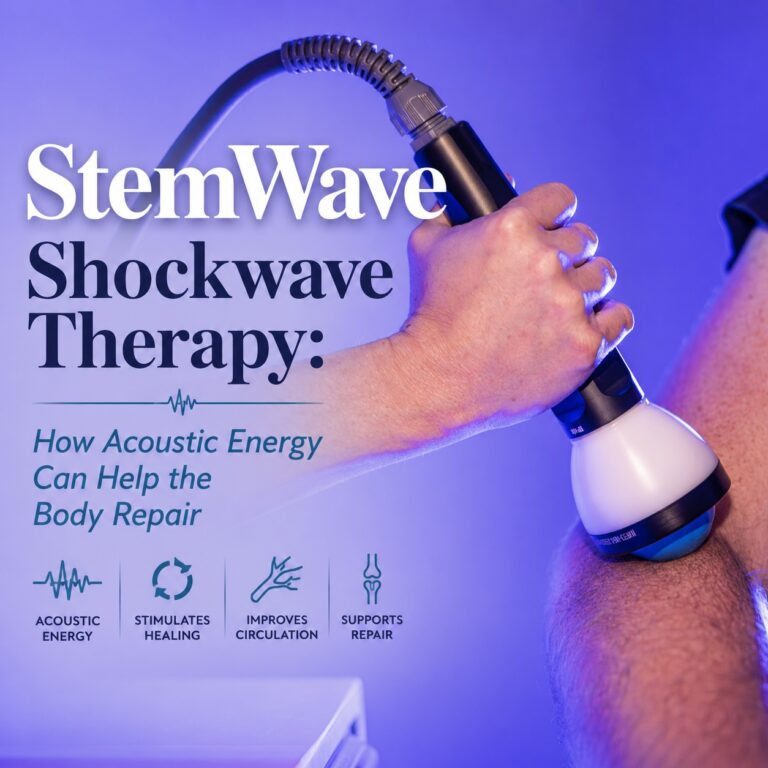
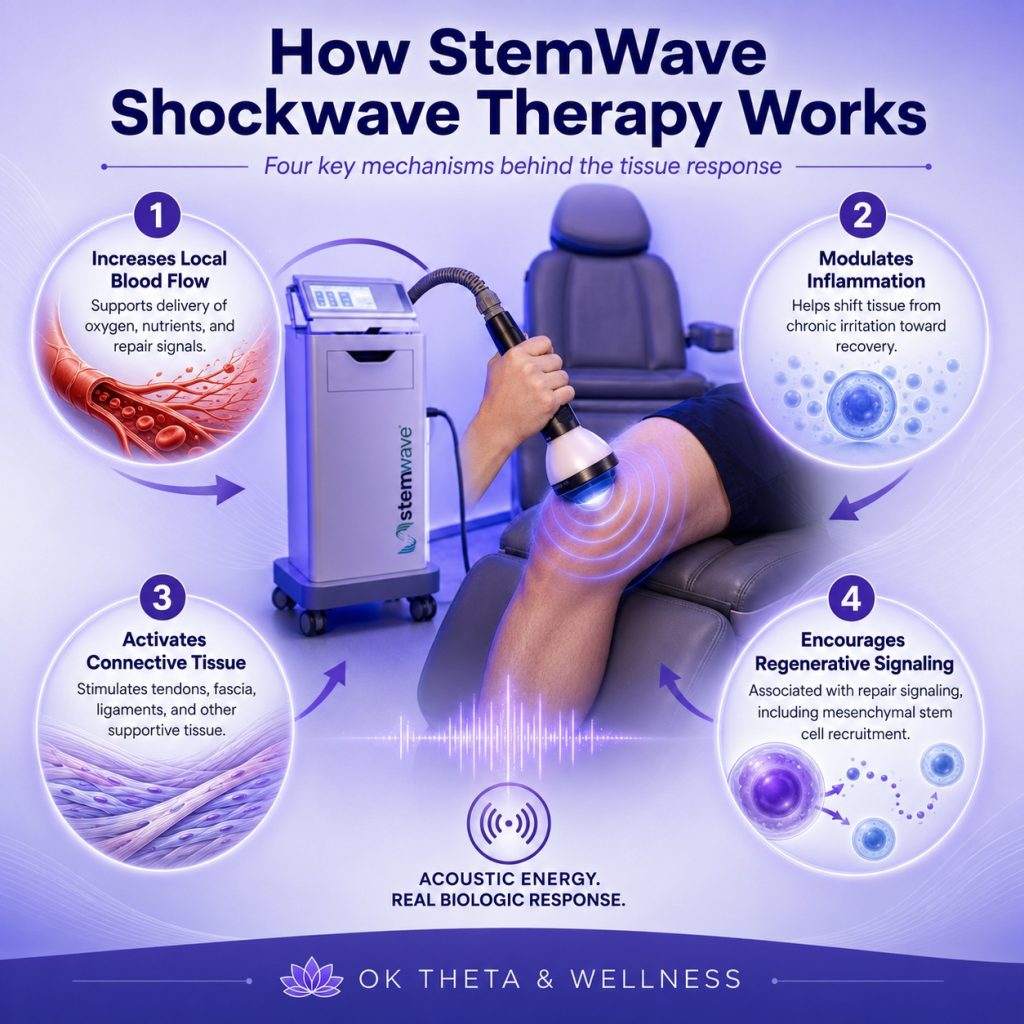
StemWave is a form of focused extracorporeal shockwave therapy. It uses acoustic pressure waves, not electrical current, directed into specific tissues. When we use StemWave in the context of neuropathy symptoms, I am not thinking of it as a magic nerve eraser. I am thinking about the environment around the nerve.
- Is the foot tender?
- Is the ankle stiff?
- Are the calves tight?
- Is there chronic inflammation or irritation in the tissues?
- Are there areas where the body is guarding because pain has been present for a long time?
- Are nearby joints, tendons, fascia, or soft tissues adding to the overall symptom burden?
These considerations matter because nerves are sensitive to their surroundings. If the tissue around a nerve is irritated, compressed, inflamed, or guarded, the nerve may have less room to settle down. StemWave can be used to support local tissue health, pain modulation, circulation in the treated region, and soft tissue recovery. In neuropathy support, we may look not only at where the symptoms are felt, but also at nearby areas that could be contributing to the problem, such as the feet, ankles, calves, knees, hips, or low back.
The goal is not to promise that the nerve will suddenly be “fixed.” The goal is to improve the local terrain. For some people, meaningful change may look like less burning, less sharpness, less tenderness, improved walking comfort, better tolerance of activity, or fewer intense flare-ups. Sometimes the first sign of improvement is not that the symptoms disappear. Sometimes the first sign is that they become quieter.
EECP: Supporting Circulation and Vascular Function
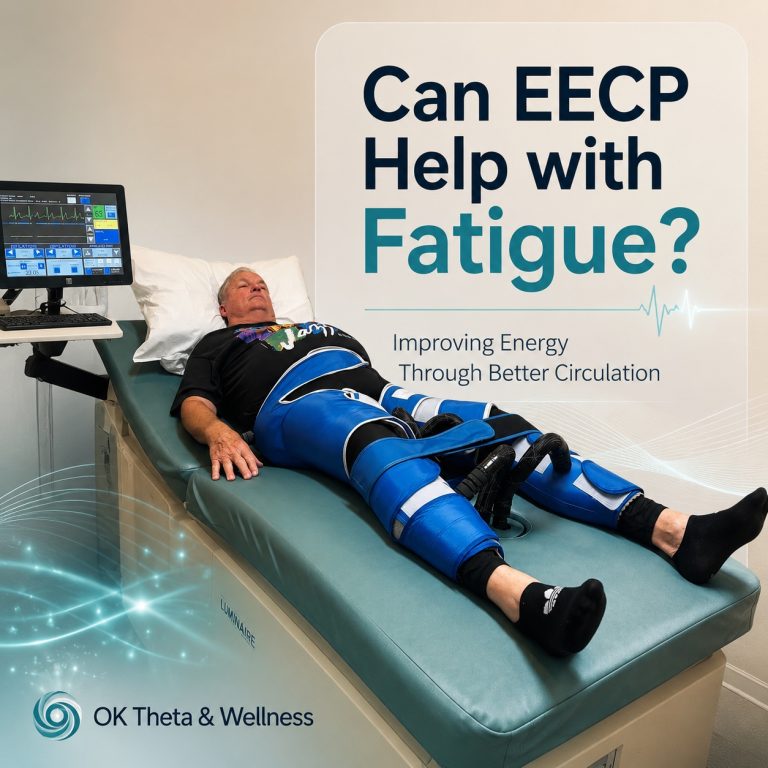
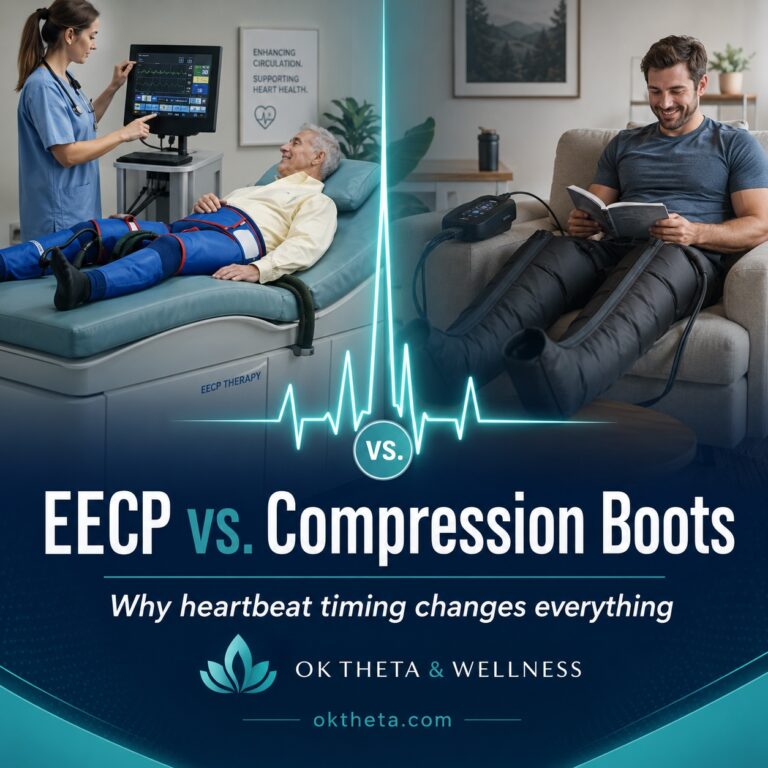
EECP stands for enhanced external counterpulsation. It is a noninvasive therapy that uses cuffs around the legs. These cuffs inflate and deflate in rhythm with the heartbeat.
EECP is a circulation-support tool. That matters for neuropathy because nerves need blood flow. The small nerves in the feet and legs are especially vulnerable to problems with circulation, diabetes, inflammation, and vascular stress. If the tissues are not being fed well, they may not function or recover as well.
EECP is not usually described as a direct neuropathy treatment in the narrowest sense. I think of it more as a vascular support therapy that may be relevant when circulation is part of the broader picture. For someone with neuropathy symptoms, I may be especially interested in circulation if they also describe cold feet, poor endurance, leg heaviness, vascular risk factors, diabetes, slow recovery, or difficulty walking comfortably.
StemWave is more local. EECP is more global. StemWave asks, “Can we improve the tissue environment in this painful region?” EECP asks, “Can we support the circulation system that feeds the legs, feet, and nerves over time?” Those are different questions, and both be relevant in someone.
With EECP, the goal is not simply to chase a symptom for a day. The goal is to provide repeated circulatory stimulation over a course of sessions. In many cases, vascular and tissue changes require repetition. The body often responds to rhythm, consistency, and time. For neuropathy support, things worth tracking during an EECP course may include foot warmth, walking tolerance, leg heaviness, recovery after activity, sleep, energy, and whether the bad days become less intense.

Morph: Supporting Pain Modulation and Nervous System Sensitivity
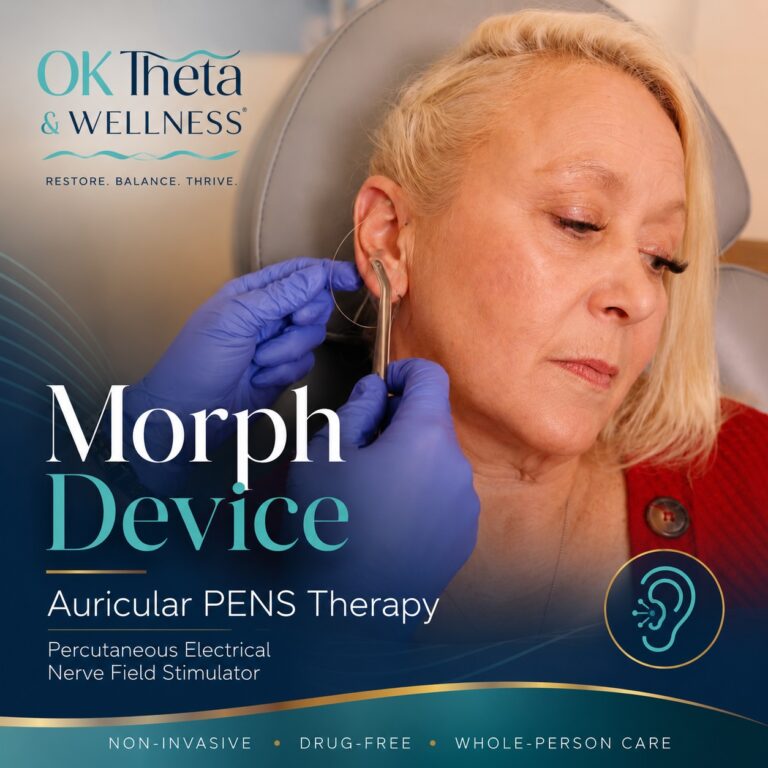
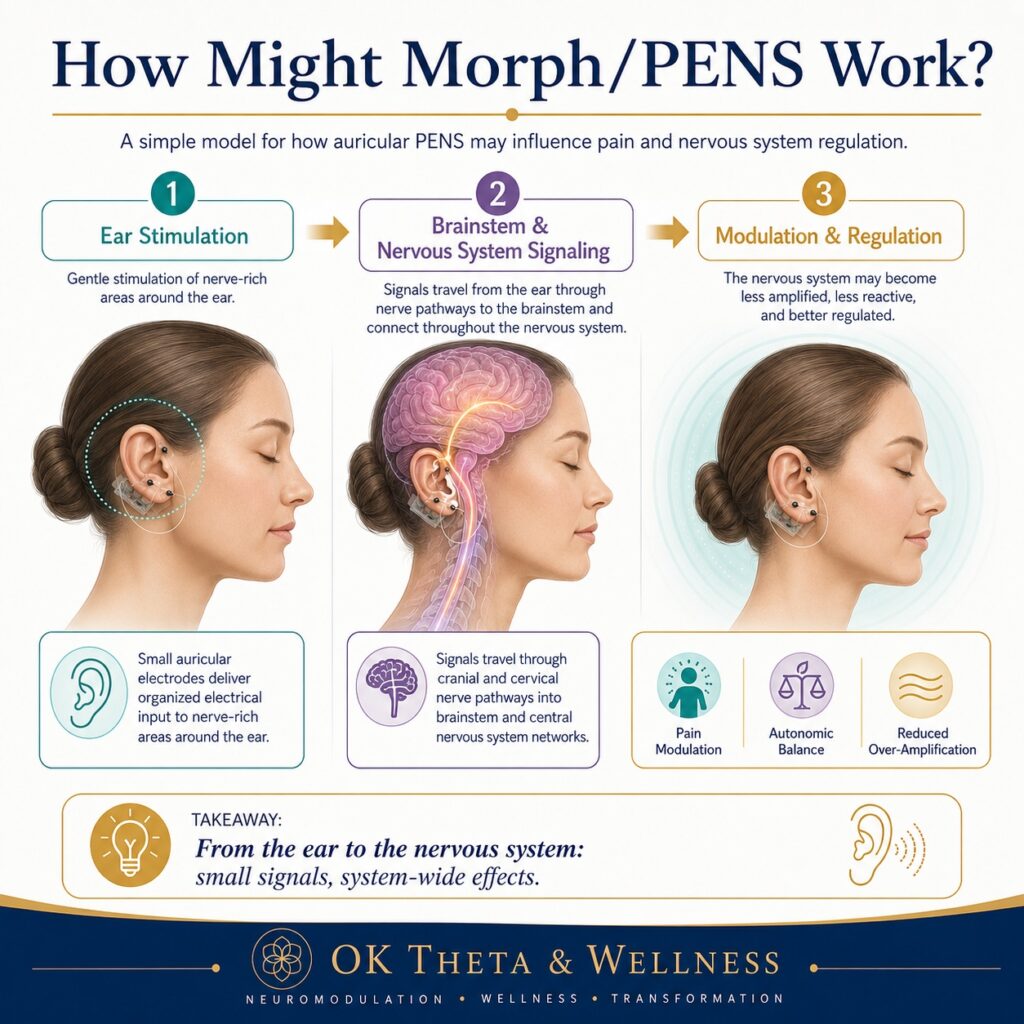
The Morph device is an ear-worn neuromodulation device. It is placed on the ear and worn for several days at a time. The ear is neurologically interesting because it contains branches of nerves that communicate with pain pathways and autonomic nervous system centers. In simple terms, the ear gives us a doorway into the nervous system.
In the context of neuropathy support, Morph is not aimed directly at the foot or hand. It is aimed more at how the nervous system is processing discomfort – an important distinction. Some people with neuropathy do not only have symptoms in the irritated nerve. They also have a nervous system that has become easier to trigger due to the chronic nature of the symptoms and the expectation that the symptoms will still be present tomorrow. Pain may flare with stress. Symptoms may worsen with poor sleep. The body may feel stuck in high alert. Small changes may produce big symptom responses.
In those cases, I want to think about the pain volume knob. Morph may fit into a neuropathy support plan when pain modulation, nervous system sensitivity, sleep disruption, or stress-related flaring are part of the picture. The goal is to support regulation, not to numb the body. For some people, improvement may show up as feeling calmer, sleeping better, having less pain reactivity, recovering faster after a flare, or feeling less trapped in a constant alarm state.
Why These Three Tools Fit Together
The reason I like this framework is that StemWave, EECP, and Morph are not trying to do the same thing. They each have a different role. StemWave supports the local tissue environment. EECP supports circulation and vascular function. Morph supports nervous system regulation and pain modulation. That gives us three different doors into the same noisy house.
If someone has focal tenderness, tissue irritation, or pain around the feet, ankles, calves, or other nerve-related areas, StemWave may be a good place to start. If someone has cold feet, poor circulation concerns, vascular risk factors, diabetes, leg heaviness, or reduced walking tolerance, EECP may deserve consideration. If someone has pain amplification, stress-related flares, poor sleep, or a body that feels stuck in high alert, Morph may be a helpful supportive tool.
Some people need one of these approaches. Some may need two. Some may benefit from thinking through all three. The plan depends on the person.
Who Might Consider Neuropathy Support at OK Theta & Wellness?
A layered neuropathy support approach may be worth a conversation if you are dealing with symptoms such as:
- Burning in the feet or hands
- Tingling or pins and needles
- Numbness or reduced sensation
- Cold feet or circulation concerns
- Sharp, stabbing, or electric-type pain
- Pain that worsens at night
- Pain that flares with stress or poor sleep
- Difficulty walking comfortably
- Reduced confidence using the affected area
- Chronic foot or leg discomfort
- Nerve sensitivity after injury or surgery
- A desire for non-opioid supportive options
This approach may be especially relevant for people who suspect their symptoms are not coming from only one source. For example, someone may have diabetic neuropathy symptoms, but also poor sleep, stress, tissue tenderness, reduced circulation, and chronic guarding in the legs and feet. In that case, it may not be enough to think about the nerve in isolation. The whole system deserves attention.

When Medical Evaluation Comes First
Supportive therapies should not delay proper medical care. I would encourage medical evaluation first if you have new or rapidly worsening numbness, sudden weakness, foot drop, loss of bowel or bladder control, open wounds, ulcers, severe back pain with neurological symptoms, rapid balance decline, unexplained weight loss, poorly controlled diabetes, or new symptoms after chemotherapy, medication changes, illness, or injury. Neuropathy can come from many causes, and some require specific medical diagnosis and treatment. At OK Theta & Wellness, we are not trying to replace that process. We are trying to support people appropriately within our lane.
What Should You Track?
With neuropathy symptoms, it is easy to focus only on whether the pain is gone. I think it is more helpful to track several signs of change. Ask yourself:
- Is the burning less intense?
- Are the tingling episodes shorter?
- Are sharp pains less frequent?
- Are my feet warmer?
- Am I sleeping better?
- Are symptoms less disruptive at night?
- Is walking more comfortable?
- Are bad days less intense?
- Are good days lasting longer?
- Am I recovering faster after activity?
- Do I feel less guarded?
- Am I more confident using the area?
- Can I return to baseline more quickly after a flare?
These are important questions because neuropathy often changes gradually. Improvement may begin as a softer signal, not a dramatic overnight transformation. Sometimes “I still feel it, but it does not control my day as much” is a meaningful step.

Realistic Expectations
Neuropathy symptoms can be stubborn. The longer symptoms have been present, the more layered the situation may be. Results can vary depending on the cause of neuropathy, severity of nerve involvement, blood sugar control, circulation, B12 status, inflammation, sleep quality, stress load, medications, alcohol exposure, prior injuries or surgeries, and whether the area continues to be re-aggravated. That is why I prefer honest hope.
I do not want to overpromise. I also do not want people to feel like nothing can be done to support their comfort, function, and quality of life. For the right person, StemWave, EECP, and Morph may offer different forms of support: local tissue support, circulation support, and nervous system support. That is the heart of our approach.
Neuropathy Support in Oklahoma City
If you are looking for neuropathy support in Oklahoma City, we would be happy to talk with you about whether a layered approach makes sense. At OK Theta & Wellness, we use tools like StemWave, EECP, and the Morph device to support the local tissue environment, circulation, pain modulation, and nervous system regulation.
Neuropathy is rarely simple. It may involve the nerve, the blood supply, the tissue around the nerve, and the nervous system’s interpretation of the signal. That is why our approach is not one-size-fits-all. For some people, the first step may be supporting irritated tissue. It may be improving circulation in others. For some, it may be calming the nervous system’s alarm response. And for many, it may be a thoughtful combination.
If your symptoms feel like burning, tingling, numbness, coldness, electric pain, or nerve sensitivity, we would be glad to help you think through your options. Support does not have to be one-dimensional. Sometimes the best plan is the one that finally respects how layered the body really is.