
Why Gentle Motion Helps the Brain Let Go

The Vestibular Science Inside the Theta Chamber
When people think about relaxation, they usually think about stillness. Be still. Sit still. Quiet the mind. Stop moving. Stop thinking. Stop reacting. But the nervous system does not always let go because we command it to. Sometimes the brain needs rhythm before it can find rest. Sometimes the body has to feel safe before the mind becomes quiet. And sometimes, gentle motion can do what effort cannot.
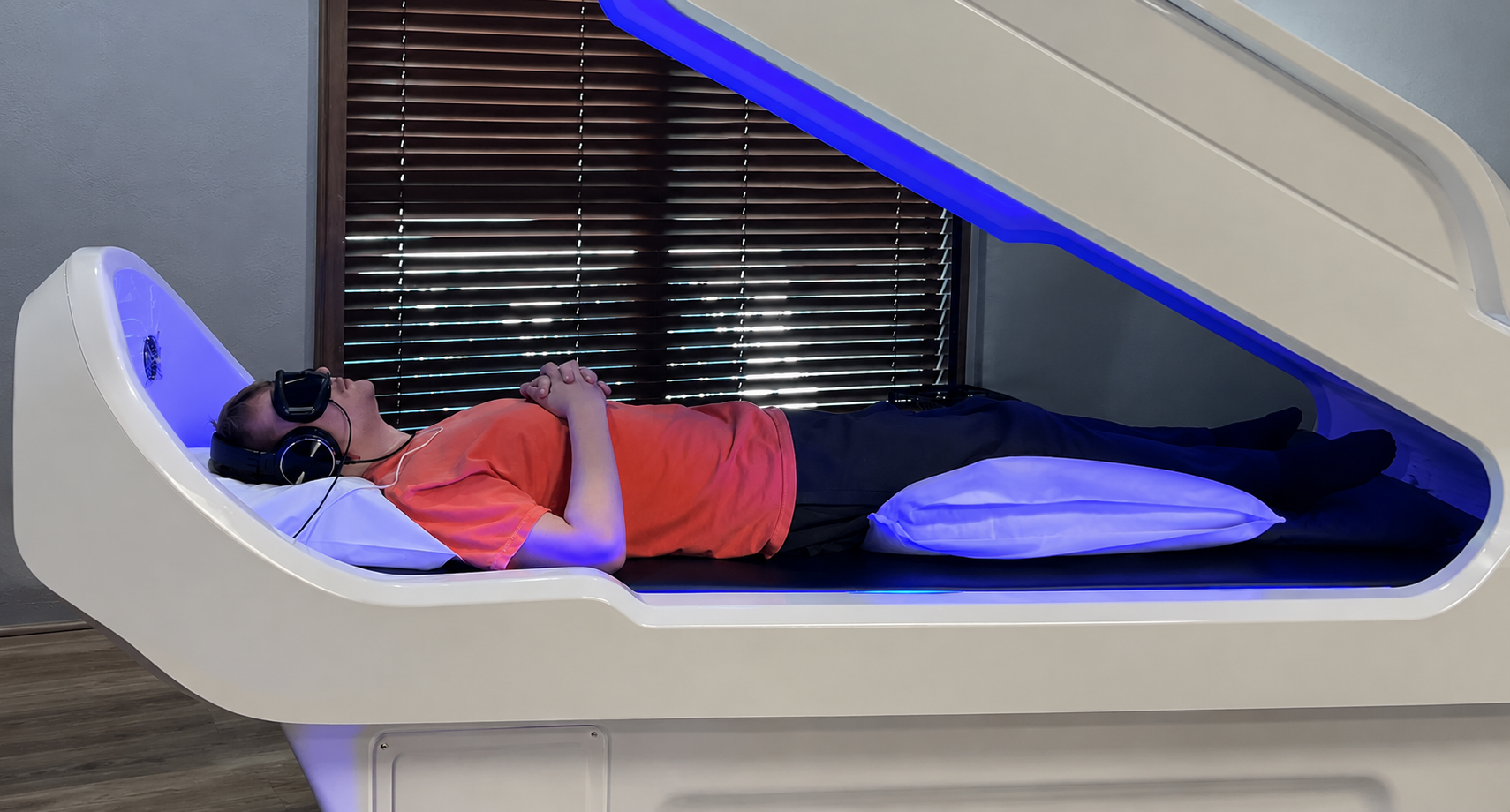
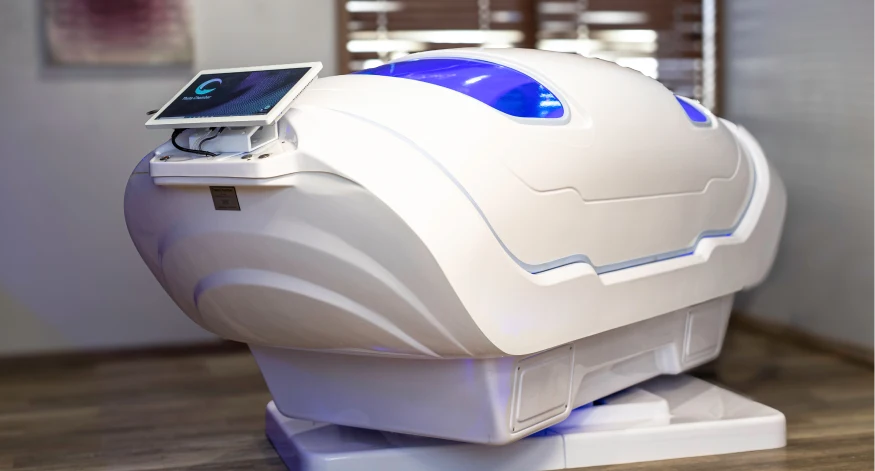
That is one of the most overlooked aspects of the Theta Chamber at OK Theta & Wellness in Oklahoma City. The chamber is not simply a place where someone lies down and tries to relax. It is a carefully layered environment that uses rhythm, sound, light, and sensory input to help the nervous system shift states. One of the most unique parts of that experience is the gentle motion of the rotating bed.
This is not motion for novelty. It is not just a “cool feature.” It is a way of speaking directly to one of the oldest regulatory systems in the body: the vestibular system.
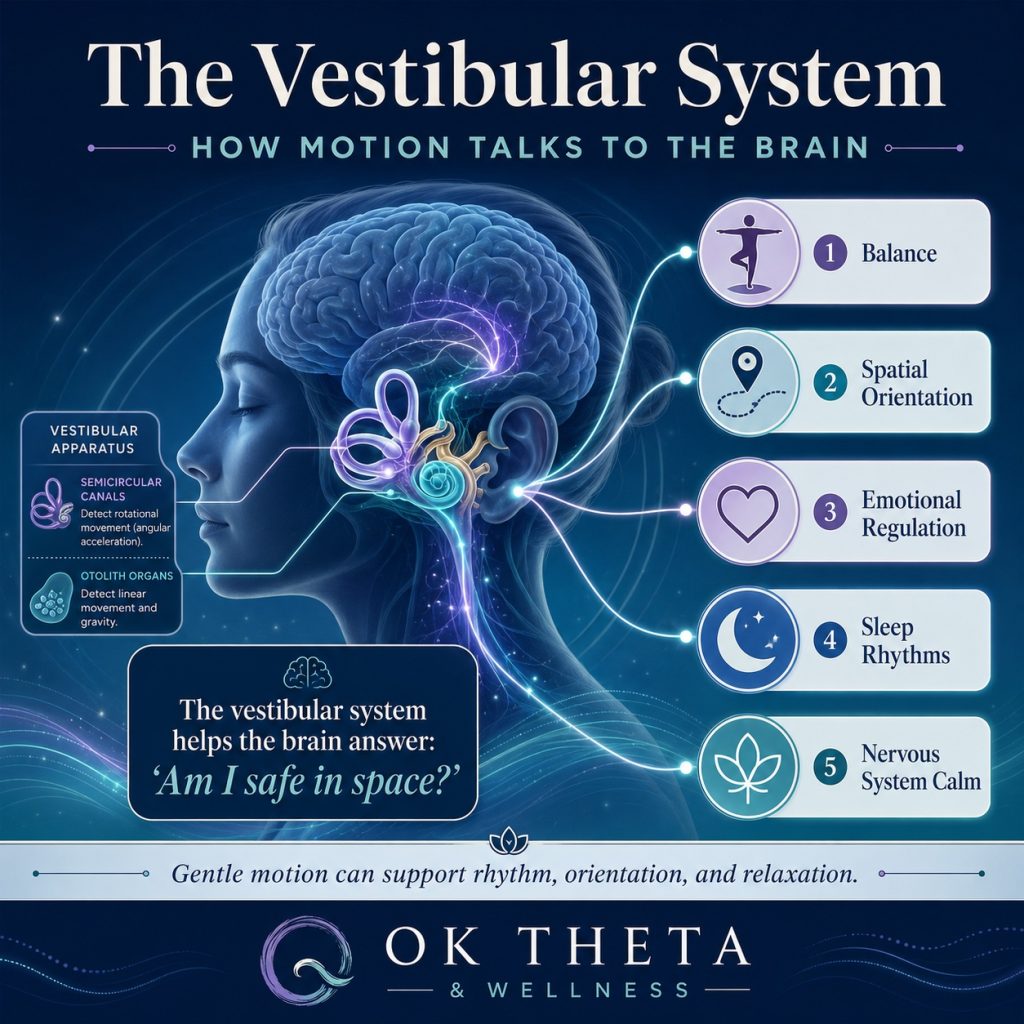
The vestibular system is the inner-ear system that helps the brain understand motion, balance, gravity, and body position. Most people think of it only in terms of dizziness or vertigo. But the vestibular system is connected to far more than balance. It communicates with brain regions involved in arousal, attention, spatial orientation, emotion, posture, autonomic regulation, and even sleep. In other words, it helps answer a very primitive question:
Am I safe in space?
And when the answer becomes yes, the brain often begins to let go.
Spin into Wellness in Oklahoma’s First Theta Chamber!
Why Rocking Calms Us
We already know this intuitively. A parent rocks a baby. A person drifts off in a hammock. A long drive can make a passenger sleepy. A rocking chair on a porch can soften the edges of a hard day. Before we ever learned the language of neuroscience, the body already knew something important: rhythmic motion can be regulating.
Modern research is beginning to explain why.
Studies looking at gentle rocking during sleep have shown that vestibular stimulation may influence sleep onset, sleep architecture, and the brain’s natural rhythms. In one study of a slowly rocking bed, researchers examined whether vestibular stimulation could affect sleep onset and sleep-related brain activity, including sleep spindles and slow oscillations. The study found that rocking was preferred by subjects and that two hours of vestibular stimulation increased N2 sleep and the total number of sleep spindles during the stimulation period, although not all expected sleep-onset or memory effects were seen across the whole night. (PubMed)
That nuance matters. The science is not saying, “rocking fixes everything.” It is saying that gentle motion can interact with the brain’s state-regulating rhythms.
A later Current Biology study found that whole-night gentle rocking at 0.25 Hz helped entrain spontaneous neural oscillations and was associated with benefits for sleep and memory consolidation. The researchers reported that rocking improved sleep continuity and deep sleep and enhanced overnight memory consolidation. (PubMed)
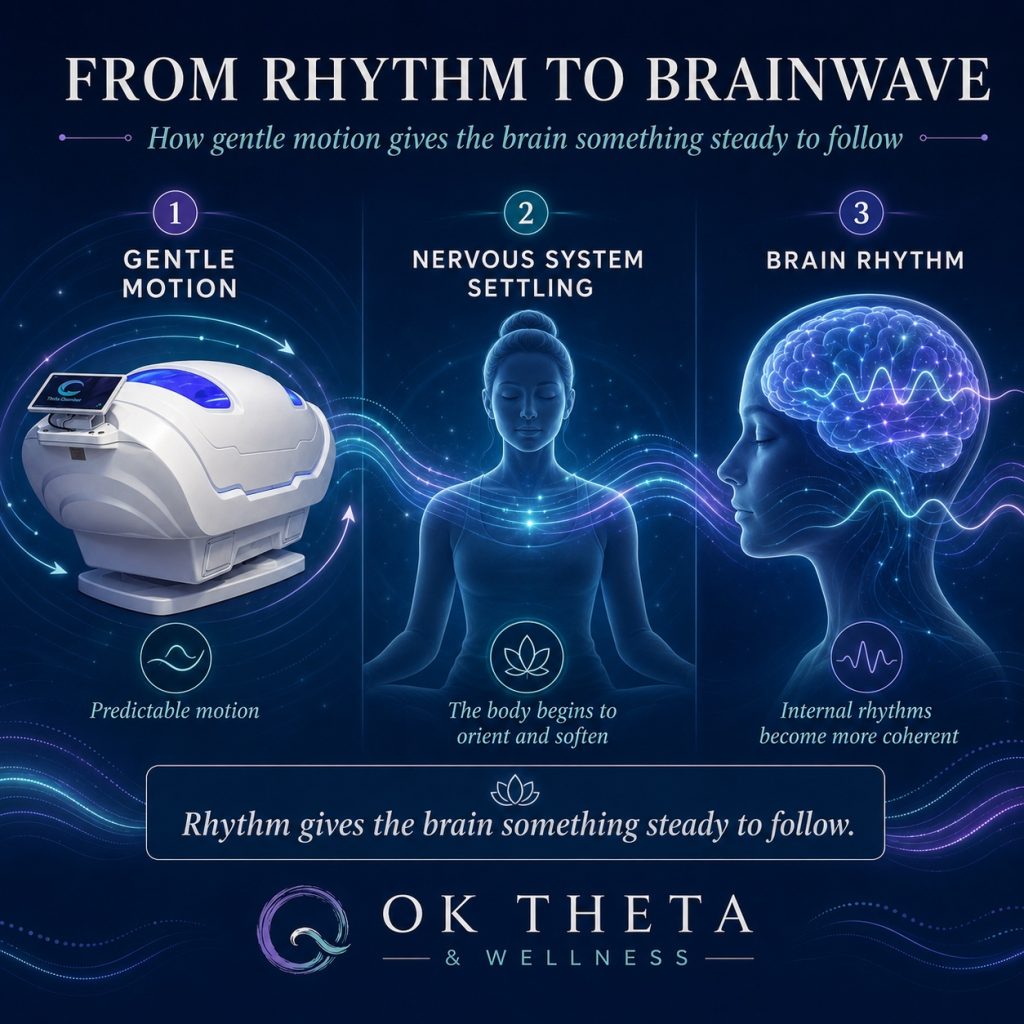
That is a remarkable idea. The brain is already rhythmic. Sleep has rhythms. Attention has rhythms. Breathing has rhythm. Heart rate has rhythm. Emotional regulation has rhythm. When we introduce a gentle external rhythm, the nervous system may begin to synchronize with it. It is less like forcing the brain into a state and more like giving it a metronome it can trust.
The Vestibular System Is Not Just About Balance
The vestibular system is often treated like a mechanical balance device, but that is too small of a view.
The vestibular system has connections with areas involved in emotion and arousal. Research reviews have described extensive links between vestibular pathways and limbic regions, which are involved in emotional behavior and regulation. (PMC) That means motion and emotion are NOT separate conversations in the brain.
Anyone who has ever felt calmer after walking, pacing, rocking, swinging, dancing, or riding in a car already knows this at the level of lived experience. The body uses movement to metabolize emotional charge. Motion gives the nervous system a pattern. Pattern gives the brain predictability. Predictability can become safety.
This is especially important for people who struggle to relax through top-down effort alone. Many people are told to meditate, breathe, pray, journal, or “just calm down.” Those are helpful practices, but they can be difficult when the nervous system is already running hot.
For some people, stillness does not initially feel peaceful. It feels exposing. The moment they lie still, the mind gets louder. The body starts scanning. Thoughts pick up speed. Old emotional weather rolls in. The person is trying to relax, but the nervous system is saying, “I am not convinced we are safe yet.”
Gentle vestibular motion can sometimes provide a bridge. It gives the body something steady, repetitive, and non-threatening to orient around. Instead of asking the mind to manufacture calm from scratch, the chamber gives the nervous system a rhythm to follow.
Why the Theta Chamber Feels Different Than “Trying to Meditate”
This is one of the most important distinctions. The Theta Chamber is not meant to replace meditation. It can make meditative states more accessible.
Traditional meditation often asks the person to generate the state internally. That is beautiful, but it can also be difficult. A stressed brain may not easily settle itself by instruction alone. The narrator mind wants to keep narrating. The problem-solving mind wants to keep solving. The threat-detection system wants to keep scanning the fence line.
The rotating bed changes the entry point.
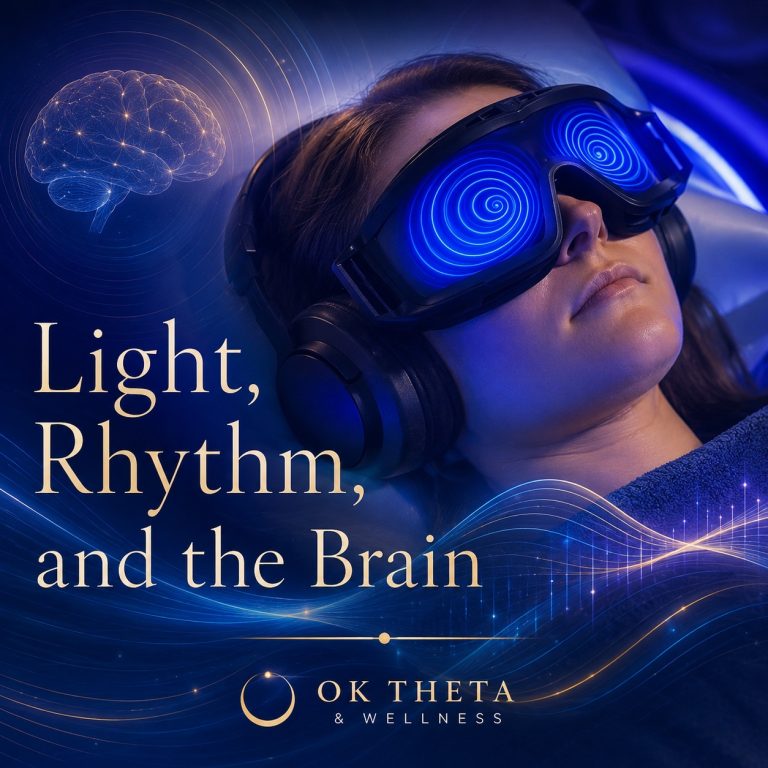
Rather than starting with thought, it starts with sensation. The body feels gentle motion. The vestibular system receives repeated rhythmic input. The auditory system may receive binaural beats or calming sound. The visual system may receive controlled light stimulation when appropriate. The body begins to receive a coherent sensory message:
You can soften now. That is the doorway.
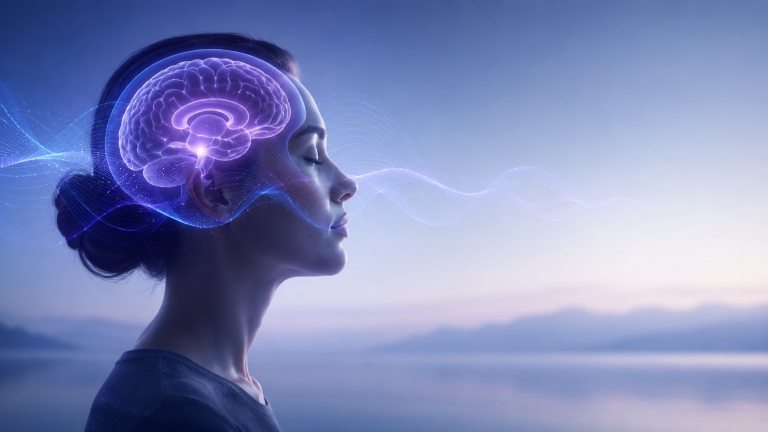
At OK Theta & Wellness, we often talk about the theta state as a teachable state. Theta brainwave activity is commonly associated with deep relaxation, internal awareness, memory processing, creativity, and emotional access. But the deeper point is not just “getting into theta.” The deeper point is helping the brain become less defended.
When the nervous system feels safe, people may have more access to reflection instead of reaction. They may be able to observe their thoughts rather than become fused with them. They may notice emotional patterns without being swallowed by them. That is where meaningful inner work often begins.

Motion, Arousal, and Anxiety
There is also emerging research connecting vestibular stimulation with emotional state and anxiety.
One Frontiers in Systems Neuroscience study examined galvanic vestibular stimulation, a non-invasive method of stimulating vestibular pathways electrically rather than mechanically. In that preliminary study, healthy young adults had a significant decrease in anxiety after an approximately 30-minutes session. The authors noted that the vestibular system is involved not only in posture and gaze stabilization, but also in cognitive functions and emotion processing. (Frontiers)
A separate study using swings as a practical form of vestibular stimulation in students reported improvement in stress-related measures, supporting the idea that natural vestibular stimulation may influence anxiety and mood state. (PMC)
Again, this does not mean motion is a treatment for anxiety by itself. It means the vestibular system appears to be part of the larger regulation network. That is the key. The brain does not regulate emotion with one switch. It regulates through networks: sensory input, breathing, posture, heart rate, memory, attention, prediction, and meaning. Vestibular input is one of those quiet but powerful channels.
Why Predictable Motion Matters
Not all motion is calming. Unpredictable motion can be stressful. Too much motion can cause nausea. Sudden motion can activate threat responses. The nervous system likes rhythm, but it does not like chaos. That is why the gentle nature of the Theta Chamber matters.
The goal is not intensity. The goal is coherence. Slow, predictable motion gives the nervous system a repeated signal it can learn. The body does not have to brace. It does not have to solve anything. It does not have to perform. Over time, that repetition can become a kind of sensory reassurance.
This is also why we individualize the experience. Some people love deeper sensory immersion. Others need a gentler start. Some may benefit from pure theta. Others may do better beginning with theta-alpha or another band depending on their goals, sensitivity, and comfort level.
The principle is simple: meet the nervous system where it is. You do not yank a stuck gate open. You take pressure off the hinge.
Gentle Motion and the Observer Mind
One of the most valuable effects of the Theta Chamber is not just relaxation. It is separation. By separation, I do not mean dissociation. I mean the healthy space between awareness and thought.
Many people live as though every thought is a command and every emotion is a verdict. A worry arises, and they believe it. A memory surfaces, and they become it. A trigger appears, and the body acts as if the past has returned. The theta state can help create enough space to notice:
- A thought is happening
- A feeling is moving through
- A pattern is asking for attention
- But I am not merely the pattern
Gentle motion supports that process because it gives the body a steady anchor while the mind begins to loosen its grip. The rocking rhythm becomes a background signal of safety. The person does not have to white-knuckle their way into presence. The body is being invited there. That is a different kind of relaxation. It is not sedation. It is not escape. It is the nervous system becoming available again.

The Practical Takeaway
The rotating bed inside the Theta Chamber is one of its most important features because it works through the body’s own sensory regulation pathways. Gentle vestibular motion may help support relaxation, sleep-related rhythms, emotional regulation, and the transition from effortful control into a more receptive state.
The literature is still developing, and we should stay honest about that. But the existing research on rocking, sleep, neural oscillations, vestibular-limbic connections, and anxiety gives us a meaningful scientific framework for what many people feel during the experience.
Gentle motion helps the brain let go because the brain is not just a thinking organ. It is an orienting organ. It is constantly asking where the body is, whether the environment is safe, and how much vigilance is required. When the body feels rhythm, the brain may feel safety. And when the brain feels safety, the mind can finally loosen its grip.
The Theta Chamber uses this principle in a practical, embodied way. We are not asking people to force calm. We are creating an environment where calm has a better chance of finding them.

Curious what your nervous system might do with the right rhythm?
Schedule a Theta Chamber session at OK Theta & Wellness and experience how gentle motion, sound, and deep relaxation can help the brain shift out of overdrive and into a more receptive state.
Revitalize Your Mind,
Renew Your Body