
EECP vs. Compression Boots: What’s the Difference?
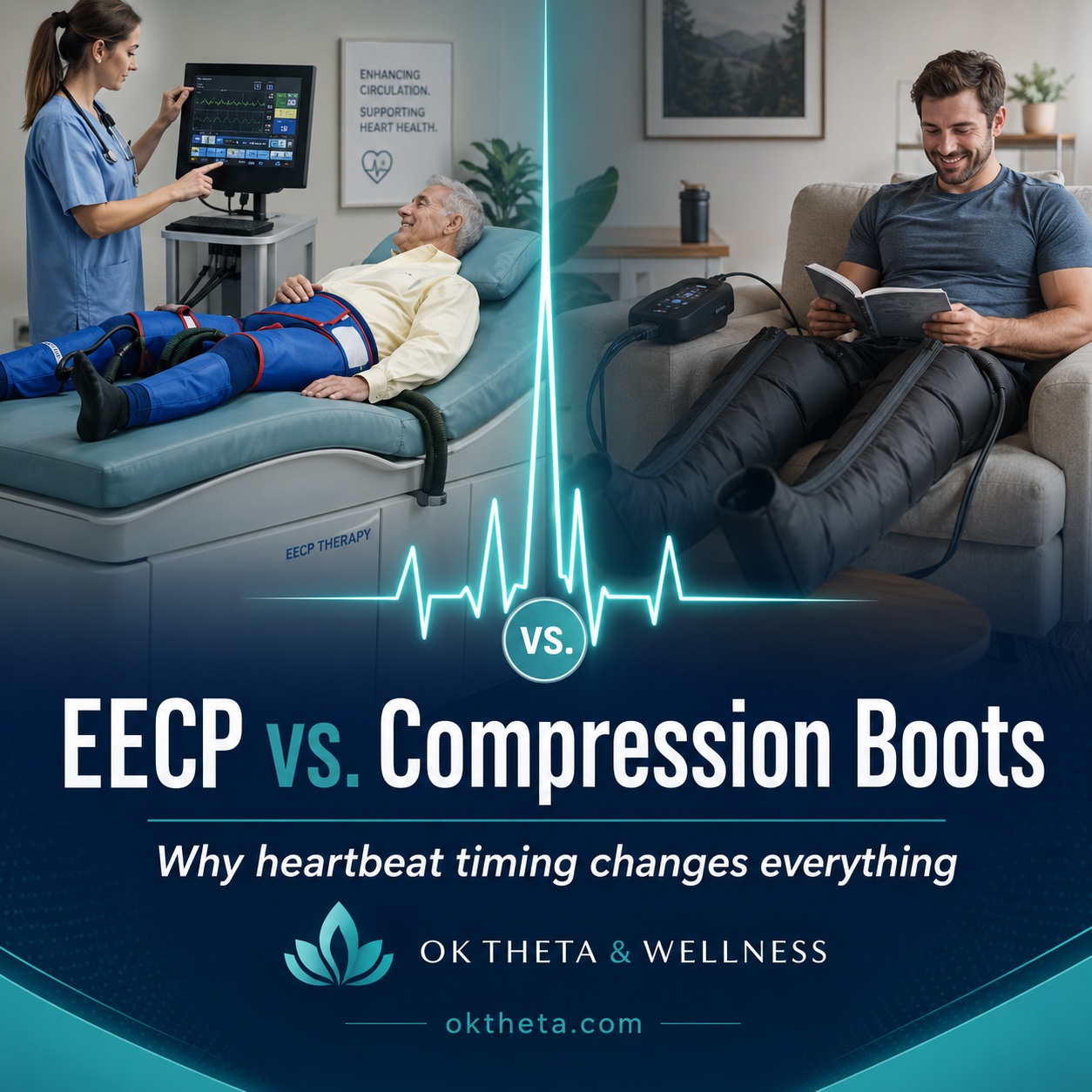
At first glance, enhanced external counterpulsation, commonly known as EECP, can look a lot like a pair of compression boots. Both involve inflatable chambers wrapped around the legs. They each apply pressure in a sequence. And both are frequently discussed using phrases such as “circulation,” “blood flow,” and “recovery.”
That visual similarity creates understandable confusion. I have seen people compare EECP with Normatec boots, athletic recovery systems, inexpensive compression sleeves sold online, and even the pneumatic compression devices used in hospitals. Some people assume EECP is simply a more powerful or more expensive version of the same technology. It is not.
Compression boots and EECP can both apply pressure to the lower extremities, but they are designed for different purposes and produce that pressure in fundamentally different ways. The defining feature of EECP is not simply how hard the cuffs squeeze. It is when they squeeze in relation to each heartbeat.
In this article, I want to separate four categories that are often blended together:
- Compression socks and sleeves
- Athletic recovery boots such as Normatec
- Medical intermittent pneumatic compression devices
- True enhanced external counterpulsation
Each may have an appropriate role. They are simply not interchangeable.
The quick answer: Recovery boots use repeated or sequential air compression to massage the legs and influence local fluid movement. EECP uses cuffs around the calves, thighs, and lower pelvic area, with inflation and deflation synchronized to the cardiac cycle using ECG monitoring. The cuffs inflate while the heart is relaxing and rapidly release before the next contraction.
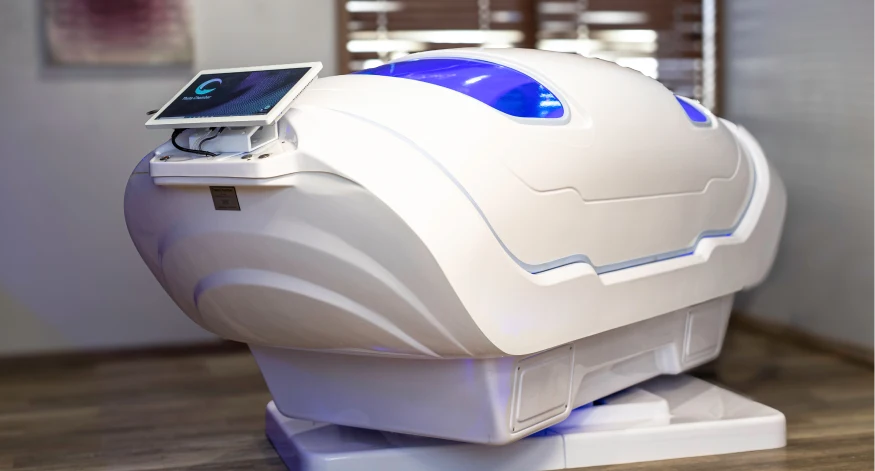
Spin into Wellness in Oklahoma’s First Theta Chamber!
Why EECP and Recovery Boots Are Easy to Confuse
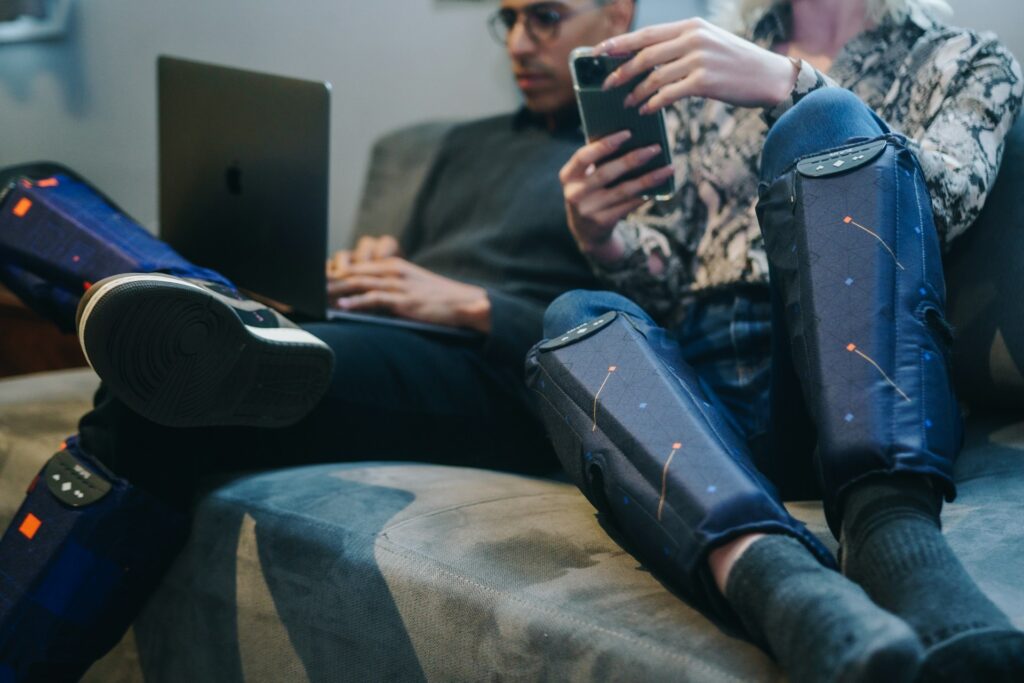
I understand why people place these technologies in the same category. Someone using recovery boots may lie back in a chair while long, inflatable sleeves rhythmically tighten around the legs. During EECP, a person also lies down while pneumatic cuffs inflate around the lower body.
In both cases:
- Air pressure is being applied externally.
- Compression may move from the lower legs upward.
- The person may feel a strong rhythmic squeezing sensation.
- The session may be described as supporting circulation.
- The equipment may cover much of the legs.
From across the room, they can appear to be cousins in inflatable pants. The confusion becomes even greater online. Recent Reddit discussions show people comparing premium Normatec systems with Sharper Image boots, Costco models, Amazon alternatives, and other lower-cost devices. They debate whether compression boots noticeably improve recovery, whether premium brands are worth the price, and whether the devices provide more than a pleasant sensation. That conversation tells me people are interested, but they do not always have a clear framework for distinguishing one type of compression from another.
To understand the real difference, we first need to sort out the larger compression-device family.
Four Types of Compression
Not All Compression Devices Belong in the Same Category
Compression socks, athletic recovery boots, medical pneumatic compression, and EECP may share some visible similarities, but they are built for different purposes.
Compression Socks and Sleeves
Compression socks, stockings, and sleeves are the simplest category.
They apply relatively continuous external pressure to an area of the body. Graduated compression garments are generally designed to apply greater pressure farther down the limb, with less pressure as the garment moves upward.
Depending on the product and the reason for use, people may wear compression garments for:
- Everyday leg support
- Prolonged standing or sitting
- Travel
- Exercise
- Venous or swelling-related concerns
- Recovery after an appropriate medical procedure
These garments do not ordinarily inflate and deflate. They do not connect to an air compressor. They do not monitor the heartbeat, and they do not perform external counterpulsation. They may be helpful in the right setting, but they occupy a different branch of the tree.
Athletic Recovery Boots
Recovery boots go a step beyond static compression. Systems such as Normatec, Therabody RecoveryAir, and a growing number of consumer devices use air pumps to inflate multiple chambers within a boot or sleeve. Those chambers may inflate in a wave-like sequence, often moving upward from the foot or ankle toward the thigh.
Hyperice describes Normatec as a dynamic air-compression massage system intended for uses such as temporarily increasing circulation, reducing muscle tension or swelling, and supporting warm-up and recovery. The Normatec 3, for example, uses five compression zones and provides adjustable pressure levels. That can create a pleasant and sometimes intense massage-like experience. Many athletes enjoy using these systems after running, cycling, weightlifting, or other demanding activity.
What recovery boots ordinarily do not do is synchronize each inflation cycle with the user’s ECG. They may follow a programmed pattern, inflate sequentially, or allow the user to adjust pressure, duration, or individual zones. However, the pattern is generally controlled by the device’s internal program rather than by the resting and contracting phases of the individual person’s heart. That difference is crucial.
Medical Intermittent Pneumatic Compression
There is also a medical category called intermittent pneumatic compression, often abbreviated IPC. These devices can be used in clinical or home-care settings for defined purposes that may include venous-thromboembolism prevention, lymphedema management, venous insufficiency, edema management, wound-care support, or other vascular and postsurgical applications.
This is why I do not describe every non-EECP compression device as a recreational gadget. Pneumatic compression has legitimate medical uses. However, medical IPC still should not automatically be thought of as similar to EECP.
An IPC device may rhythmically inflate around a foot, calf, leg, or limb. It may use multiple chambers and sequential pressure. Its purpose is often to influence venous return, edema, or local fluid movement. EECP is designed around a different hemodynamic event: external counterpulsation synchronized with the cardiac cycle.
What Makes True EECP Different?
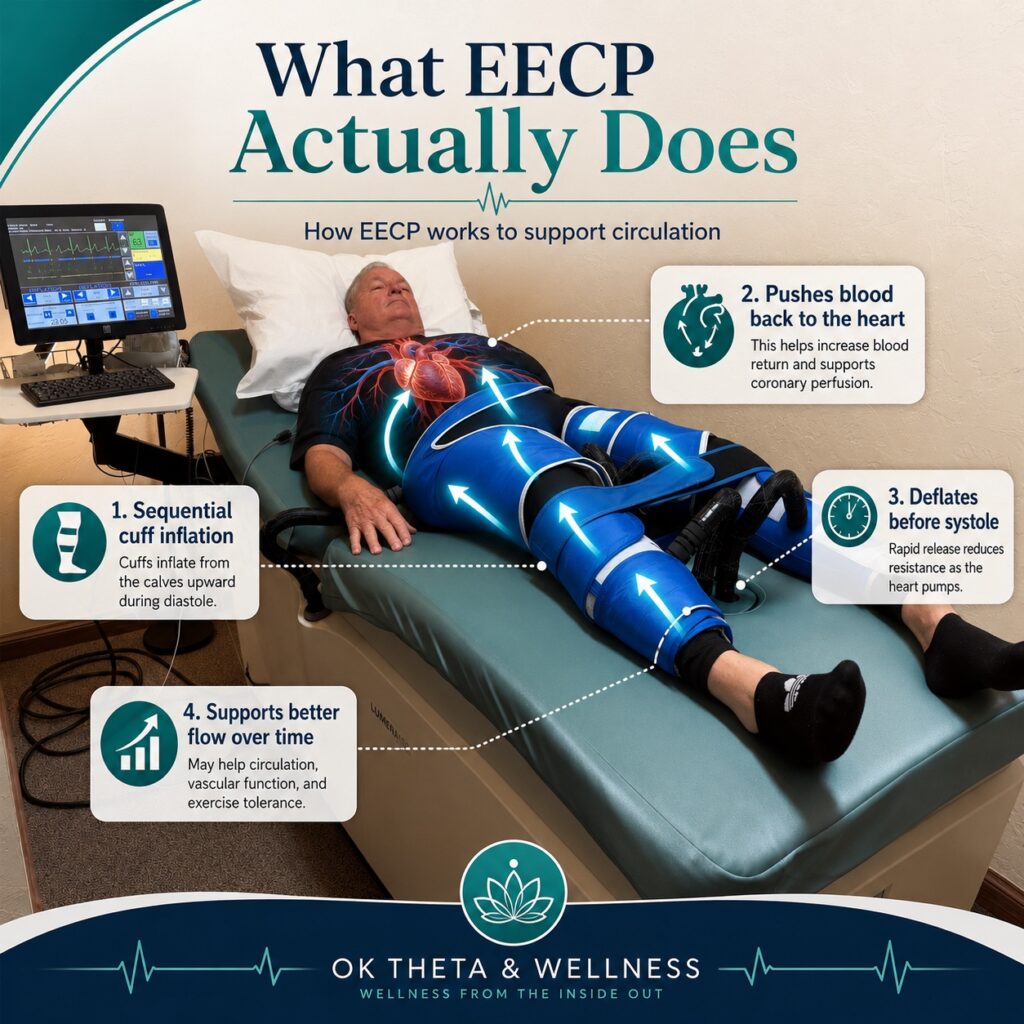
During an EECP session, large pneumatic cuffs are placed around the calves, thighs, and lower pelvic or buttock region. ECG electrodes monitor the person’s heartbeat, allowing the system to coordinate cuff inflation and deflation with specific phases of the cardiac cycle.
The difference is not simply compression. The difference is timing.
The cuffs inflate sequentially from the lower legs upward while the heart is in diastole, the resting and filling portion of the cycle. They then rapidly deflate before the next contraction. This timing is intended to augment diastolic blood flow and reduce the resistance the heart encounters as it begins its next pumping phase.
That is why the word counterpulsation matters. EECP is not simply squeezing the legs and hoping the pressure moves in a helpful direction. The system is attempting to place each compression wave inside the rhythm of the cardiovascular system.
The Difference Is Not Just Compression. It Is Timing.
I consider this the most important distinction in the entire comparison.
The heart continually alternates between two broad phases:
- Systole, when the heart contracts and pumps blood outward
- Diastole, when the heart relaxes and fills before the next contraction
During EECP, the cuffs inflate during diastole. They then release rapidly before systole. The timing is controlled through ECG monitoring rather than by a generic sequence running independently in the background. Blood-pressure or pulse-wave monitoring may also help the operator assess the quality of the counterpulsation response.
A recovery boot creates a traveling squeeze through the legs. EECP attempts to place that squeeze at a very particular location in time, entering during the resting phase of the heartbeat and releasing just before the next contraction. That timing is the dividing line.
A device does not become EECP merely because it:
- Inflates from the ankles upward
- Uses several air chambers
- Applies strong pressure
- Costs hundreds or thousands of dollars
- Is marketed as professional-grade
- Temporarily increases circulation
- Makes the legs feel lighter
Sequential compression by itself is not the same as counterpulsation.
EECP vs. Compression Boots: Side-by-Side
| Feature | Compression socks or sleeves | Recovery boots | True EECP |
| Pressure pattern | Usually continuous | Cyclic or sequential | Sequential and synchronized with the cardiac cycle |
| ECG monitoring | No | No | Yes |
| Timing | Not heartbeat-triggered | Device-programmed | Inflation during diastole and rapid deflation before systole |
| Typical coverage | Foot, calf or leg | Foot through thigh | Calves, thighs and lower pelvic region |
| Main purpose | External support or fluid management | Massage, recovery and leg comfort | Cardiovascular counterpulsation |
| Typical setting | Home or clinical | Home, gym or recovery clinic | Supervised clinical setting |
| Treatment structure | Variable | Individual recovery sessions | Often a structured multi-session course |
| Can it substitute for EECP? | No | No | Not applicable |
The presence of inflatable chambers does not tell us what a machine is accomplishing.
A treadmill and a cardiac stress test both involve walking, but they are not the same procedure. In the same way, recovery boots and EECP may share visible pieces of equipment without sharing the same physiological target.
What Are Compression Boots Actually Good For?
I do not think we need to diminish recovery boots in order to explain EECP. Many people find pneumatic recovery systems relaxing. They may appreciate the temporary feeling of lighter legs, reduced tightness, or massage-like pressure after activity. These systems can also provide a convenient recovery ritual while someone rests, reads, watches television, or prepares for another training session.
The research picture, however, is more modest than some marketing language might suggest. A 2024 systematic review and meta-analysis found that lower-limb intermittent pneumatic compression may have potential value in sports recovery, particularly for reducing perceived muscle soreness. The authors also noted that the scientific support remains limited and that improvements in objective recovery or physical performance have not been consistently demonstrated.
Other studies have reported temporary changes in blood flow or cardiovascular recovery after exercise, while some have found little meaningful improvement in muscle-damage recovery or later performance. My interpretation is that recovery boots can be a reasonable tool when they are treated as exactly that: one optional recovery tool. They do not replace sleep, nutrition, appropriate training progression, active recovery, physical therapy, or medical evaluation. They also do not reproduce the cardiac-synchronized effects of EECP.
What Is EECP Designed to Do?
EECP has an established history as a noninvasive outpatient cardiovascular treatment. Its best-recognized clinical role is in selected patients with disabling chronic stable angina whose symptoms remain limiting despite medical treatment and who are not readily suited for additional revascularization procedures. Medicare’s national coverage criteria are specifically focused on patients with severe stable angina who meet defined requirements.
This is an important point because there is a difference between:
- A device’s FDA-cleared uses
- The conditions studied in published research
- The narrower situations covered by Medicare or another insurer
- The broader wellness applications that some clinics may discuss
Those categories should not be blended into one giant promise. Researchers have explored EECP in connection with endothelial function, peripheral vascular function, exercise capacity, heart failure, cerebral blood flow, autonomic regulation, and other cardiovascular or systemic questions. Some areas are promising, while others remain investigational or are supported by much smaller bodies of evidence.
At OK Theta & Wellness, I believe the responsible approach is to explain where the evidence is established, where it is developing, and where uncertainty remains. I do not want EECP presented as a magic pair of boots that fixes anything related to blood flow. It is a specialized form of external counterpulsation with a distinct mechanism, treatment structure, and screening process.
Why Does EECP Usually Involve Multiple Sessions?
Recovery boots are often used as individual sessions. Someone may use them for 20 to 30 minutes after a workout or whenever the legs feel tired.
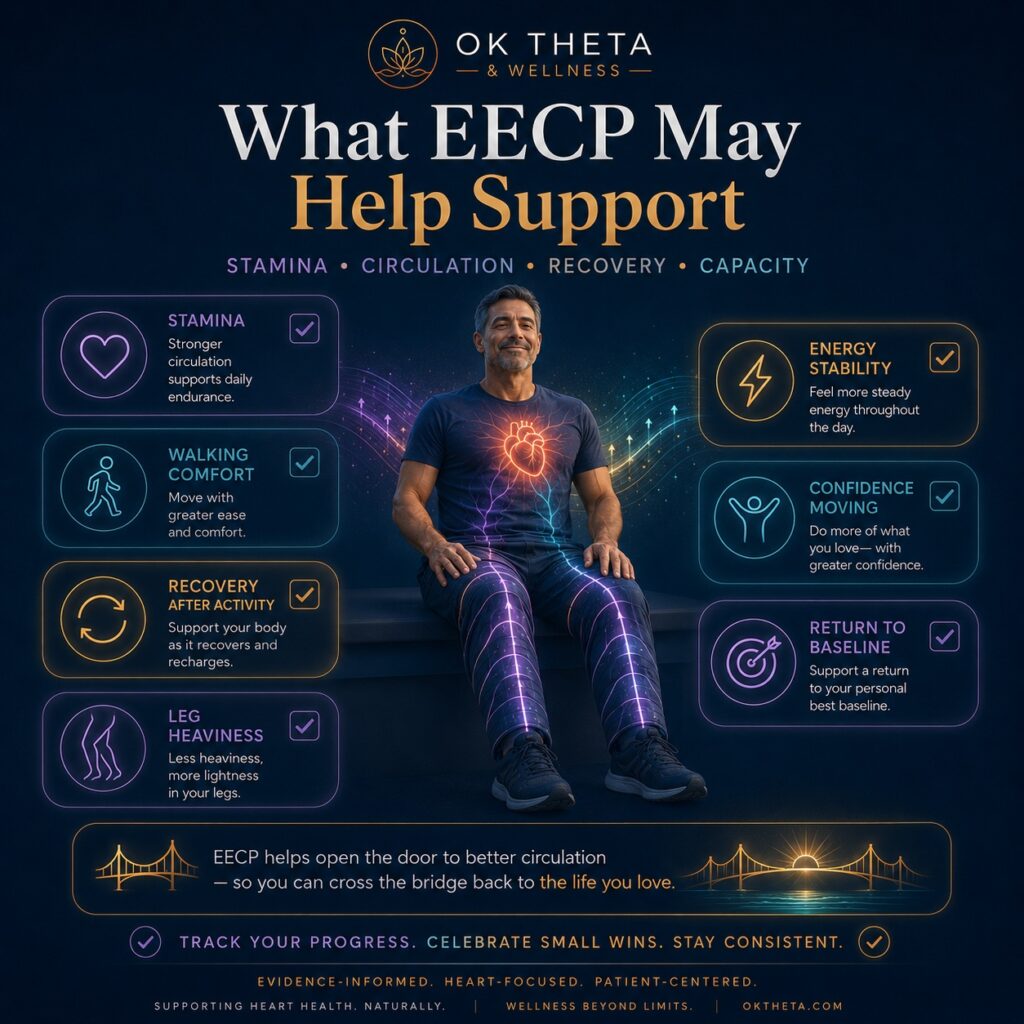
Traditional EECP is different. A conventional EECP course usually includes 35 hours of treatment, commonly delivered as one-hour sessions, five days per week, over seven weeks. That schedule reflects the idea that EECP is a cumulative intervention rather than a single massage or recovery experience. A person may notice certain immediate effects during an individual session, but the traditional treatment model is built around repeated exposure over time.
This is another reason I resist comparing one hour in compression boots with one hour of EECP as though we were comparing two versions of the same service. The equipment may look related, but the intent and delivery model are different.
Can Compression Boots Replace EECP?
No, not when the goal is true external counterpulsation.
A pair of Normatec boots or an inexpensive pneumatic system may produce a strong sequential squeeze. It may temporarily change local blood flow. It may feel pleasant or help someone perceive less soreness.
What it does not ordinarily provide is:
- ECG-guided timing
- Diastolic augmentation
- Rapid presystolic deflation
- Coordinated lower-leg, thigh, and pelvic compression
- Monitoring of the counterpulsation response
- A structured EECP treatment protocol
Turning the pressure higher does not bridge that gap. A louder drum does not become an orchestra conductor.
Could Both Technologies Have a Place?
Yes.
They simply occupy different lanes. A runner might use recovery boots after a long training session. Someone with a venous, lymphatic, or postsurgical concern might be prescribed a medical pneumatic-compression device. A properly screened individual might pursue EECP through a structured cardiovascular treatment or wellness program.
These uses do not cancel one another out. Owning a pair of recovery boots does not mean someone has already experienced EECP. Completing EECP also does not mean that ordinary compression has no possible value for a separate goal.
The better question is:
What is the goal, and which technology was actually designed for that goal?
How Can I Tell Whether a Device Is Really EECP?
When someone encounters a clinic, product, or online listing using words such as counterpulsation, circulation therapy, compression therapy, or cardiovascular recovery, I recommend asking several specific questions.
1. Is the device using an ECG signal?
True EECP uses the person’s cardiac rhythm to control cuff timing.
2. Do the cuffs inflate during diastole?
The inflation should be coordinated with the resting phase of the cardiac cycle.
3. Do the cuffs rapidly release before systole?
Deflation before the next contraction is part of the counterpulsation process.
4. Where are the cuffs placed?
Traditional EECP uses cuffs around the calves, thighs, and lower pelvic or buttock region, rather than only the feet or calves.
5. Is the session clinically supervised?
True EECP involves specialized equipment, screening, monitoring, and trained operation.
6. Is the provider assessing the counterpulsation response?
A provider should be able to explain more than the pressure setting. They should understand the cardiac timing and the quality of diastolic augmentation.
7. What is the device actually called?
Terms such as compression therapy, pneumatic compression, recovery compression, IPC, ECP, and EECP are not automatically interchangeable.
A photograph of inflatable cuffs cannot tell us what a machine is doing. The timing system, monitoring, pressure sequence, cuff placement, and intended purpose matter far more than the appearance.
Is Normatec the Same as EECP?
No.
Normatec is a dynamic air-compression massage and recovery system. It uses adjustable pressure and multiple zones to create a pulsing compression experience. It can be used at home and is marketed primarily for wellness, athletic recovery, warm-up, and temporary relief of muscle discomfort or tension.
EECP uses ECG-guided timing to coordinate compression with the heartbeat. Normatec may be a high-quality product within its own category. It simply is not an EECP system.
Are Amazon Compression Boots the Same as EECP?
No.
There are many consumer compression systems available online. They vary in build quality, pressure range, chamber design, fit, programming, warranty, and price. Some may provide effective sequential pneumatic compression. Others may function more like basic inflatable massagers.
Unless a device is specifically designed and cleared as an external counterpulsation system, uses ECG-guided cardiac synchronization, and is operated through an appropriate clinical protocol, it should not be represented as EECP. The word compression describes what the material is doing to the legs. It does not fully describe what the system is doing to the cardiovascular cycle.
Do Compression Boots Improve Circulation?
This question is difficult because “improve circulation” is an extremely broad phrase. Pneumatic compression can temporarily alter blood-flow velocity and fluid movement in the legs. Recovery-boot manufacturers frequently describe temporary increases in local circulation as one of the intended effects of their devices. However, that does not mean every circulation-related effect is equivalent.
“Improved circulation” might refer to:
- Venous return from the legs
- Temporary changes in local blood-flow velocity
- Movement of interstitial fluid
- Reduced pooling or heaviness
- Diastolic augmentation
- Coronary perfusion
- Endothelial adaptation over time
Those are not interchangeable concepts. This broad use of the word “circulation” is one of the main reasons consumers can easily assume recovery boots and EECP are doing the same thing.
Is EECP Just a More Powerful Compression Boot?
No.
The pressure level matters, but it is not what defines EECP. EECP is defined by the coordination of sequential lower-body compression with the cardiac cycle. The cuffs inflate during diastole and rapidly deflate before systole. A recovery boot with a very high pressure setting is still a recovery boot if it is not synchronized with the heartbeat.
Can EECP Be Done at Home?
True EECP is generally delivered through a specialized clinical system with trained supervision, cardiac monitoring, and an appropriate screening process. Consumer recovery boots are designed to be more portable and self-directed. That convenience is part of their purpose.
The need for clinical supervision is not a decorative difference. EECP changes cardiovascular loading conditions with each heartbeat, so the person’s medical history, vascular status, blood pressure, rhythm, and other safety considerations matter.
Compression Is Not Appropriate for Everyone
People sometimes assume that external compression is harmless because it does not involve a medication, injection, or incision. That is not always true. Someone with known cardiovascular disease, significant vascular disease, a history of blood clots, unexplained swelling, skin injury, altered sensation, recent surgery, uncontrolled blood-pressure concerns, or other important medical conditions should obtain appropriate guidance before using strong compression.
EECP requires its own screening process. Cleveland Clinic and University of Michigan Health both describe pretreatment assessment and list cardiovascular history, heart rhythm, vascular disease history, clotting history, pregnancy, and blood-pressure considerations that may affect eligibility.
The exact decision should be individualized. A list on the internet cannot replace a thoughtful review of the person and the specific device.
Choosing the Right Tool for the Goal
Compression socks, recovery boots, medical pneumatic compression, and EECP all involve external pressure, but that does not make them variations of one treatment.
I think of them this way:
- Compression socks and sleeves provide relatively continuous external support.
- Recovery boots provide programmable pneumatic compression for massage, comfort, warm-up, or recovery.
- Medical IPC devices are used for specific venous, lymphatic, vascular, or postsurgical purposes.
- EECP coordinates lower-body compression with each heartbeat to create external counterpulsation.
The most important takeaway is simple:
EECP is not defined by how the cuffs look. It is defined by what the cuffs do in relation to the heart.
At OK Theta & Wellness in Oklahoma City, we use a Vasomedical Lumenair EECP system, not a consumer recovery-boot device. During each session, the system coordinates cuff inflation and deflation with the individual’s cardiac cycle.
My goal is not to tell everyone that they need EECP or that recovery boots have no value. My goal is to help people understand what they are actually considering.
Once we separate massage-oriented pneumatic compression from cardiac-synchronized counterpulsation, the comparison becomes much clearer.
The machines may look related. Their jobs are not the same.
This article is intended for general educational purposes and does not diagnose a condition or determine whether a particular device or therapy is appropriate for an individual. Anyone with cardiovascular, vascular, clotting, swelling, pregnancy, postsurgical, or other medical concerns should seek appropriate individualized guidance before beginning a compression-based intervention.